



 Chat with AI
Exam 7: The Sun

Exam 1: Here and Now97 Questions
Exam 2: A Users Guide to the Sky116 Questions
Exam 3: Cycles of the Sun and Moon154 Questions
Exam 4: The Origin of Modern Astronomy144 Questions
Exam 5: Light and Telescopes156 Questions
Exam 6: Atoms and Spectra125 Questions
Exam 7: The Sun146 Questions
Exam 8: The Family of Stars190 Questions
Exam 9: The Formation and Structure of Stars136 Questions
Exam 10: The Deaths of Stars127 Questions
Exam 11: Neutron Stars and Black Holes99 Questions
Exam 12: The Milky Way Galaxy117 Questions
Exam 13: Galaxies: Normal and Active151 Questions
Exam 14: Modern Cosmology112 Questions
Exam 15: The Origin of the Solar System108 Questions
Exam 16: Earth and Moon: Bases for Comparative Planetology98 Questions
Exam 17: Mercury, Venus, and Mars83 Questions
Exam 18: The Outer Solar System136 Questions
Exam 19: Meteorites, Asteroids, and Comets91 Questions
Exam 20: Astrobiology: Life on Other Worlds97 Questions
Select questions type


Which of the following is suggested as the best explanation of the missing solar neutrinos
(Multiple Choice)
5.0/5  (76)
(76) What is the solar wind, and how does it affect objects in the solar system
(Essay)
4.8/5 (75)
(75) Fusion occurs in __________ numbers of atomic mass nuclei whereas fission occurs in ___________ numbers of atomic mass nuclei up to _________.
(Multiple Choice)
4.9/5 (78)
(78) The figure shows the Sun and pairs of sunspots. One could say that there is really a 22-year sunspot cycle because 
(Multiple Choice)
4.8/5 (76)
(76) When four hydrogen are fused to make one helium nuclei, a small amount of matter is converted into what
(Multiple Choice)
4.9/5 (89)
(89) The ordering of the atmospheric layers of the Sun from outer to inner is chromosphere, corona, photosphere.
(True/False)
5.0/5 (73)
(73) 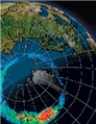 -The above image of an aurora on Earth is centered near Earth's rotational axis.
 (True/False)
4.8/5 (77)
(77) One sees differences in ________ depending on the time in the sunspot cycle.I.the latitude at which most sunspots occur II.the number of sunspots that are visible
III)the rotation rate of the Sun's equator
IV)the magnetic polarity of the sunspot pair members in a hemisphere
(Multiple Choice)
4.7/5 (74)
(74)  -The above image is a __________ wavelength image of granulation in the ___________.
 (Multiple Choice)
4.9/5 (69)
(69)  -The above image is of the active Sun's corona taken in far ultraviolet wavelengths. If you wanted to show higher elevations of the Sun's corona, which wavelength band would you choose to take your image
 (Multiple Choice)
4.7/5 (79)
(79) Helioseismology is the study of the differential rotation and magnetic field of the Sun.
(True/False)
4.8/5 (79)
(79) What is the explanation for the pattern of granulation seen on the visible surface of the Sun
(Multiple Choice)
4.9/5 (91)
(91) The four fundamental forces in nature are ______________, _____________, ____________________, and _____________________.
(Short Answer)
4.9/5 (77)
(77) Most of the visible light we see coming from the Sun originates from the
(Multiple Choice)
4.9/5 (86)
(86)  -The squiggly dark line in the upper left quadrant of the Sun in the image above is called a ___________.
 (Multiple Choice)
4.7/5 (82)
(82) 
Filters
- Essay(0)
- Multiple Choice(0)
- Short Answer(0)
- True False(0)
- Matching(0)