



 Chat with AI
Exam 20: Antimicrobial Drugs

Exam 1: The Microbial World and You65 Questions
Exam 2: Chemical Principles65 Questions
Exam 3: Observing Microorganisms Through a Microscope65 Questions
Exam 4: Functional Anatomy of Prokaryotic and Eukaryotic65 Questions
Exam 5: Microbial Metabolism67 Questions
Exam 6: Microbial Growth65 Questions
Exam 7: The Control of Microbial Growth67 Questions
Exam 8: Microbial Genetics65 Questions
Exam 9: Biotechnology and Dna Technology64 Questions
Exam 10: Classification of Microorganisms65 Questions
Exam 11: The Prokaryotes: Domains Bacteria and Archaea60 Questions
Exam 12: The Eukaryotes: Fungi, algae, protozoa, and Helminths65 Questions
Exam 13: Viruses,viroids,and Prions66 Questions
Exam 14: Principles of Disease and Epidemiology65 Questions
Exam 15: Microbial Mechanisms of Pathogenicity63 Questions
Exam 16: Innate Immunity: Nonspecific Defenses of the Host65 Questions
Exam 17: Adaptive Immunity: Specific Defenses of the Host65 Questions
Exam 18: Practical Applications of Immunology65 Questions
Exam 19: Disorders Associated With the Immune System67 Questions
Exam 20: Antimicrobial Drugs65 Questions
Exam 21: Microbial Diseases of the Skin and Eyes65 Questions
Exam 22: Microbial Diseases of the Nervous System65 Questions
Exam 23: Microbial Diseases of the Cardiovascular and Lymphatic Systems65 Questions
Exam 24: Microbial Diseases of the Respiratory System65 Questions
Exam 25: Microbial Diseases of the Digestive System66 Questions
Exam 26: Microbial Diseases of the Urinary and Reproductive Systems65 Questions
Exam 27: Environmental Microbiology65 Questions
Exam 28: Applied and Industrial Microbiology65 Questions
Select questions type


Which of the following antibiotics is recommended for use against gram-negative bacteria?
(Multiple Choice)
4.8/5  (81)
(81) Which of the following antibiotics does NOT interfere with cell wall synthesis?
(Multiple Choice)
4.9/5 (66)
(66) Which one of the following does NOT belong with the others?
(Multiple Choice)
4.8/5 (81)
(81) Table 20.2
The following results were obtained from a disk-diffusion test for microbial susceptibility to antibiotics.Staphylococcus aureus was the test organism.
Antibiotic Zone of Inhibition A 3 B 7 C 0 D 10
-In Table 20.2,the most effective antibiotic tested was
(Multiple Choice)
4.8/5 (70)
(70) Which one of the following anti-protozoan drugs was a traditional Chinese medicine for controlling fevers,but which has also exhibited useful anti-malarial properties?
(Multiple Choice)
4.7/5 (74)
(74) Which of the following would be selective against the tubercle bacillus?
(Multiple Choice)
5.0/5 (68)
(68) The antibiotic actinomycin D binds between adjacent G-C pairs,thus interfering with
(Multiple Choice)
4.8/5 (88)
(88) Undergrowth of fungi after antibiotic use is commonly referred to as a superinfection.
(True/False)
4.8/5 (85)
(85) Explain why penicillin was called the "miracle drug" when it was first used in the 1940s.
(Essay)
4.7/5 (85)
(85) Which of the following antibiotics causes misreading of mRNA?
(Multiple Choice)
4.8/5 (83)
(83) Niclosamide prevents ATP generation in mitochondria.You would expect this drug to be effective against
(Multiple Choice)
4.9/5 (92)
(92) If you tested a 2nd strain of S.aureus with the same method and concentrations of drugs as indicated in Table 20.2,but you found that the zone of inhibition caused by drug D had dropped to 2 mm,what does this indicate?
(Multiple Choice)
5.0/5 (78)
(78) Figure 20.2
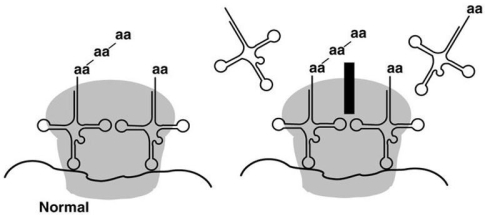 -In Figure 20.2,chloramphenicol binds to the 50S ribosome subunit.What effect would occur if this drug is administered to a eukaryote?
 (Multiple Choice)
5.0/5 (71)
(71) Community-acquired MRSA is typically less virulent than healthcare-associated MRSA.
(True/False)
4.9/5 (86)
(86) Figure 20.3 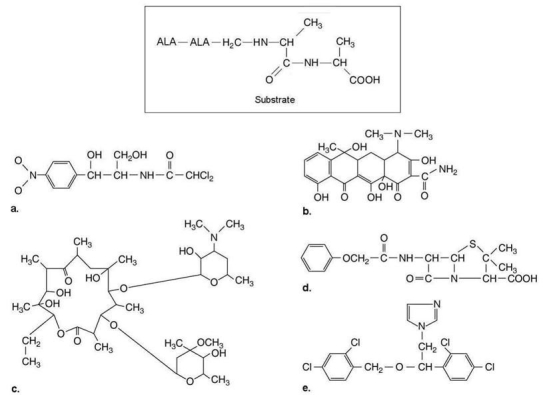 The substrate for transpeptidase used to synthesize peptidoglycan is shown in Figure 20.3.Which of the drugs shown would inhibit peptidoglycan synthesis?
 (Multiple Choice)
4.8/5 (87)
(87) Which of the following methods of action would be bacteriostatic?
(Multiple Choice)
4.9/5 (77)
(77) 
Filters
- Essay(0)
- Multiple Choice(0)
- Short Answer(0)
- True False(0)
- Matching(0)