



 Chat with AI
Exam 19: Disorders Associated With the Immune System

Exam 1: The Microbial World and You65 Questions
Exam 2: Chemical Principles65 Questions
Exam 3: Observing Microorganisms Through a Microscope65 Questions
Exam 4: Functional Anatomy of Prokaryotic and Eukaryotic65 Questions
Exam 5: Microbial Metabolism67 Questions
Exam 6: Microbial Growth65 Questions
Exam 7: The Control of Microbial Growth67 Questions
Exam 8: Microbial Genetics65 Questions
Exam 9: Biotechnology and Dna Technology64 Questions
Exam 10: Classification of Microorganisms65 Questions
Exam 11: The Prokaryotes: Domains Bacteria and Archaea60 Questions
Exam 12: The Eukaryotes: Fungi, algae, protozoa, and Helminths65 Questions
Exam 13: Viruses,viroids,and Prions66 Questions
Exam 14: Principles of Disease and Epidemiology65 Questions
Exam 15: Microbial Mechanisms of Pathogenicity63 Questions
Exam 16: Innate Immunity: Nonspecific Defenses of the Host65 Questions
Exam 17: Adaptive Immunity: Specific Defenses of the Host65 Questions
Exam 18: Practical Applications of Immunology65 Questions
Exam 19: Disorders Associated With the Immune System67 Questions
Exam 20: Antimicrobial Drugs65 Questions
Exam 21: Microbial Diseases of the Skin and Eyes65 Questions
Exam 22: Microbial Diseases of the Nervous System65 Questions
Exam 23: Microbial Diseases of the Cardiovascular and Lymphatic Systems65 Questions
Exam 24: Microbial Diseases of the Respiratory System65 Questions
Exam 25: Microbial Diseases of the Digestive System66 Questions
Exam 26: Microbial Diseases of the Urinary and Reproductive Systems65 Questions
Exam 27: Environmental Microbiology65 Questions
Exam 28: Applied and Industrial Microbiology65 Questions
Select questions type


Which of the terms regarding treatments after transplantation of an organ is mismatched?
(Multiple Choice)
4.8/5  (75)
(75) Graft-versus-host disease will most likely be a complication of a(n)
(Multiple Choice)
4.9/5 (77)
(77) Differentiate type II from type III hypersensitivity reactions.
(Short Answer)
4.7/5 (87)
(87) Which of the following statements about type IV reactions is FALSE?
(Multiple Choice)
4.7/5 (89)
(89) Figure 19.1
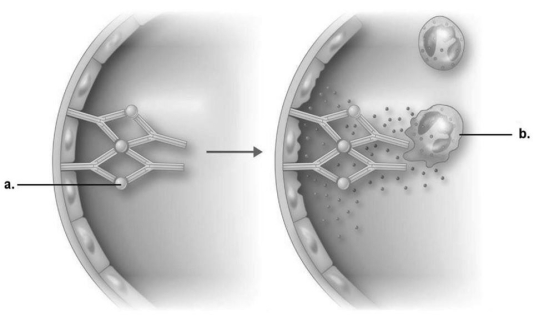 -In immune complex reaction shown in Figure 19.1,what is the end result of the reaction?
 (Multiple Choice)
4.8/5 (65)
(65) Vaccines against HIV have proven to be very effective in halting the spread of disease.
(True/False)
4.9/5 (89)
(89) A health care worker had a needlestick injury while drawing blood from an AIDS patient.Lab tests on the worker's serum were negative.Explain why the worker can still be infected even though her lab tests were negative.How should her health care be monitored?
(Essay)
4.9/5 (80)
(80) Which of the following describes a cytotoxic autoimmune reaction?
(Multiple Choice)
4.9/5 (76)
(76) All of the following lead to drug-induced thrombocytopenic purpura.Which occurs first?
(Multiple Choice)
4.9/5 (77)
(77) Table 19.1
Donor Recipient 1. , 2. , , 3. , 4. , , 5. , ,
Which blood transfusions in Table 19.1 are incompatible?
(Multiple Choice)
4.8/5 (74)
(74) The reasons for investigating stem cells to replace damaged organs and tissues in a patient include all of the following EXCEPT
(Multiple Choice)
4.8/5 (73)
(73) When testing donated blood for compatibility you would find a person with O type blood
(Multiple Choice)
4.8/5 (78)
(78) An inherited immunodeficiency is termed ________ and a secondary immunodeficiency is also known as ________.
(Multiple Choice)
4.9/5 (82)
(82) Xenotransplantation is an effective alternative to using isografts.
(True/False)
4.9/5 (85)
(85) Skin tests are reliable indicators for the diagnosis of food-related allergies.
(True/False)
4.8/5 (85)
(85) Which of the following statements is true of phase 3 HIV infection?
(Multiple Choice)
4.7/5 (77)
(77) 
Filters
- Essay(0)
- Multiple Choice(0)
- Short Answer(0)
- True False(0)
- Matching(0)