



 Chat with AI
Exam 17: Adaptive Immunity: Specific Defenses of the Host

Exam 1: The Microbial World and You65 Questions
Exam 2: Chemical Principles65 Questions
Exam 3: Observing Microorganisms Through a Microscope65 Questions
Exam 4: Functional Anatomy of Prokaryotic and Eukaryotic65 Questions
Exam 5: Microbial Metabolism67 Questions
Exam 6: Microbial Growth65 Questions
Exam 7: The Control of Microbial Growth67 Questions
Exam 8: Microbial Genetics65 Questions
Exam 9: Biotechnology and Dna Technology64 Questions
Exam 10: Classification of Microorganisms65 Questions
Exam 11: The Prokaryotes: Domains Bacteria and Archaea60 Questions
Exam 12: The Eukaryotes: Fungi, algae, protozoa, and Helminths65 Questions
Exam 13: Viruses,viroids,and Prions66 Questions
Exam 14: Principles of Disease and Epidemiology65 Questions
Exam 15: Microbial Mechanisms of Pathogenicity63 Questions
Exam 16: Innate Immunity: Nonspecific Defenses of the Host65 Questions
Exam 17: Adaptive Immunity: Specific Defenses of the Host65 Questions
Exam 18: Practical Applications of Immunology65 Questions
Exam 19: Disorders Associated With the Immune System67 Questions
Exam 20: Antimicrobial Drugs65 Questions
Exam 21: Microbial Diseases of the Skin and Eyes65 Questions
Exam 22: Microbial Diseases of the Nervous System65 Questions
Exam 23: Microbial Diseases of the Cardiovascular and Lymphatic Systems65 Questions
Exam 24: Microbial Diseases of the Respiratory System65 Questions
Exam 25: Microbial Diseases of the Digestive System66 Questions
Exam 26: Microbial Diseases of the Urinary and Reproductive Systems65 Questions
Exam 27: Environmental Microbiology65 Questions
Exam 28: Applied and Industrial Microbiology65 Questions
Select questions type


Figure 17.2
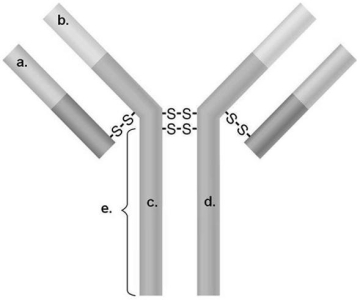 -In Figure 17.2,which areas represent antigen-binding sites?
 (Multiple Choice)
4.9/5  (79)
(79) At a minimum,the human immune system is capable of recognizing approximately how many different antigens?
(Multiple Choice)
4.8/5 (86)
(86) Which of the following statements is NOT a possible outcome of antigen-antibody reaction?
(Multiple Choice)
4.7/5 (86)
(86) Figure 17.1
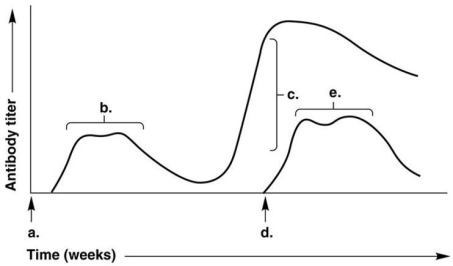 -In Figure 17.1,which letter on the graph indicates the highest antibody titer during the patient's response to a second and distinct/different antigen?
 (Multiple Choice)
4.9/5 (95)
(95) The following events elicit an antibody response.What is the third step?
(Multiple Choice)
4.8/5 (90)
(90) In addition to IgG,the antibodies that can fix complement are
(Multiple Choice)
4.7/5 (80)
(80) The variable region of the antibody is solely responsible for the response to the significant diversity of antigen targets.
(True/False)
4.9/5 (79)
(79) Newborns' immunity due to the transfer of antibodies across the placenta is an example of
(Multiple Choice)
4.9/5 (70)
(70) Which of the following statements about natural killer cells is FALSE?
(Multiple Choice)
4.8/5 (81)
(81) The following events occur in cellular immunity,leading to a response from TH cells.What is the third step?
(Multiple Choice)
4.9/5 (83)
(83) Cytokines are protein-based chemical messengers that allow for communication between cells of the immune system.
(True/False)
4.8/5 (83)
(83) 
Filters
- Essay(0)
- Multiple Choice(0)
- Short Answer(0)
- True False(0)
- Matching(0)