



 Chat with AI
Exam 13: Viruses,viroids,and Prions

Exam 1: The Microbial World and You65 Questions
Exam 2: Chemical Principles65 Questions
Exam 3: Observing Microorganisms Through a Microscope65 Questions
Exam 4: Functional Anatomy of Prokaryotic and Eukaryotic65 Questions
Exam 5: Microbial Metabolism67 Questions
Exam 6: Microbial Growth65 Questions
Exam 7: The Control of Microbial Growth67 Questions
Exam 8: Microbial Genetics65 Questions
Exam 9: Biotechnology and Dna Technology64 Questions
Exam 10: Classification of Microorganisms65 Questions
Exam 11: The Prokaryotes: Domains Bacteria and Archaea60 Questions
Exam 12: The Eukaryotes: Fungi, algae, protozoa, and Helminths65 Questions
Exam 13: Viruses,viroids,and Prions66 Questions
Exam 14: Principles of Disease and Epidemiology65 Questions
Exam 15: Microbial Mechanisms of Pathogenicity63 Questions
Exam 16: Innate Immunity: Nonspecific Defenses of the Host65 Questions
Exam 17: Adaptive Immunity: Specific Defenses of the Host65 Questions
Exam 18: Practical Applications of Immunology65 Questions
Exam 19: Disorders Associated With the Immune System67 Questions
Exam 20: Antimicrobial Drugs65 Questions
Exam 21: Microbial Diseases of the Skin and Eyes65 Questions
Exam 22: Microbial Diseases of the Nervous System65 Questions
Exam 23: Microbial Diseases of the Cardiovascular and Lymphatic Systems65 Questions
Exam 24: Microbial Diseases of the Respiratory System65 Questions
Exam 25: Microbial Diseases of the Digestive System66 Questions
Exam 26: Microbial Diseases of the Urinary and Reproductive Systems65 Questions
Exam 27: Environmental Microbiology65 Questions
Exam 28: Applied and Industrial Microbiology65 Questions
Select questions type


Figure 13.1
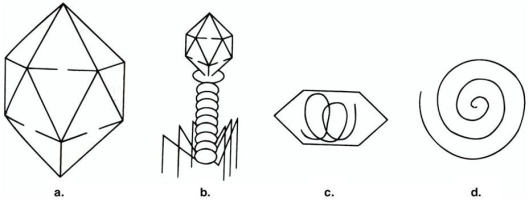 -The morphological types of viruses illustrated in Figure 13.1 are ultimately determined by the
 (Multiple Choice)
4.8/5  (65)
(65) Bacteriophages and animal viruses do NOT differ significantly in which one of the following steps?
(Multiple Choice)
5.0/5 (88)
(88) Assume you have isolated an unknown virus.This virus has a single,positive sense strand of RNA,and possesses an envelope.To which group does it most likely belong?
(Multiple Choice)
4.8/5 (87)
(87) A viroid is a completely developed infectious agent composed of nucleic acid and surrounded by a capsid.
(True/False)
4.7/5 (79)
(79) Why do most scientists agree that viruses are nonliving entities?
(Multiple Choice)
4.8/5 (93)
(93) Figure 13.1
-In Figure 13.1,which structure is a complex virus?
-In Figure 13.1,which structure is a complex virus? (Multiple Choice)
4.9/5 (74)
(74) Researchers studying tissues of diseased marine mammals have identified what appear to be viral particles by electron microscopy.Describe three methods you might use to attempt to culture this virus for further study.
(Essay)
4.9/5 (74)
(74) Dogs do not get measles because their cells lack the correct receptor sites for that virus.
(True/False)
4.8/5 (77)
(77) DNA made from an RNA template will be incorporated into the virus capsid of
(Multiple Choice)
5.0/5 (87)
(87) Which of the following is most likely a product of an early gene?
(Multiple Choice)
4.8/5 (91)
(91) Explain the steps involved in bacteriophage DNA entering a bacterial cell.
(Essay)
4.8/5 (89)
(89) 
Filters
- Essay(0)
- Multiple Choice(0)
- Short Answer(0)
- True False(0)
- Matching(0)