



 Chat with AI
Exam 5: Microbial Metabolism

Exam 1: The Microbial World and You65 Questions
Exam 2: Chemical Principles65 Questions
Exam 3: Observing Microorganisms Through a Microscope65 Questions
Exam 4: Functional Anatomy of Prokaryotic and Eukaryotic65 Questions
Exam 5: Microbial Metabolism67 Questions
Exam 6: Microbial Growth65 Questions
Exam 7: The Control of Microbial Growth67 Questions
Exam 8: Microbial Genetics65 Questions
Exam 9: Biotechnology and Dna Technology64 Questions
Exam 10: Classification of Microorganisms65 Questions
Exam 11: The Prokaryotes: Domains Bacteria and Archaea60 Questions
Exam 12: The Eukaryotes: Fungi, algae, protozoa, and Helminths65 Questions
Exam 13: Viruses,viroids,and Prions66 Questions
Exam 14: Principles of Disease and Epidemiology65 Questions
Exam 15: Microbial Mechanisms of Pathogenicity63 Questions
Exam 16: Innate Immunity: Nonspecific Defenses of the Host65 Questions
Exam 17: Adaptive Immunity: Specific Defenses of the Host65 Questions
Exam 18: Practical Applications of Immunology65 Questions
Exam 19: Disorders Associated With the Immune System67 Questions
Exam 20: Antimicrobial Drugs65 Questions
Exam 21: Microbial Diseases of the Skin and Eyes65 Questions
Exam 22: Microbial Diseases of the Nervous System65 Questions
Exam 23: Microbial Diseases of the Cardiovascular and Lymphatic Systems65 Questions
Exam 24: Microbial Diseases of the Respiratory System65 Questions
Exam 25: Microbial Diseases of the Digestive System66 Questions
Exam 26: Microbial Diseases of the Urinary and Reproductive Systems65 Questions
Exam 27: Environmental Microbiology65 Questions
Exam 28: Applied and Industrial Microbiology65 Questions
Select questions type


Why do eukaryotes generate only about 36 ATP per glucose in aerobic respiration but prokaryotes may generate about 38 ATP?
(Multiple Choice)
4.9/5  (81)
(81) Which organism is NOT correctly matched to its energy source?
(Multiple Choice)
4.9/5 (91)
(91) Figure 5.3 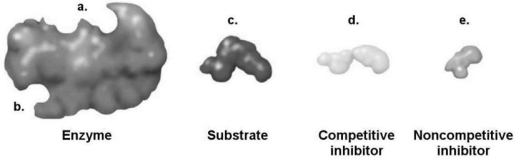 -How would a noncompetitive inhibitor interfere with a reaction involving the enzyme shown in Figure 5.3?
 (Multiple Choice)
4.9/5 (76)
(76) Streptococcus lacks an electron transport chain.How does this bacterium reoxidize NADH? Where is the NADH formed?
(Short Answer)
5.0/5 (77)
(77) Which of the following is the best definition of fermentation?
(Multiple Choice)
4.8/5 (72)
(72) Once an enzyme has converted substrates into products,the active site reverts back to its original form.
(True/False)
4.7/5 (77)
(77) A urease test is used to identify Mycobacterium tuberculosis because
(Multiple Choice)
4.8/5 (76)
(76) Both respiration and photosynthesis use water molecules for the donation of hydrogen ions.
(True/False)
4.8/5 (82)
(82) Differentiate the following two laboratory tests: starch hydrolysis and starch fermentation.
(Short Answer)
4.8/5 (80)
(80) The use of enzymes is necessary to increase the activation energy requirements of a chemical reaction.
(True/False)
4.9/5 (62)
(62) Gallionella bacteria can get energy from the reaction Fe²⁺ → Fe³⁺.This reaction is an example of
(Multiple Choice)
4.7/5 (63)
(63) Rhodopseudomonas is an anaerobic photoautotroph that uses organic compounds as an electron donor.It is also capable of chemoheterotrophic metabolism.Diagram the metabolic pathways of this bacterium.
(Essay)
4.7/5 (88)
(88) Which of the following uses CO₂ for carbon and H₂ for energy?
(Multiple Choice)
4.9/5 (80)
(80) Which of the following is the best definition of oxidative phosphorylation?
(Multiple Choice)
4.8/5 (68)
(68) An apoenzyme that loses its coenzyme subunit will be non-functional.
(True/False)
4.9/5 (69)
(69) 
Filters
- Essay(0)
- Multiple Choice(0)
- Short Answer(0)
- True False(0)
- Matching(0)