



 Chat with AI
Exam 2: Chemical Principles

Exam 1: The Microbial World and You65 Questions
Exam 2: Chemical Principles65 Questions
Exam 3: Observing Microorganisms Through a Microscope65 Questions
Exam 4: Functional Anatomy of Prokaryotic and Eukaryotic65 Questions
Exam 5: Microbial Metabolism67 Questions
Exam 6: Microbial Growth65 Questions
Exam 7: The Control of Microbial Growth67 Questions
Exam 8: Microbial Genetics65 Questions
Exam 9: Biotechnology and Dna Technology64 Questions
Exam 10: Classification of Microorganisms65 Questions
Exam 11: The Prokaryotes: Domains Bacteria and Archaea60 Questions
Exam 12: The Eukaryotes: Fungi, algae, protozoa, and Helminths65 Questions
Exam 13: Viruses,viroids,and Prions66 Questions
Exam 14: Principles of Disease and Epidemiology65 Questions
Exam 15: Microbial Mechanisms of Pathogenicity63 Questions
Exam 16: Innate Immunity: Nonspecific Defenses of the Host65 Questions
Exam 17: Adaptive Immunity: Specific Defenses of the Host65 Questions
Exam 18: Practical Applications of Immunology65 Questions
Exam 19: Disorders Associated With the Immune System67 Questions
Exam 20: Antimicrobial Drugs65 Questions
Exam 21: Microbial Diseases of the Skin and Eyes65 Questions
Exam 22: Microbial Diseases of the Nervous System65 Questions
Exam 23: Microbial Diseases of the Cardiovascular and Lymphatic Systems65 Questions
Exam 24: Microbial Diseases of the Respiratory System65 Questions
Exam 25: Microbial Diseases of the Digestive System66 Questions
Exam 26: Microbial Diseases of the Urinary and Reproductive Systems65 Questions
Exam 27: Environmental Microbiology65 Questions
Exam 28: Applied and Industrial Microbiology65 Questions
Select questions type


Which of the following statements regarding protein structure is FALSE?
(Multiple Choice)
4.8/5  (83)
(83) What is the type of strong chemical bond between carbon,hydrogen,and oxygen atoms in a single organic molecule?
(Multiple Choice)
4.7/5 (86)
(86) Water has recently been found just beneath the soil on Mars,but in frozen form.What does this mean for both the prospect of finding life on Mars in some form,but also for the possibility of humans to survive on/colonize the surface of Mars?
(Essay)
4.8/5 (76)
(76) A scientist wants to perform a test that will indicate whether a nucleic acid sample is composed of either RNA or DNA.Testing for the presence of which of the following is most appropriate in this situation?
(Multiple Choice)
4.9/5 (86)
(86) Based upon the valence numbers of the elements magnesium (2)and hydrogen (1),predict how many covalent bonds would form between these atoms to achieve the full complement of electrons in their outermost energy shells.
(Multiple Choice)
4.9/5 (67)
(67) Which of the following is the type of bond between molecules of water in a beaker of water?
(Multiple Choice)
4.8/5 (79)
(79) Figure 2.3 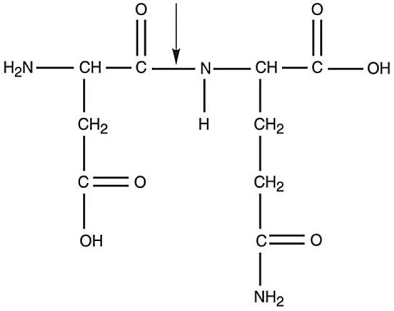 -What kind of bond is at the arrow in Figure 2.3?
 (Multiple Choice)
4.8/5 (94)
(94) Identify the following reaction: Glucose + Fructose → Sucrose + Water
(Multiple Choice)
4.8/5 (77)
(77) Which one of the following microbes would grow best at pH 1-3.5?
(Multiple Choice)
4.8/5 (82)
(82) Radioisotopes are frequently used to label molecules in a cell.The fate of atoms and molecules in a cell can then be followed.Assume Saccharomyces cerevisiae is grown in a nutrient medium containing the radioisotope ³²P.After a 48-hour incubation,the majority of the ³²P would be found in the S.cerevisiae's
(Multiple Choice)
4.9/5 (73)
(73) Identify the following reaction: HCl + NaHCO₃ → NaCl + H₂CO₃
(Multiple Choice)
4.9/5 (85)
(85) Which one of the following would be the most difficult covalent bond to break in a chemical reaction?
(Multiple Choice)
4.9/5 (75)
(75) If an amino acid contained a large hydrocarbon (a group of multiple carbons and hydrogens linked together)as its side group,in which of the following categories could it be appropriately designated?
(Multiple Choice)
4.7/5 (71)
(71) Table 2.1
Using the information in Table 2.1,calculate the number of moles in 92 grams of ethanol,C₂H₅OH.
(Multiple Choice)
4.9/5 (86)
(86) A dehydration synthesis reaction between glucose (C₆H₁₂O₆)and fructose (C₆H₁₂O₆)produces a molecule of sucrose (C₁₂H₂₂O₁₁).Why don't the two individual molecular formulae add up to the same number of atoms in the sucrose product?
(Multiple Choice)
4.9/5 (87)
(87) Compare a molecule of a nucleotide to ATP.Could a cell simply insert ATP into DNA without altering it? Explain.
(Essay)
4.9/5 (71)
(71) 
Filters
- Essay(0)
- Multiple Choice(0)
- Short Answer(0)
- True False(0)
- Matching(0)