



 Chat with AI
Exam 3: The Age of Enlightenment: Reason and Reform

Exam 1: The Rise of Sovereignty: Transition to the Modern State84 Questions
Exam 2: The Scientific Revolution: the Universe Seen As a Mechanism81 Questions
Exam 3: The Age of Enlightenment: Reason and Reform89 Questions
Exam 4: The French Revolution: the Affirmation of Liberty and Equality118 Questions
Exam 5: The Industrial Revolution: the Great Transformation77 Questions
Exam 6: Thought and Culture in the Early Nineteenth Century105 Questions
Exam 7: Revolution and Counterrevolution, 1815-184879 Questions
Exam 8: Thought and Culture in the Mid-Nineteenth Century: Realism and Social Criticism81 Questions
Exam 9: The Surge of Nationalism: From Liberal to Extreme Nationalism77 Questions
Exam 10: The Industrial West: Responses to Modernization91 Questions
Exam 11: Imperialism: Western Global Dominance92 Questions
Exam 12: Modern Consciousness: New Views of Nature, human Nature, and the Arts80 Questions
Exam 13: World War I: the West in Despair87 Questions
Exam 14: An Era of Totalitarianism112 Questions
Exam 15: Thought and Culture in an Era of World Wars and Totalitarianism75 Questions
Exam 16: World War Ii: Western Civilization in the Balance85 Questions
Exam 17: Europe After World War II: Recovery and Realignment, 1945-198987 Questions
Exam 18: The Troubled Present85 Questions
Select questions type


All of the following characterized civil society and the public sphere in Enlightenment Europe EXCEPT
(Multiple Choice)
4.9/5  (68)
(68) Instructions: Please use this outline map of the world to answer the question(s).
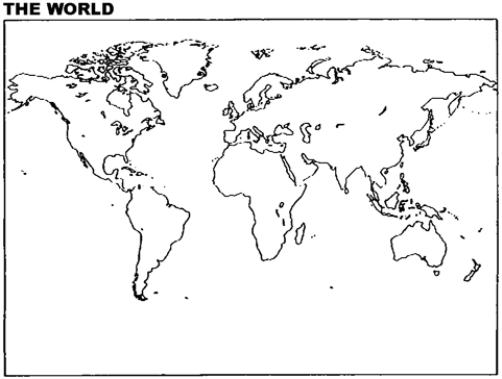 -Which institutions and individuals were most threatened by the principles and practices of the Enlightenment,and why were they challenged by the new ideas?
 (Essay)
4.7/5 (81)
(81) Which of the following statements was true concerning freedom of expression during the seventeenth century?
(Multiple Choice)
4.9/5 (84)
(84) For the history of the Enlightenment,Madame de Châtelet's greatest accomplishment was her
(Multiple Choice)
4.8/5 (82)
(82) John Locke's ideal form of government can best be described as a
(Multiple Choice)
4.8/5 (68)
(68) The term freethinking,as applied to individuals in the eighteenth century,suggested
(Multiple Choice)
4.8/5 (90)
(90) Instructions: Please use this outline map of the world to answer the question(s).
-Which characteristics of the philosophes illustrate a new way of looking at the world? List three major philosophes,and discusstheir major contributions.
-Which characteristics of the philosophes illustrate a new way of looking at the world? List three major philosophes,and discusstheir major contributions. (Essay)
5.0/5 (68)
(68) Please define the following key terms. Show Who? What? Where? When? Why Important?
-laissez faire
(Essay)
4.8/5 (83)
(83) Instructions: Please use this outline map of the world to answer the question(s).
-Discuss why capitalists could find a champion in Adam Smith.Would Adam Smith have wanted to be such a champion? Can some issues that interested Adam Smith have a relationship to contemporary ones?
-Discuss why capitalists could find a champion in Adam Smith.Would Adam Smith have wanted to be such a champion? Can some issues that interested Adam Smith have a relationship to contemporary ones? (Essay)
4.9/5 (86)
(86) Instructions: Please use this outline map of the world to answer the question(s).
-In challenging traditional values and authorities,how did the Enlightenment contribute to a new,modern worldview?
-In challenging traditional values and authorities,how did the Enlightenment contribute to a new,modern worldview? (Essay)
4.7/5 (82)
(82) Instructions: Please use this outline map of the world to answer the question(s).
-What is the difference between skepticism and freethinking? Provide examples of each.
-What is the difference between skepticism and freethinking? Provide examples of each. (Essay)
4.9/5 (84)
(84) Please define the following key terms. Show Who? What? Where? When? Why Important?
-natural rights
(Short Answer)
4.9/5 (72)
(72) Instructions: Please use this outline map of the world to answer the question(s).
-Locate and label the areas belonging tothe following colonial empires in 1750: Spanish,Dutch,French,and British.
-Locate and label the areas belonging tothe following colonial empires in 1750: Spanish,Dutch,French,and British. (Essay)
4.8/5 (85)
(85) The text states that no Enlightenment philosopher was more dangerous to the Old Regime than which champion of democracy?
(Multiple Choice)
4.8/5 (76)
(76) 
Filters
- Essay(0)
- Multiple Choice(0)
- Short Answer(0)
- True False(0)
- Matching(0)