



 Chat with AI
Exam 13: World War I: the West in Despair


The Bosnian crises in 1908 and 1912

 (79)
 Verified
E
Please define the following key terms. Show Who? What? Where? When? Why Important?
-Triple Alliance
(91)  Answered by Examlex AI Copilot
The Triple Alliance was a military alliance formed in the late 19th and early 20th centuries. Here is a breakdown of the key aspects of the Triple Alliance:
Who?
The Triple Alliance was primarily composed of three European powers: Germany, Austria-Hungary, and Italy.
What?
It was an agreement between these nations to provide mutual support and military assistance to each other in the event that any one of them was attacked by two or more powers, or in the case of Germany and Italy, if they were attacked by France. The alliance was one of the central agreements that defined the balance of power in Europe leading up to World War I.
Where?
The alliance concerned these European countries and was focused on their interests and security within the continent, particularly in Central and Southern Europe.
When?
The Triple Alliance was formed on May 20, 1882, and it lasted until the beginning of World War I in 1914. The alliance underwent several renewals and modifications before it effectively ended.
Why Important?
The Triple Alliance was significant for several reasons:
1. Balance of Power: It was a key component in the complex web of alliances and treaties that sought to maintain a balance of power in Europe, which was a central aspect of late 19th and early 20th-century international relations.
2. Precursor to World War I: The existence of such alliances contributed to the outbreak of World War I, as the commitment to mutual defense meant that a conflict involving one member of an alliance could quickly involve the others, turning a localized conflict into a broader war.
3. Shifting Alliances: Italy's membership in the Triple Alliance was tenuous, and when World War I broke out, Italy chose not to join its allies, citing a defensive clause in the agreement. Instead, Italy eventually joined the opposing Entente Powers after being promised territorial gains.
4. Military Strategy: The Triple Alliance influenced military planning and strategy in the pre-war years, as member states had to consider the possibility of a two-front war and coordinate their military efforts.
In summary, the Triple Alliance was an important factor in the international relations of pre-World War I Europe, influencing diplomatic decisions, military strategies, and ultimately playing a role in the chain of events that led to the outbreak of one of the deadliest conflicts in human history.
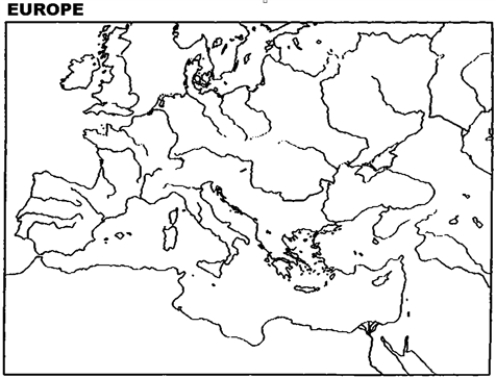
Instructions: Please use this outline map of Europe to answer the question(s).
 -Explain how the Bolsheviks were able to take advantage of situations that were not always of their making.
 (73) Answered by Examlex AI CopilotThe Bolsheviks were able to take advantage of situations that were not always of their making through a combination of strategic planning, opportunism, and the weaknesses of their opponents. One key factor was their ability to exploit the chaos and instability that followed the Russian Revolution of 1917. The Bolsheviks, led by Vladimir Lenin, were able to capitalize on the disarray within the Provisional Government and the various factions vying for power in the wake of the revolution.
Additionally, the Bolsheviks were adept at using propaganda and agitation to sway public opinion in their favor. They were able to tap into the widespread discontent and disillusionment with the existing political order, and present themselves as the champions of the working class and the oppressed.
Furthermore, the Bolsheviks were able to take advantage of the disorganization and infighting among their opponents, including other socialist and liberal factions. This allowed them to consolidate their power and eliminate potential rivals, ultimately establishing a one-party state under their control.
Overall, the Bolsheviks were able to exploit the tumultuous and uncertain conditions of the time to advance their own agenda and ultimately seize power, despite the fact that these situations were not always of their making.
Which of the following contributed to the military stalemate on the Western Front in 1914?
(78) Please define the following key terms. Show Who? What? Where? When? Why Important?
-Treaty of Versailles
(82) Please define the following key terms. Show Who? What? Where? When? Why Important?
-Pan-Slavism
(80) Why did Germany's break with Russia in 1890 prove to be so serious?
(77) When the war became mired down in trench warfare,the military and civilian leaders of the warring countries
(76) Instructions: Please use this outline map of Europe to answer the question(s).
-How did the war contribute to the rise and success of overtly anti-democratic,anti-liberal movements from 1917 onward?
-How did the war contribute to the rise and success of overtly anti-democratic,anti-liberal movements from 1917 onward? (90) The fundamental problem in Austria-Hungary in the eve of World War I was
(92) Please define the following key terms. Show Who? What? Where? When? Why Important?
-Provisional Government
(80) Instructions: Please use this outline map of Europe to answer the question(s).
-Discuss how some of the intellectual trends presented in earlier chapters might have contributed to Europeans' readiness to go to war in the fall of 1914.Use specific examples to support your answer.
-Discuss how some of the intellectual trends presented in earlier chapters might have contributed to Europeans' readiness to go to war in the fall of 1914.Use specific examples to support your answer. (68) Which of the following indicates the aggressive new foreign policy pursued by Germany after 1890?
(78) Please define the following key terms. Show Who? What? Where? When? Why Important?
-Black Hand
(68) Instructions: Please use this outline map of Europe to answer the question(s).
-Why did many Europeans see the coming of war in 1914 as a cause for celebration?
-Why did many Europeans see the coming of war in 1914 as a cause for celebration? (88) 
Filters
- Essay(0)
- Multiple Choice(0)
- Short Answer(0)
- True False(0)
- Matching(0)