



 Chat with AI
Exam 1: The Rise of Sovereignty: Transition to the Modern State


The Dutch state combined all the following EXCEPT

 (70)
 Verified
C
Please define the following key terms. Show Who? What? Where? When? Why Important?
-raison d'état
(77)  Answered by Examlex AI Copilot
Raison d'état is a French term that translates to "reason of state" in English. It refers to the principle that a government's actions and policies should be guided by the best interests of the state, even if it means sacrificing individual rights or moral principles.
Who: Raison d'état is a concept that applies to governments and political leaders.
What: It is the principle that justifies the use of any means necessary to preserve the security and stability of the state.
Where: Raison d'état can be applied in any country or political system.
When: This principle has been used throughout history by various governments facing threats to their power or stability.
Why Important: Raison d'état is important because it raises ethical and moral questions about the extent to which a government should prioritize the well-being of the state over the rights and freedoms of its citizens. It also has implications for international relations and the use of force in foreign policy.
The Valois failure to produce a male heir led in 1589 to the coming to power in France of the
(87) Please define the following key terms. Show Who? What? Where? When? Why Important?
-intendants
(83) When compared with their French counterparts,the main disadvantage the Stuarts had in their efforts to establish absolutism was
(67) What events were part of the constitutionalcrisis England faced in the seventeenth century?
(73) Please define the following key terms. Show Who? What? Where? When? Why Important?
-stadholder
(77) In the Glorious Revolution,William of Orange and the Dutch accepted the invitation of the English Parliament because it would secure their
(84) Please use this outline map of Europe to answer the question(s)
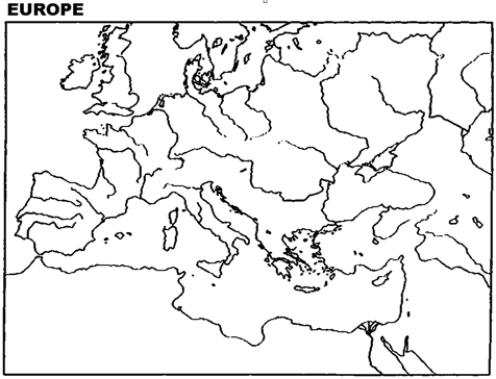 -The text states that "[f]rom the thirteenth to the seventeenth century,a new and unique form of political organization emerged in the West: the dynastic,or national,state." What is meant by the "dynastic state," how did it develop,and why was it so unique?
 (93) Which of the following helped usher in the modern world,according to the text?
(78) Please define the following key terms. Show Who? What? Where? When? Why Important?
-Thirty Years' War
(86) Please use this outline map of Europe to answer the question(s)
-The engine that drove the development of the centralized European state was war.Make an argument to support or refute this statement,and defend it with specific evidence.
-The engine that drove the development of the centralized European state was war.Make an argument to support or refute this statement,and defend it with specific evidence. (71) In hisInstructions for the Dauphin,Louis XIV claimed that successful kingship lies in
(88) Please define the following key terms. Show Who? What? Where? When? Why Important?
-Versailles
(81) The two most common forms of government in early modern Europe were
(86) Please use this outline map of Europe to answer the question(s)
-Compare and contrast the ambitions of Philip II and Louis XIV.How successful was each in achieving his aims?
-Compare and contrast the ambitions of Philip II and Louis XIV.How successful was each in achieving his aims?
(81) 
Filters
- Essay(0)
- Multiple Choice(0)
- Short Answer(0)
- True False(0)
- Matching(0)