



 Chat with AI
Exam 43: The Immune System

Exam 1: Introduction: Evolution and Themes of Biology70 Questions
Exam 2: The Chemical Context of Life90 Questions
Exam 3: Water and Life80 Questions
Exam 4: Carbon and the Molecular Diversity of Life78 Questions
Exam 5: The Structure and Function of Large Biological Molecules117 Questions
Exam 6: A Tour of the Cell96 Questions
Exam 7: Membrane Structure and Function78 Questions
Exam 8: An Introduction to Metabolism88 Questions
Exam 9: Cellular Respiration and Fermentation117 Questions
Exam 10: Photosynthesis89 Questions
Exam 11: Cell Communication77 Questions
Exam 12: The Cell Cycle83 Questions
Exam 13: Meiosis and Sexual Life Cycles74 Questions
Exam 14: Mendel and the Gene Idea82 Questions
Exam 15: The Chromosomal Basis of Inheritance66 Questions
Exam 16: The Molecular Basis of Inheritance67 Questions
Exam 17: From Gene to Protein91 Questions
Exam 18: Regulation of Gene Expression107 Questions
Exam 19: Viruses53 Questions
Exam 20: Dna Tools and Biotechnology72 Questions
Exam 21: Genomes and Their Evolution52 Questions
Exam 22: Descent With Modification: a Darwinian View of Life63 Questions
Exam 23: The Evolution of Populations86 Questions
Exam 24: The Origin of Species71 Questions
Exam 25: The History of Life on Earth83 Questions
Exam 26: Phylogeny and the Tree of Life81 Questions
Exam 27: Bacteria and Archaea86 Questions
Exam 28: Protists84 Questions
Exam 29: Plant Diversity I: How Plants Colonized Land82 Questions
Exam 30: Plant Diversity Ii: the Evolution of Seed Plants110 Questions
Exam 31: Fungi97 Questions
Exam 32: An Overview of Animal Diversity82 Questions
Exam 33: An Introduction to Invertebrates101 Questions
Exam 34: The Origin and Evolution of Vertebrates117 Questions
Exam 35: Plant Structure, Growth, and Development75 Questions
Exam 36: Resource Acquisition and Transport in Vascular Plants89 Questions
Exam 37: Soil and Plant Nutrition91 Questions
Exam 38: Angiosperm Reproduction and Biotechnology94 Questions
Exam 39: Plant Responses to Internal and External Signals116 Questions
Exam 40: Basic Principles of Animal Form and Function86 Questions
Exam 41: Animal Nutrition73 Questions
Exam 42: Circulation and Gas Exchange100 Questions
Exam 43: The Immune System110 Questions
Exam 44: Osmoregulation and Excretion79 Questions
Exam 45: Hormones and the Endocrine System82 Questions
Exam 46: Animal Reproduction104 Questions
Exam 47: Animal Development98 Questions
Exam 48: Neurons, Synapses, and Signalling81 Questions
Exam 49: Nervous Systems73 Questions
Exam 50: Sensory and Motor Mechanisms91 Questions
Exam 51: Animal Behaviour79 Questions
Exam 52: An Introduction to Ecology and the Biosphere81 Questions
Exam 53: Population Ecology87 Questions
Exam 54: Community Ecology85 Questions
Exam 55: Ecosystems and Restoration Ecology89 Questions
Exam 56: Conservation Biology and Global Change75 Questions
Select questions type


Mutant fruit flies that make only one antimicrobial peptide were tested for survival after infection with Neurospora crassa fungi or with Micrococcus luteus bacteria.
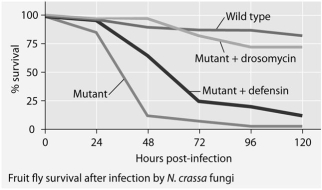
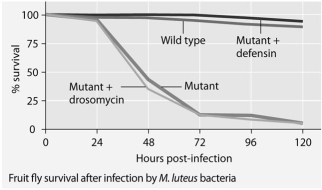 -The results shown in the graphs support the hypothesis that
 (Multiple Choice)
5.0/5  (82)
(82) A patient who undergoes a high level of mast cell degranulation, dilation of blood vessels, and acute drop in blood pressure is likely suffering from
(Multiple Choice)
4.9/5 (79)
(79) Infection by a bacterium that has elements on its surface that enhance its resistance to lysozyme will likely result in
(Multiple Choice)
4.9/5 (90)
(90) Which statement best describes the difference in responses of effector B cells (plasma cells)and cytotoxic T cells?
(Multiple Choice)
4.9/5 (79)
(79) Which of the following would not help a virus avoid triggering an adaptive immune response?
(Multiple Choice)
4.9/5 (73)
(73) Cave art by early humans recognized the existence of the major signs of inflammation. The most inclusive set of symptoms of inflammation that might appear in such early human art is
(Multiple Choice)
4.8/5 (84)
(84) Use the following table to answer the questions below.
 -Study the table. The mother could exhibit an anti-Rh-factor reaction to the developing fetus in
 (Multiple Choice)
4.9/5 (76)
(76) Use the following information as background for the next few questions.
Immunodeficiencies can be genetic in origin, and two examples are Bruton's agammaglobulinemia, an X-linked disorder, and DiGeorge syndrome, caused by a deletion from chromosome 22. Bruton's disorder results in underdeveloped B cells, whereas DiGeorge syndrome results in a missing or seriously underdeveloped thymus.
-Select the description that likely indicates a child with Bruton's disease.
(Multiple Choice)
4.7/5 (97)
(97) Normal immune responses can be described as polyclonal because
(Multiple Choice)
4.8/5 (75)
(75) A nonfunctional CD4 protein on a helper T cell would result in the helper T cell being unable to
(Multiple Choice)
4.8/5 (90)
(90) Use the following table to answer the questions below.
-After a long and cold winter, Jim was excited to start exploring the woods behind his new home. His first adventure included exposure to poison ivy without any reaction. A month later, though, a second walk through the woods was not so great, since two days later Jim had a terrible rash that lasted for weeks. The fact that the rash took two days to develop indicates that this immune response was an example of
-After a long and cold winter, Jim was excited to start exploring the woods behind his new home. His first adventure included exposure to poison ivy without any reaction. A month later, though, a second walk through the woods was not so great, since two days later Jim had a terrible rash that lasted for weeks. The fact that the rash took two days to develop indicates that this immune response was an example of (Multiple Choice)
4.8/5 (83)
(83) The transfusion of type A blood to a person who has type O blood would result in
(Multiple Choice)
4.7/5 (84)
(84) B cells have antigen receptors that bind to antigens that are either freely dissolved or present on the surface of invading/foreign cells. T cells have antigen receptors that
(Multiple Choice)
4.8/5 (76)
(76) After cutting your foot on piece of glass, you notice localized redness, swelling and heat. The immune cells responsible for these symptoms are
(Multiple Choice)
4.9/5 (73)
(73) Yearly vaccination of humans for influenza viruses is necessary because
(Multiple Choice)
4.8/5 (78)
(78) 
Filters
- Essay(0)
- Multiple Choice(0)
- Short Answer(0)
- True False(0)
- Matching(0)