



 Chat with AI
Exam 23: The Evolution of Populations

Exam 1: Introduction: Evolution and Themes of Biology70 Questions
Exam 2: The Chemical Context of Life90 Questions
Exam 3: Water and Life80 Questions
Exam 4: Carbon and the Molecular Diversity of Life78 Questions
Exam 5: The Structure and Function of Large Biological Molecules117 Questions
Exam 6: A Tour of the Cell96 Questions
Exam 7: Membrane Structure and Function78 Questions
Exam 8: An Introduction to Metabolism88 Questions
Exam 9: Cellular Respiration and Fermentation117 Questions
Exam 10: Photosynthesis89 Questions
Exam 11: Cell Communication77 Questions
Exam 12: The Cell Cycle83 Questions
Exam 13: Meiosis and Sexual Life Cycles74 Questions
Exam 14: Mendel and the Gene Idea82 Questions
Exam 15: The Chromosomal Basis of Inheritance66 Questions
Exam 16: The Molecular Basis of Inheritance67 Questions
Exam 17: From Gene to Protein91 Questions
Exam 18: Regulation of Gene Expression107 Questions
Exam 19: Viruses53 Questions
Exam 20: Dna Tools and Biotechnology72 Questions
Exam 21: Genomes and Their Evolution52 Questions
Exam 22: Descent With Modification: a Darwinian View of Life63 Questions
Exam 23: The Evolution of Populations86 Questions
Exam 24: The Origin of Species71 Questions
Exam 25: The History of Life on Earth83 Questions
Exam 26: Phylogeny and the Tree of Life81 Questions
Exam 27: Bacteria and Archaea86 Questions
Exam 28: Protists84 Questions
Exam 29: Plant Diversity I: How Plants Colonized Land82 Questions
Exam 30: Plant Diversity Ii: the Evolution of Seed Plants110 Questions
Exam 31: Fungi97 Questions
Exam 32: An Overview of Animal Diversity82 Questions
Exam 33: An Introduction to Invertebrates101 Questions
Exam 34: The Origin and Evolution of Vertebrates117 Questions
Exam 35: Plant Structure, Growth, and Development75 Questions
Exam 36: Resource Acquisition and Transport in Vascular Plants89 Questions
Exam 37: Soil and Plant Nutrition91 Questions
Exam 38: Angiosperm Reproduction and Biotechnology94 Questions
Exam 39: Plant Responses to Internal and External Signals116 Questions
Exam 40: Basic Principles of Animal Form and Function86 Questions
Exam 41: Animal Nutrition73 Questions
Exam 42: Circulation and Gas Exchange100 Questions
Exam 43: The Immune System110 Questions
Exam 44: Osmoregulation and Excretion79 Questions
Exam 45: Hormones and the Endocrine System82 Questions
Exam 46: Animal Reproduction104 Questions
Exam 47: Animal Development98 Questions
Exam 48: Neurons, Synapses, and Signalling81 Questions
Exam 49: Nervous Systems73 Questions
Exam 50: Sensory and Motor Mechanisms91 Questions
Exam 51: Animal Behaviour79 Questions
Exam 52: An Introduction to Ecology and the Biosphere81 Questions
Exam 53: Population Ecology87 Questions
Exam 54: Community Ecology85 Questions
Exam 55: Ecosystems and Restoration Ecology89 Questions
Exam 56: Conservation Biology and Global Change75 Questions
Select questions type


What is true of natural selection?

Free
(Multiple Choice)
4.7/5  (91)
(91) Correct Answer: Verified
D
Which of the following is most likely to produce an African butterfly species in the wild whose members have one of two strikingly different colour patterns?
Free
(Multiple Choice)
4.9/5 (94)
(94) Correct Answer:Verified
VerifiedD
Use this information to answer the following questions
Many species once roamed across large areas of continents, and for millions of years these species were "shaped" by their environment. Today, numerous species, especially large carnivores, are found in national parks and nature reserves that are isolated by hundreds or thousands of kilometres of land now occupied by humans. The cheetah is one example of a species that has shown several dramatic decreases in numbers over time, and now occupies a small fraction of its historic range.
-Which of the following statements would most likely apply to cheetahs currently found in Kenya and South Africa?
Free
(Multiple Choice)
4.8/5 (84)
(84) Correct Answer:Verified
VerifiedE
With respect to the sickle-cell allele, what should be true of the β hemoglobin locus in U.S. populations of African-Americans whose ancestors were from equatorial Africa? 1. The average heterozygosity at this locus should be decreasing over time.
2. There is an increasing heterozygote advantage at this locus.
3. Diploidy is helping to preserve the sickle-cell allele at this locus.
4. Frequency-dependent selection is helping to preserve the sickle-cell allele at this locus.
(Multiple Choice)
4.8/5 (79)
(79) There are 40 individuals in population 1, all with genotype A1A1, and there are 25 individuals in population 2, all with genotype A2A2. Assume that these populations are located far from each other and that their environmental conditions are very similar. Based on the information given here, the observed genetic variation is most likely an example of
(Multiple Choice)
4.9/5 (80)
(80) Arrange the following from most general (i.e., most inclusive)to most specific (i.e., least inclusive): 1 natural selection
2. microevolution
3. intrasexual selection
4. evolution
5. sexual selection
(Multiple Choice)
4.9/5 (77)
(77) Which statement about the beak size of finches on the island of Daphne Major during prolonged drought is true?
(Multiple Choice)
4.9/5 (94)
(94) In the wild, male house finches (Carpodus mexicanus)vary considerably in the amount of red pigmentation in their head and throat feathers, with colours ranging from pale yellow to bright red. These colours come from carotenoid pigments that are found in the birds' diets; no vertebrates are known to synthesize carotenoid pigments. Thus, the brighter red the male's feathers are, the more successful he has been at acquiring the red carotenoid pigment by his food-gathering efforts (all other factors being equal). During breeding season, one should expect female house finches to prefer to mate with males with the brightest red feathers. Which of the following is true of this situation?
(Multiple Choice)
4.7/5 (81)
(81) Adult male humans generally have deeper voices than do adult female humans, which is the direct result of higher levels of testosterone causing growth of the larynx. If the fossil records of apes and humans alike show a trend toward decreasing larynx size in adult females and increasing larynx size in adult males, then
(Multiple Choice)
4.8/5 (74)
(74) Which of the following is a true statement concerning genetic variation?
(Multiple Choice)
4.8/5 (81)
(81) If, on average, 46% of the loci in a species' gene pool are heterozygous, then the average homozygosity of the species should be
(Multiple Choice)
4.8/5 (85)
(85) In the formula for determining a population's genotype frequencies, the 2 in the term 2pq is necessary because
(Multiple Choice)
4.9/5 (72)
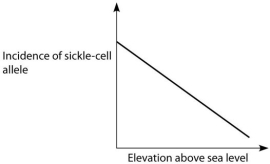
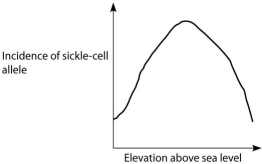
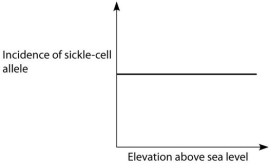
(72) If global warming permits mosquitoes to live at higher altitudes than they currently do, then in which direction should the entire plot in the correct distribution below be shifted? 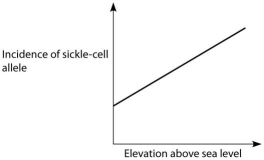 A.
 B.
 C.
 D.
A.
B.
C.
D. (Multiple Choice)
4.8/5 (71)
(71) In modern terminology, diversity is understood to be a result of genetic variation. Which of the following is a recognized source of variation for evolution?
(Multiple Choice)
4.8/5 (72)
(72) The restriction enzymes of bacteria protect the bacteria from successful attack by bacteriophages, whose genomes can be degraded by the restriction enzymes. The bacterial genomes are not vulnerable to these restriction enzymes because bacterial DNA is methylated. This situation selects for bacteriophages whose genomes are also methylated. As new strains of resistant bacteriophages become more prevalent, this in turn selects for bacteria whose genomes are not methylated and whose restriction enzymes instead degrade methylated DNA. The outcome of the conflict between bacteria and bacteriophage at any point in time results from
(Multiple Choice)
4.9/5 (78)
(78) Considering the overall human population of the U.S. mainland at the time when the slave trade brought large numbers of people from equatorial Africa, what was primarily acting to change the frequency of the sickle-cell allele in the overall U.S. population?
(Multiple Choice)
4.9/5 (81)
(81) In a Hardy-Weinberg population with two alleles, A and a, that are in equilibrium, the frequency of the allele a is 0.3. What is the percentage of the population that is homozygous for this allele?
(Multiple Choice)
4.9/5 (83)
(83) You are maintaining a small population of fruit flies in the laboratory by transferring the flies to a new culture bottle after each generation. After several generations, you notice that the viability of the flies has decreased greatly. Recognizing that small population size is likely to be linked to decreased viability, the best way to reverse this trend is to
(Multiple Choice)
4.9/5 (92)
(92) 
Filters
- Essay(0)
- Multiple Choice(0)
- Short Answer(0)
- True False(0)
- Matching(0)