



 Chat with AI
Exam 17: From Gene to Protein

Exam 1: Introduction: Evolution and Themes of Biology70 Questions
Exam 2: The Chemical Context of Life90 Questions
Exam 3: Water and Life80 Questions
Exam 4: Carbon and the Molecular Diversity of Life78 Questions
Exam 5: The Structure and Function of Large Biological Molecules117 Questions
Exam 6: A Tour of the Cell96 Questions
Exam 7: Membrane Structure and Function78 Questions
Exam 8: An Introduction to Metabolism88 Questions
Exam 9: Cellular Respiration and Fermentation117 Questions
Exam 10: Photosynthesis89 Questions
Exam 11: Cell Communication77 Questions
Exam 12: The Cell Cycle83 Questions
Exam 13: Meiosis and Sexual Life Cycles74 Questions
Exam 14: Mendel and the Gene Idea82 Questions
Exam 15: The Chromosomal Basis of Inheritance66 Questions
Exam 16: The Molecular Basis of Inheritance67 Questions
Exam 17: From Gene to Protein91 Questions
Exam 18: Regulation of Gene Expression107 Questions
Exam 19: Viruses53 Questions
Exam 20: Dna Tools and Biotechnology72 Questions
Exam 21: Genomes and Their Evolution52 Questions
Exam 22: Descent With Modification: a Darwinian View of Life63 Questions
Exam 23: The Evolution of Populations86 Questions
Exam 24: The Origin of Species71 Questions
Exam 25: The History of Life on Earth83 Questions
Exam 26: Phylogeny and the Tree of Life81 Questions
Exam 27: Bacteria and Archaea86 Questions
Exam 28: Protists84 Questions
Exam 29: Plant Diversity I: How Plants Colonized Land82 Questions
Exam 30: Plant Diversity Ii: the Evolution of Seed Plants110 Questions
Exam 31: Fungi97 Questions
Exam 32: An Overview of Animal Diversity82 Questions
Exam 33: An Introduction to Invertebrates101 Questions
Exam 34: The Origin and Evolution of Vertebrates117 Questions
Exam 35: Plant Structure, Growth, and Development75 Questions
Exam 36: Resource Acquisition and Transport in Vascular Plants89 Questions
Exam 37: Soil and Plant Nutrition91 Questions
Exam 38: Angiosperm Reproduction and Biotechnology94 Questions
Exam 39: Plant Responses to Internal and External Signals116 Questions
Exam 40: Basic Principles of Animal Form and Function86 Questions
Exam 41: Animal Nutrition73 Questions
Exam 42: Circulation and Gas Exchange100 Questions
Exam 43: The Immune System110 Questions
Exam 44: Osmoregulation and Excretion79 Questions
Exam 45: Hormones and the Endocrine System82 Questions
Exam 46: Animal Reproduction104 Questions
Exam 47: Animal Development98 Questions
Exam 48: Neurons, Synapses, and Signalling81 Questions
Exam 49: Nervous Systems73 Questions
Exam 50: Sensory and Motor Mechanisms91 Questions
Exam 51: Animal Behaviour79 Questions
Exam 52: An Introduction to Ecology and the Biosphere81 Questions
Exam 53: Population Ecology87 Questions
Exam 54: Community Ecology85 Questions
Exam 55: Ecosystems and Restoration Ecology89 Questions
Exam 56: Conservation Biology and Global Change75 Questions
Select questions type


In the 1920s, Muller discovered that X-rays caused mutation in Drosophila. In a related series of experiments in the 1940s, Charlotte Auerbach discovered that chemicals-she used nitrogen mustards-have a similar effect. A new chemical food additive is developed by a cereal manufacturer. Why do we test for its ability to induce mutation?

Free
(Multiple Choice)
4.7/5  (83)
(83) Correct Answer: Verified
D
A transcription unit that is 8000 nucleotides long may use 1200 nucleotides to make a protein consisting of approximately 400 amino acids. This is best explained by the fact that
Free
(Multiple Choice)
4.9/5 (81)
(81) Correct Answer:Verified
VerifiedA
Use the following figure to answer the questions below.
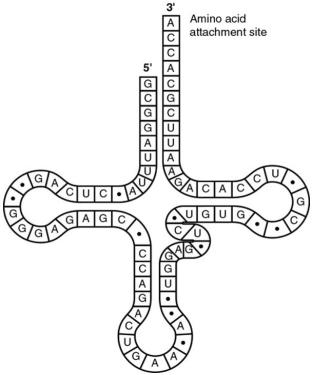 -The tRNA shown in the figure has its 3' end projecting beyond its 5' end. What will occur at this 3' end?
Free
(Multiple Choice)
4.9/5 (79)
(79) Correct Answer:Verified
VerifiedB
Suppose that exposure to a chemical mutagen results in a change in the sequence that alters the 5' end of intron 1 (I₁). What might occur?
(Multiple Choice)
4.9/5 (91)
(91) The following questions refer to this figure of a simple metabolic pathway:
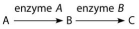 -If A, B, and C are all required for growth, a strain that is mutant for the gene-encoding enzyme A would be able to grow on which of the following media?
 (Multiple Choice)
4.9/5 (80)
(80) The following questions refer to this figure of a simple metabolic pathway:
-A mutation results in a defective enzyme A. Which of the following would be a consequence of that mutation?
-A mutation results in a defective enzyme A. Which of the following would be a consequence of that mutation? (Multiple Choice)
4.9/5 (102)
(102) Which of the following does not occur in prokaryotic eukaryotic gene expression, but does in eukaryotic gene expression?
(Multiple Choice)
4.8/5 (72)
(72) During splicing, which molecular component of the spliceosome catalyzes the excision reaction?
(Multiple Choice)
4.9/5 (90)
(90) A particular triplet of bases in the template strand of DNA is 5' AGT 3'. The corresponding codon for the mRNA transcribed is
(Multiple Choice)
4.9/5 (75)
(75) If a nucleotide substitution switched a U for a C, such that the codon was read as CGC instead of CGU, what would the effect be?
(Multiple Choice)
4.9/5 (69)
(69) Use the following information to answer the questions below.
Yeast is capable of synthesizing the amino acids necessary for survival and can grow on minimal media or enriched media easily. In both conditions, the colonies have a cream colour. The production of adenine is regulated by two genes, ADE1 and ADE2. If either of these genes is defective, adenine cannot be synthesized and the colony will look red (as a result of accumulation of precursors). A common undergraduate lab study is to irradiate yeast cells with ultra violet light from 2-5 sec up to 1-5 minutes, and see what will happen.
-If, after irradiating and growing cultures in enriched media, you see some red colonies, what is the easiest way to confirm that the phenotype observed is due to a lack of adenine metabolism?
(Multiple Choice)
5.0/5 (80)
(80) Use this representation to answer the following questions.
DNA template strand 5' ____________________________ 3'
DNA complementary strand 3' ____________________________ 5'
-Given the locally unwound double strand above, in which direction does the RNA polymerase move?
(Multiple Choice)
4.9/5 (82)
(82) Which of the following types of mutation, resulting in an error in the mRNA just after the AUG start of translation, is likely to have the most serious effect on the polypeptide product?
(Multiple Choice)
4.8/5 (87)
(87) Use the following figure to answer the questions below.
-The figure represents tRNA that recognizes and binds a particular amino acid (in this instance, phenylalanine). Which codon on the mRNA strand codes for this amino acid?
-The figure represents tRNA that recognizes and binds a particular amino acid (in this instance, phenylalanine). Which codon on the mRNA strand codes for this amino acid? (Multiple Choice)
4.8/5 (75)
(75) Use the following model of a eukaryotic transcript to answer the next few questions.
5' UTR E₁ I₁ E₂ I₂ E₃ I₃ E₄ UTR 3'
-Which of the following is a useful feature of introns for this model?
(Multiple Choice)
4.9/5 (92)
(92) Which small-scale mutation would be most likely to have a catastrophic effect on the functioning of a protein?
(Multiple Choice)
4.9/5 (79)
(79) Garrod's information about the enzyme alteration resulting in alkaptonuria led to further elucidation of the same pathway in humans. Phenylketonuria (PKU)occurs when another enzyme in the pathway is altered or missing, resulting in a failure of phenylalanine (phe)to be metabolized to another amino acid: tyrosine. Tyrosine is an earlier substrate in the pathway altered in alkaptonuria. How might PKU affect the presence or absence of alkaptonuria?
(Multiple Choice)
4.7/5 (83)
(83) The following questions refer to this figure of a simple metabolic pathway:
-According to Beadle and Tatum"s hypothesis, how many genes are necessary for this pathway?
-According to Beadle and Tatum"s hypothesis, how many genes are necessary for this pathway? (Multiple Choice)
4.8/5 (83)
(83) A particular triplet of bases in the coding sequence of DNA is AAA. The anticodon on the tRNA that binds the mRNA codon is
(Multiple Choice)
4.8/5 (71)
(71) 
Filters
- Essay(0)
- Multiple Choice(0)
- Short Answer(0)
- True False(0)
- Matching(0)