



 Chat with AI
Exam 17: From Gene to Protein

Exam 1: Introduction: Evolution and Themes of Biology70 Questions
Exam 2: The Chemical Context of Life90 Questions
Exam 3: Water and Life80 Questions
Exam 4: Carbon and the Molecular Diversity of Life78 Questions
Exam 5: The Structure and Function of Large Biological Molecules117 Questions
Exam 6: A Tour of the Cell96 Questions
Exam 7: Membrane Structure and Function78 Questions
Exam 8: An Introduction to Metabolism88 Questions
Exam 9: Cellular Respiration and Fermentation117 Questions
Exam 10: Photosynthesis89 Questions
Exam 11: Cell Communication77 Questions
Exam 12: The Cell Cycle83 Questions
Exam 13: Meiosis and Sexual Life Cycles74 Questions
Exam 14: Mendel and the Gene Idea82 Questions
Exam 15: The Chromosomal Basis of Inheritance66 Questions
Exam 16: The Molecular Basis of Inheritance67 Questions
Exam 17: From Gene to Protein91 Questions
Exam 18: Regulation of Gene Expression107 Questions
Exam 19: Viruses53 Questions
Exam 20: Dna Tools and Biotechnology72 Questions
Exam 21: Genomes and Their Evolution52 Questions
Exam 22: Descent With Modification: a Darwinian View of Life63 Questions
Exam 23: The Evolution of Populations86 Questions
Exam 24: The Origin of Species71 Questions
Exam 25: The History of Life on Earth83 Questions
Exam 26: Phylogeny and the Tree of Life81 Questions
Exam 27: Bacteria and Archaea86 Questions
Exam 28: Protists84 Questions
Exam 29: Plant Diversity I: How Plants Colonized Land82 Questions
Exam 30: Plant Diversity Ii: the Evolution of Seed Plants110 Questions
Exam 31: Fungi97 Questions
Exam 32: An Overview of Animal Diversity82 Questions
Exam 33: An Introduction to Invertebrates101 Questions
Exam 34: The Origin and Evolution of Vertebrates117 Questions
Exam 35: Plant Structure, Growth, and Development75 Questions
Exam 36: Resource Acquisition and Transport in Vascular Plants89 Questions
Exam 37: Soil and Plant Nutrition91 Questions
Exam 38: Angiosperm Reproduction and Biotechnology94 Questions
Exam 39: Plant Responses to Internal and External Signals116 Questions
Exam 40: Basic Principles of Animal Form and Function86 Questions
Exam 41: Animal Nutrition73 Questions
Exam 42: Circulation and Gas Exchange100 Questions
Exam 43: The Immune System110 Questions
Exam 44: Osmoregulation and Excretion79 Questions
Exam 45: Hormones and the Endocrine System82 Questions
Exam 46: Animal Reproduction104 Questions
Exam 47: Animal Development98 Questions
Exam 48: Neurons, Synapses, and Signalling81 Questions
Exam 49: Nervous Systems73 Questions
Exam 50: Sensory and Motor Mechanisms91 Questions
Exam 51: Animal Behaviour79 Questions
Exam 52: An Introduction to Ecology and the Biosphere81 Questions
Exam 53: Population Ecology87 Questions
Exam 54: Community Ecology85 Questions
Exam 55: Ecosystems and Restoration Ecology89 Questions
Exam 56: Conservation Biology and Global Change75 Questions
Select questions type


When the function of the newly made polypeptide is to be secreted from the cell where it has been made, what must occur?
(Multiple Choice)
4.8/5  (67)
(67) Which of the following is the first event to take place in translation in eukaryotes?
(Multiple Choice)
4.8/5 (88)
(88) How does a plasma membrane protein become imbedded in the membrane?
(Multiple Choice)
4.8/5 (77)
(77) The white fur colouration of the "spirit bear" of British Columbia, is a result of
(Multiple Choice)
4.9/5 (84)
(84) Which of the following is true of transcription in domain Archaea?
(Multiple Choice)
4.8/5 (71)
(71) If a protein is coded for by a single gene and this protein has six clearly defined domains, which number of exons below is the gene likely to have?
(Multiple Choice)
4.7/5 (78)
(78) The nitrogenous base adenine is found in all members of which group?
(Multiple Choice)
4.9/5 (75)
(75) Suppose that an induced mutation removes most of the 5' end of the 5' UTR. What might result?
(Multiple Choice)
4.9/5 (69)
(69) The TATA sequence is found approximately 25 nucleotides upstream from the start site of transcription. This most probably relates to which of the following?
(Multiple Choice)
5.0/5 (71)
(71) Use the following information to answer the questions below.
Yeast is capable of synthesizing the amino acids necessary for survival and can grow on minimal media or enriched media easily. In both conditions, the colonies have a cream colour. The production of adenine is regulated by two genes, ADE1 and ADE2. If either of these genes is defective, adenine cannot be synthesized and the colony will look red (as a result of accumulation of precursors). A common undergraduate lab study is to irradiate yeast cells with ultra violet light from 2-5 sec up to 1-5 minutes, and see what will happen.
-If, after irradiating and growing cultures in minimal media, you see no red cultures, what can you conclude?
(Multiple Choice)
4.7/5 (86)
(86) Accuracy in the translation of mRNA into the primary structure of a polypeptide depends on specificity in the
(Multiple Choice)
4.7/5 (72)
(72) When translating secretory or membrane proteins, ribosomes are directed to the ER membrane by
(Multiple Choice)
4.9/5 (73)
(73) Which of the following nucleotide triplets best represents a codon?
(Multiple Choice)
4.8/5 (86)
(86) In an experimental situation, a student researcher inserts an mRNA molecule into a eukaryotic cell after he has removed its 5' cap and poly-A tail. Which of the following would you expect him to find?
(Multiple Choice)
4.8/5 (79)
(79) Gene expression in the domain Archaea in part resembles that of bacteria and in part that of the domain Eukarya. In which way is it most like the domain Eukarya?
(Multiple Choice)
4.8/5 (72)
(72) If a nucleotide substitution switched an A for a U, such that the codon was read as UAA instead of AAA, what would the effect be?
(Multiple Choice)
4.8/5 (76)
(76) The following information should be used for the next few questions.
A part of an mRNA molecule with the following sequence is being read by a ribosome: 5' CCG-ACG 3' (mRNA). The following charged transfer RNA molecules (with their anticodons shown in the 3' to 5' direction) are available. Two of them can correctly match the mRNA so that a dipeptide can form.
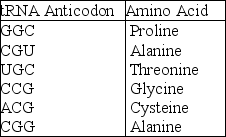 -The anticodon loop of the first tRNA that will complement this mRNA is
 (Multiple Choice)
4.8/5 (92)
(92) 
Filters
- Essay(0)
- Multiple Choice(0)
- Short Answer(0)
- True False(0)
- Matching(0)