



 Chat with AI
Exam 16: The Molecular Basis of Inheritance

Exam 1: Introduction: Evolution and Themes of Biology70 Questions
Exam 2: The Chemical Context of Life90 Questions
Exam 3: Water and Life80 Questions
Exam 4: Carbon and the Molecular Diversity of Life78 Questions
Exam 5: The Structure and Function of Large Biological Molecules117 Questions
Exam 6: A Tour of the Cell96 Questions
Exam 7: Membrane Structure and Function78 Questions
Exam 8: An Introduction to Metabolism88 Questions
Exam 9: Cellular Respiration and Fermentation117 Questions
Exam 10: Photosynthesis89 Questions
Exam 11: Cell Communication77 Questions
Exam 12: The Cell Cycle83 Questions
Exam 13: Meiosis and Sexual Life Cycles74 Questions
Exam 14: Mendel and the Gene Idea82 Questions
Exam 15: The Chromosomal Basis of Inheritance66 Questions
Exam 16: The Molecular Basis of Inheritance67 Questions
Exam 17: From Gene to Protein91 Questions
Exam 18: Regulation of Gene Expression107 Questions
Exam 19: Viruses53 Questions
Exam 20: Dna Tools and Biotechnology72 Questions
Exam 21: Genomes and Their Evolution52 Questions
Exam 22: Descent With Modification: a Darwinian View of Life63 Questions
Exam 23: The Evolution of Populations86 Questions
Exam 24: The Origin of Species71 Questions
Exam 25: The History of Life on Earth83 Questions
Exam 26: Phylogeny and the Tree of Life81 Questions
Exam 27: Bacteria and Archaea86 Questions
Exam 28: Protists84 Questions
Exam 29: Plant Diversity I: How Plants Colonized Land82 Questions
Exam 30: Plant Diversity Ii: the Evolution of Seed Plants110 Questions
Exam 31: Fungi97 Questions
Exam 32: An Overview of Animal Diversity82 Questions
Exam 33: An Introduction to Invertebrates101 Questions
Exam 34: The Origin and Evolution of Vertebrates117 Questions
Exam 35: Plant Structure, Growth, and Development75 Questions
Exam 36: Resource Acquisition and Transport in Vascular Plants89 Questions
Exam 37: Soil and Plant Nutrition91 Questions
Exam 38: Angiosperm Reproduction and Biotechnology94 Questions
Exam 39: Plant Responses to Internal and External Signals116 Questions
Exam 40: Basic Principles of Animal Form and Function86 Questions
Exam 41: Animal Nutrition73 Questions
Exam 42: Circulation and Gas Exchange100 Questions
Exam 43: The Immune System110 Questions
Exam 44: Osmoregulation and Excretion79 Questions
Exam 45: Hormones and the Endocrine System82 Questions
Exam 46: Animal Reproduction104 Questions
Exam 47: Animal Development98 Questions
Exam 48: Neurons, Synapses, and Signalling81 Questions
Exam 49: Nervous Systems73 Questions
Exam 50: Sensory and Motor Mechanisms91 Questions
Exam 51: Animal Behaviour79 Questions
Exam 52: An Introduction to Ecology and the Biosphere81 Questions
Exam 53: Population Ecology87 Questions
Exam 54: Community Ecology85 Questions
Exam 55: Ecosystems and Restoration Ecology89 Questions
Exam 56: Conservation Biology and Global Change75 Questions
Select questions type


After mixing a heat-killed, phosphorescent strain of bacteria with a living nonphosphorescent strain, you discover that some of the living cells are now phosphorescent. Which observations would provide the best evidence that the ability to fluoresce is a heritable trait?

Free
(Multiple Choice)
4.7/5  (71)
(71) Correct Answer: Verified
D
Which of the following represents the order of increasingly higher levels of organization of chromatin?
Free
(Multiple Choice)
4.9/5 (79)
(79) Correct Answer:Verified
VerifiedA
Which of the following help(s)to hold the DNA strands apart while they are being replicated?
Free
(Multiple Choice)
4.8/5 (80)
(80) Correct Answer:Verified
VerifiedD
What is meant by the description "antiparallel" regarding the strands that make up DNA?
(Multiple Choice)
4.8/5 (73)
(73) 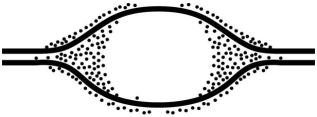 Grains represent radioactive material within the replicating eye.
-In an experiment, DNA is allowed to replicate in an environment with all necessary enzymes, dATP, dCTP, dGTP, and radioactively labeled dTTP (³H thymidine)for several minutes and then switched to nonradioactive medium. It is then viewed by electron microscopy and autoradiography. The figure above represents the results. Which of the following is the most likely interpretation?
Grains represent radioactive material within the replicating eye.
-In an experiment, DNA is allowed to replicate in an environment with all necessary enzymes, dATP, dCTP, dGTP, and radioactively labeled dTTP (³H thymidine)for several minutes and then switched to nonradioactive medium. It is then viewed by electron microscopy and autoradiography. The figure above represents the results. Which of the following is the most likely interpretation? (Multiple Choice)
4.8/5 (76)
(76) Which of the following investigator(s)was/were responsible for the following discovery? In DNA from any species, the amount of adenine equals the amount of thymine, and the amount of guanine equals the amount of cytosine.
(Multiple Choice)
4.7/5 (78)
(78) In analyzing the number of different bases in a DNA sample, which result would be consistent with the base-pairing rules?
(Multiple Choice)
4.8/5 (71)
(71) In trying to determine whether DNA or protein is the genetic material, Hershey and Chase made use of which of the following facts?
(Multiple Choice)
4.7/5 (76)
(76) The enzyme telomerase solves the problem of replication at the ends of linear chromosomes by which method?
(Multiple Choice)
4.7/5 (80)
(80) An Okazaki fragment has which of the following arrangements?
(Multiple Choice)
4.7/5 (70)
(70) You briefly expose bacteria undergoing DNA replication to radioactively labelled nucleotides. When you centrifuge the DNA isolated from the bacteria, the DNA separates into two classes. One class of labelled DNA includes very large molecules (thousands or even millions of nucleotides long), and the other includes short stretches of DNA (several hundred to a few thousand nucleotides in length). These two classes of DNA probably represent
(Multiple Choice)
4.9/5 (74)
(74) Suppose you are provided with an actively dividing culture of E. coli bacteria to which radioactive thymine has been added. What would happen if a cell replicates once in the presence of this radioactive base?
(Multiple Choice)
4.9/5 (82)
(82) One major difference in prokaryote replication versus eukaryote replication is
(Multiple Choice)
4.8/5 (70)
(70) In his transformation experiments, what did Griffith observe?
(Multiple Choice)
4.9/5 (78)
(78) To repair a thymine dimer by nucleotide excision repair, in which order do the necessary enzymes act?
(Multiple Choice)
4.9/5 (97)
(97) Use the following figure to answer the questions below.
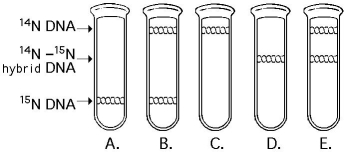 -In the late 1950s, Meselson and Stahl grew bacteria in a medium containing "heavy" nitrogen (¹⁵N)and then transferred them to a medium containing ¹⁴N. Which of the results in the figure above would be expected after one round of DNA replication in the presence of ¹⁴N?
 (Multiple Choice)
4.9/5 (77)
(77) 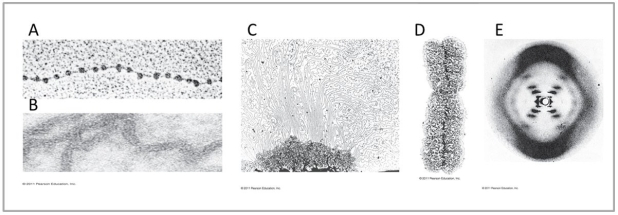 The images above are of DNA at various levels of coiling and folding. Use this image to answer the questions below.
-Which image shows scaffolding?
The images above are of DNA at various levels of coiling and folding. Use this image to answer the questions below.
-Which image shows scaffolding? (Multiple Choice)
4.8/5 (75)
(75) 
Filters
- Essay(0)
- Multiple Choice(0)
- Short Answer(0)
- True False(0)
- Matching(0)