



 Chat with AI
Exam 16: The Molecular Basis of Inheritance

Exam 1: Introduction: Evolution and Themes of Biology70 Questions
Exam 2: The Chemical Context of Life90 Questions
Exam 3: Water and Life80 Questions
Exam 4: Carbon and the Molecular Diversity of Life78 Questions
Exam 5: The Structure and Function of Large Biological Molecules117 Questions
Exam 6: A Tour of the Cell96 Questions
Exam 7: Membrane Structure and Function78 Questions
Exam 8: An Introduction to Metabolism88 Questions
Exam 9: Cellular Respiration and Fermentation117 Questions
Exam 10: Photosynthesis89 Questions
Exam 11: Cell Communication77 Questions
Exam 12: The Cell Cycle83 Questions
Exam 13: Meiosis and Sexual Life Cycles74 Questions
Exam 14: Mendel and the Gene Idea82 Questions
Exam 15: The Chromosomal Basis of Inheritance66 Questions
Exam 16: The Molecular Basis of Inheritance67 Questions
Exam 17: From Gene to Protein91 Questions
Exam 18: Regulation of Gene Expression107 Questions
Exam 19: Viruses53 Questions
Exam 20: Dna Tools and Biotechnology72 Questions
Exam 21: Genomes and Their Evolution52 Questions
Exam 22: Descent With Modification: a Darwinian View of Life63 Questions
Exam 23: The Evolution of Populations86 Questions
Exam 24: The Origin of Species71 Questions
Exam 25: The History of Life on Earth83 Questions
Exam 26: Phylogeny and the Tree of Life81 Questions
Exam 27: Bacteria and Archaea86 Questions
Exam 28: Protists84 Questions
Exam 29: Plant Diversity I: How Plants Colonized Land82 Questions
Exam 30: Plant Diversity Ii: the Evolution of Seed Plants110 Questions
Exam 31: Fungi97 Questions
Exam 32: An Overview of Animal Diversity82 Questions
Exam 33: An Introduction to Invertebrates101 Questions
Exam 34: The Origin and Evolution of Vertebrates117 Questions
Exam 35: Plant Structure, Growth, and Development75 Questions
Exam 36: Resource Acquisition and Transport in Vascular Plants89 Questions
Exam 37: Soil and Plant Nutrition91 Questions
Exam 38: Angiosperm Reproduction and Biotechnology94 Questions
Exam 39: Plant Responses to Internal and External Signals116 Questions
Exam 40: Basic Principles of Animal Form and Function86 Questions
Exam 41: Animal Nutrition73 Questions
Exam 42: Circulation and Gas Exchange100 Questions
Exam 43: The Immune System110 Questions
Exam 44: Osmoregulation and Excretion79 Questions
Exam 45: Hormones and the Endocrine System82 Questions
Exam 46: Animal Reproduction104 Questions
Exam 47: Animal Development98 Questions
Exam 48: Neurons, Synapses, and Signalling81 Questions
Exam 49: Nervous Systems73 Questions
Exam 50: Sensory and Motor Mechanisms91 Questions
Exam 51: Animal Behaviour79 Questions
Exam 52: An Introduction to Ecology and the Biosphere81 Questions
Exam 53: Population Ecology87 Questions
Exam 54: Community Ecology85 Questions
Exam 55: Ecosystems and Restoration Ecology89 Questions
Exam 56: Conservation Biology and Global Change75 Questions
Select questions type


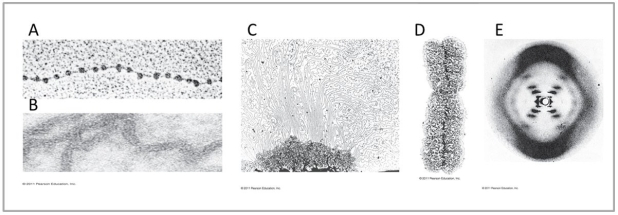 The images above are of DNA at various levels of coiling and folding. Use this image to answer the questions below.
-Which image represents the 10 nm fibre, showing nucleosomes?
The images above are of DNA at various levels of coiling and folding. Use this image to answer the questions below.
-Which image represents the 10 nm fibre, showing nucleosomes? (Multiple Choice)
4.8/5  (62)
(62) What is the basis for the difference in how the leading and lagging strands of DNA molecules are synthesized?
(Multiple Choice)
4.8/5 (79)
(79) E. coli cells grown on ¹⁵N medium are transferred to ¹⁴N medium and allowed to grow for two more generations (two rounds of DNA replication). DNA extracted from these cells is centrifuged. What density distribution of DNA would you expect in this experiment?
(Multiple Choice)
4.8/5 (77)
(77) Which of the enzymes removes the RNA nucleotides from the primer and adds equivalent DNA nucleotides to the 3' end of Okazaki fragments?
(Multiple Choice)
4.8/5 (85)
(85)
The images above are of DNA at various levels of coiling and folding. Use this image to answer the questions below.
-Which image represents the chromatid?
The images above are of DNA at various levels of coiling and folding. Use this image to answer the questions below.
-Which image represents the chromatid? (Multiple Choice)
4.7/5 (85)
(85) Once the pattern found after one round of replication was observed, Meselson and Stahl could be confident of which of the following conclusions?
(Multiple Choice)
4.8/5 (64)
(64) Individuals with the disorder xeroderma pigmentosum are hypersensitive to sunlight. This occurs because their cells are impaired in what way?
(Multiple Choice)
4.8/5 (64)
(64) Use the following figure to answer the questions below.
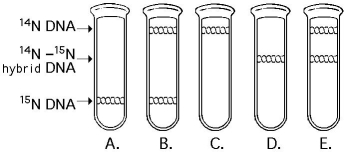 -A space probe returns with a culture of a microorganism found on a distant planet. Analysis shows that it is a carbon-based life form that has DNA. You grow the cells in ¹⁵N medium for several generations and then transfer them to ¹⁴N medium. Which pattern in the figure above would you expect if the DNA was replicated in a conservative manner?
 (Multiple Choice)
4.9/5 (76)
(76) In a linear eukaryotic chromatin sample, which of the following strands is looped into domains by scaffolding?
(Multiple Choice)
4.9/5 (76)
(76) The difference between ATP and the nucleoside triphosphates used during DNA synthesis is that
(Multiple Choice)
4.8/5 (83)
(83) Which of the following would you expect of a eukaryote lacking telomerase?
(Multiple Choice)
4.9/5 (94)
(94) It became apparent to Watson and Crick after completion of their model that the DNA molecule could carry a vast amount of hereditary information in which of the following?
(Multiple Choice)
4.9/5 (79)
(79) Use the following information to answer the questions below.
The green algae Chlamydomonas is said to be GC rich.
-The GC content of Chlamydomonas is approximately 70% in the coding sequences. What percentage of DNA is made up of adenine bases?
(Multiple Choice)
5.0/5 (74)
(74)
The images above are of DNA at various levels of coiling and folding. Use this image to answer the questions below.
-Which image represents the smallest level of DNA visualization?
The images above are of DNA at various levels of coiling and folding. Use this image to answer the questions below.
-Which image represents the smallest level of DNA visualization? (Multiple Choice)
4.9/5 (74)
(74) 
Filters
- Essay(0)
- Multiple Choice(0)
- Short Answer(0)
- True False(0)
- Matching(0)