



 Chat with AI
Exam 43: The Immune System

Exam 1: Introduction: Evolution and Themes of Biology70 Questions
Exam 2: The Chemical Context of Life90 Questions
Exam 3: Water and Life80 Questions
Exam 4: Carbon and the Molecular Diversity of Life78 Questions
Exam 5: The Structure and Function of Large Biological Molecules117 Questions
Exam 6: A Tour of the Cell96 Questions
Exam 7: Membrane Structure and Function78 Questions
Exam 8: An Introduction to Metabolism88 Questions
Exam 9: Cellular Respiration and Fermentation117 Questions
Exam 10: Photosynthesis89 Questions
Exam 11: Cell Communication77 Questions
Exam 12: The Cell Cycle83 Questions
Exam 13: Meiosis and Sexual Life Cycles74 Questions
Exam 14: Mendel and the Gene Idea82 Questions
Exam 15: The Chromosomal Basis of Inheritance66 Questions
Exam 16: The Molecular Basis of Inheritance67 Questions
Exam 17: From Gene to Protein91 Questions
Exam 18: Regulation of Gene Expression107 Questions
Exam 19: Viruses53 Questions
Exam 20: Dna Tools and Biotechnology72 Questions
Exam 21: Genomes and Their Evolution52 Questions
Exam 22: Descent With Modification: a Darwinian View of Life63 Questions
Exam 23: The Evolution of Populations86 Questions
Exam 24: The Origin of Species71 Questions
Exam 25: The History of Life on Earth83 Questions
Exam 26: Phylogeny and the Tree of Life81 Questions
Exam 27: Bacteria and Archaea86 Questions
Exam 28: Protists84 Questions
Exam 29: Plant Diversity I: How Plants Colonized Land82 Questions
Exam 30: Plant Diversity Ii: the Evolution of Seed Plants110 Questions
Exam 31: Fungi97 Questions
Exam 32: An Overview of Animal Diversity82 Questions
Exam 33: An Introduction to Invertebrates101 Questions
Exam 34: The Origin and Evolution of Vertebrates117 Questions
Exam 35: Plant Structure, Growth, and Development75 Questions
Exam 36: Resource Acquisition and Transport in Vascular Plants89 Questions
Exam 37: Soil and Plant Nutrition91 Questions
Exam 38: Angiosperm Reproduction and Biotechnology94 Questions
Exam 39: Plant Responses to Internal and External Signals116 Questions
Exam 40: Basic Principles of Animal Form and Function86 Questions
Exam 41: Animal Nutrition73 Questions
Exam 42: Circulation and Gas Exchange100 Questions
Exam 43: The Immune System110 Questions
Exam 44: Osmoregulation and Excretion79 Questions
Exam 45: Hormones and the Endocrine System82 Questions
Exam 46: Animal Reproduction104 Questions
Exam 47: Animal Development98 Questions
Exam 48: Neurons, Synapses, and Signalling81 Questions
Exam 49: Nervous Systems73 Questions
Exam 50: Sensory and Motor Mechanisms91 Questions
Exam 51: Animal Behaviour79 Questions
Exam 52: An Introduction to Ecology and the Biosphere81 Questions
Exam 53: Population Ecology87 Questions
Exam 54: Community Ecology85 Questions
Exam 55: Ecosystems and Restoration Ecology89 Questions
Exam 56: Conservation Biology and Global Change75 Questions
Select questions type


In some insects, such as Drosophila, fungal cell wall elements can activate the protein Toll, which
(Multiple Choice)
4.8/5  (82)
(82) A fruit fly, internally infected by a potentially pathogenic fungus, is protected by
(Multiple Choice)
4.8/5 (70)
(70) Several strains of the human papillomavirus (HPV)can cause cervical cancer in some women. In 2006, a vaccine against several of the cancer-causing HPV strains was released. If a mutation occurs in the virus resulting in antigenic variation, the vaccine may no longer be effective because
(Multiple Choice)
4.8/5 (68)
(68) Which of the following should be the same in identical twins?
(Multiple Choice)
5.0/5 (77)
(77) The ability of some viruses to remain inactive (latent)for a period of time is exemplified by
(Multiple Choice)
4.9/5 (78)
(78) The cells involved in innate immunity, whose absence increases the chances of developing malignant tumours, are
(Multiple Choice)
4.9/5 (85)
(85) A patient complaining of watery, itchy eyes and sneezing after being given a flower bouquet as a birthday gift should first be treated with
(Multiple Choice)
4.9/5 (87)
(87) A cell type that interacts with both the humoral and cell-mediated immune pathways is a
(Multiple Choice)
4.8/5 (70)
(70) Antibodies of the different classes IgM, IgG, IgA, IgD, and IgE differ from each other
(Multiple Choice)
4.7/5 (84)
(84) A patient who has a parasitic worm infection and another patient responding to an allergen such as ragweed pollen have which of the following in common?
(Multiple Choice)
4.8/5 (77)
(77) Bacterial infection in a previously uninfected house cat would most quickly activate its
(Multiple Choice)
4.9/5 (76)
(76) Which of the following cells are involved in cell-mediated immunity and also respond to class I MHC molecule-antigen complexes?
(Multiple Choice)
4.9/5 (87)
(87) Use the following graph to answer the questions below.
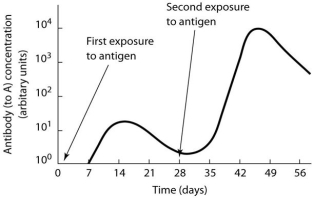 -According to the graph, naive B cells will produce effector cells
 (Multiple Choice)
4.7/5 (72)
(72) Use the following information to answer the next few questions.
In a famous study, women were asked to smell and rate the attractiveness of axillary odours on t-shirts worn by different men. Results showed that ovulating women preferred the odour of the t-shirts worn by MHC (major histocompatibility complex) dissimilar men. This indicates that dissimilarity in MHC may play a role in mate selection.
-The purpose of an MHC molecule is to
(Multiple Choice)
4.9/5 (68)
(68) An invertebrate, such as an insect, has innate immunity activity in its intestine that likely includes
(Multiple Choice)
4.8/5 (87)
(87) An immune response to a tissue graft will differ from an immune response to a bacterium because
(Multiple Choice)
4.7/5 (75)
(75) 
Filters
- Essay(0)
- Multiple Choice(0)
- Short Answer(0)
- True False(0)
- Matching(0)