



 Chat with AI
Exam 37: Soil and Plant Nutrition

Exam 1: Introduction: Evolution and Themes of Biology70 Questions
Exam 2: The Chemical Context of Life90 Questions
Exam 3: Water and Life80 Questions
Exam 4: Carbon and the Molecular Diversity of Life78 Questions
Exam 5: The Structure and Function of Large Biological Molecules117 Questions
Exam 6: A Tour of the Cell96 Questions
Exam 7: Membrane Structure and Function78 Questions
Exam 8: An Introduction to Metabolism88 Questions
Exam 9: Cellular Respiration and Fermentation117 Questions
Exam 10: Photosynthesis89 Questions
Exam 11: Cell Communication77 Questions
Exam 12: The Cell Cycle83 Questions
Exam 13: Meiosis and Sexual Life Cycles74 Questions
Exam 14: Mendel and the Gene Idea82 Questions
Exam 15: The Chromosomal Basis of Inheritance66 Questions
Exam 16: The Molecular Basis of Inheritance67 Questions
Exam 17: From Gene to Protein91 Questions
Exam 18: Regulation of Gene Expression107 Questions
Exam 19: Viruses53 Questions
Exam 20: Dna Tools and Biotechnology72 Questions
Exam 21: Genomes and Their Evolution52 Questions
Exam 22: Descent With Modification: a Darwinian View of Life63 Questions
Exam 23: The Evolution of Populations86 Questions
Exam 24: The Origin of Species71 Questions
Exam 25: The History of Life on Earth83 Questions
Exam 26: Phylogeny and the Tree of Life81 Questions
Exam 27: Bacteria and Archaea86 Questions
Exam 28: Protists84 Questions
Exam 29: Plant Diversity I: How Plants Colonized Land82 Questions
Exam 30: Plant Diversity Ii: the Evolution of Seed Plants110 Questions
Exam 31: Fungi97 Questions
Exam 32: An Overview of Animal Diversity82 Questions
Exam 33: An Introduction to Invertebrates101 Questions
Exam 34: The Origin and Evolution of Vertebrates117 Questions
Exam 35: Plant Structure, Growth, and Development75 Questions
Exam 36: Resource Acquisition and Transport in Vascular Plants89 Questions
Exam 37: Soil and Plant Nutrition91 Questions
Exam 38: Angiosperm Reproduction and Biotechnology94 Questions
Exam 39: Plant Responses to Internal and External Signals116 Questions
Exam 40: Basic Principles of Animal Form and Function86 Questions
Exam 41: Animal Nutrition73 Questions
Exam 42: Circulation and Gas Exchange100 Questions
Exam 43: The Immune System110 Questions
Exam 44: Osmoregulation and Excretion79 Questions
Exam 45: Hormones and the Endocrine System82 Questions
Exam 46: Animal Reproduction104 Questions
Exam 47: Animal Development98 Questions
Exam 48: Neurons, Synapses, and Signalling81 Questions
Exam 49: Nervous Systems73 Questions
Exam 50: Sensory and Motor Mechanisms91 Questions
Exam 51: Animal Behaviour79 Questions
Exam 52: An Introduction to Ecology and the Biosphere81 Questions
Exam 53: Population Ecology87 Questions
Exam 54: Community Ecology85 Questions
Exam 55: Ecosystems and Restoration Ecology89 Questions
Exam 56: Conservation Biology and Global Change75 Questions
Select questions type


Which of the following best describes the general role of micronutrients in plants?
(Multiple Choice)
4.9/5  (85)
(85) Which of the following soil minerals is most likely leached away during a hard rain?
(Multiple Choice)
4.8/5 (76)
(76) A soil well suited for the growth of most plants would have all of the following properties except
(Multiple Choice)
4.8/5 (77)
(77) A researcher analyzes the mineral content of a particular grass and is surprised to find substantial levels of uranium in both leaf and root tissues. The most likely explanation for this finding is that
(Multiple Choice)
4.8/5 (72)
(72) Which soil type or habitat would be least likely to have high populations of mycorrhizae?
(Multiple Choice)
4.7/5 (88)
(88) If you wanted to increase the cation exchange and water retention capacity of loamy soil, what should you do?
(Multiple Choice)
4.8/5 (79)
(79) For this pair of items, choose the option that best describes their relationship. I. the amount of molybdenum in a gram of dried plant material
II. the amount of sulphur in a gram of dried plant material
(Multiple Choice)
4.9/5 (72)
(72) A greenhouse experiment to test growth rates in tomato cultivars was conducted using sterile soil mix and watering with sterile solutions of water and fertilizer. Following germination, half of the plants in each group were transplanted into soil that was obtained from a nearby agricultural field (nonsterile), the other half into sterile soil. After several weeks the plants that were transplanted into nonsterile soil exhibited a much higher growth rate compared to the plants transplanted into sterile soil. The most likely explanation for this result is
(Multiple Choice)
4.7/5 (75)
(75) In west Texas, cotton has become an important crop in the last several decades. However, in this hot, dry part of the country there is little rainfall, so farmers irrigate their cotton fields. They must also regularly fertilize the cotton fields because the soil is very sandy. The figure below shows the record of annual productivity (measured in kilograms of cotton per hectare of land) since 1960 in a west Texas cotton field. Use these data to answer the following questions.
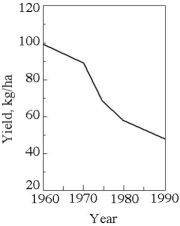 -Based on the information provided in the above figure, what is the most likely cause of the decline in productivity?
 (Multiple Choice)
4.8/5 (72)
(72) Which of the following is a true statement about nitrogen fixation in root nodules?
(Multiple Choice)
4.8/5 (67)
(67) Hyphae form a covering over roots. These hyphae create a large surface area that helps to do which of the following?
(Multiple Choice)
4.9/5 (99)
(99) A woodlot was sprayed with a fungicide. What would be the most serious effect of such spraying?
(Multiple Choice)
4.9/5 (87)
(87) Which of the following is not true of micronutrients in plants?
(Multiple Choice)
4.8/5 (77)
(77) Reddish-purple colouring of leaves, especially along the margins of young leaves, is a typical symptom of deficiency of which element?
(Multiple Choice)
4.7/5 (74)
(74) An example of a mutualistic association between a plant and a fungus would be
(Multiple Choice)
4.9/5 (73)
(73) Carnivorous plants have evolved mechanisms that trap and digest small animals. The products of this digestion are used to supplement the plant's supply of
(Multiple Choice)
5.0/5 (55)
(55) Dwarf mistletoe grows on many pine trees in the Rockies. Although the mistletoe is green, it is probably not sufficiently active in photosynthesis to produce all the sugar it needs. The mistletoe also produces haustoria. Thus, dwarf mistletoe growing on pine trees is best classified as
(Multiple Choice)
5.0/5 (75)
(75) 
Filters
- Essay(0)
- Multiple Choice(0)
- Short Answer(0)
- True False(0)
- Matching(0)