



 Chat with AI
Exam 37: Soil and Plant Nutrition

Exam 1: Introduction: Evolution and Themes of Biology70 Questions
Exam 2: The Chemical Context of Life90 Questions
Exam 3: Water and Life80 Questions
Exam 4: Carbon and the Molecular Diversity of Life78 Questions
Exam 5: The Structure and Function of Large Biological Molecules117 Questions
Exam 6: A Tour of the Cell96 Questions
Exam 7: Membrane Structure and Function78 Questions
Exam 8: An Introduction to Metabolism88 Questions
Exam 9: Cellular Respiration and Fermentation117 Questions
Exam 10: Photosynthesis89 Questions
Exam 11: Cell Communication77 Questions
Exam 12: The Cell Cycle83 Questions
Exam 13: Meiosis and Sexual Life Cycles74 Questions
Exam 14: Mendel and the Gene Idea82 Questions
Exam 15: The Chromosomal Basis of Inheritance66 Questions
Exam 16: The Molecular Basis of Inheritance67 Questions
Exam 17: From Gene to Protein91 Questions
Exam 18: Regulation of Gene Expression107 Questions
Exam 19: Viruses53 Questions
Exam 20: Dna Tools and Biotechnology72 Questions
Exam 21: Genomes and Their Evolution52 Questions
Exam 22: Descent With Modification: a Darwinian View of Life63 Questions
Exam 23: The Evolution of Populations86 Questions
Exam 24: The Origin of Species71 Questions
Exam 25: The History of Life on Earth83 Questions
Exam 26: Phylogeny and the Tree of Life81 Questions
Exam 27: Bacteria and Archaea86 Questions
Exam 28: Protists84 Questions
Exam 29: Plant Diversity I: How Plants Colonized Land82 Questions
Exam 30: Plant Diversity Ii: the Evolution of Seed Plants110 Questions
Exam 31: Fungi97 Questions
Exam 32: An Overview of Animal Diversity82 Questions
Exam 33: An Introduction to Invertebrates101 Questions
Exam 34: The Origin and Evolution of Vertebrates117 Questions
Exam 35: Plant Structure, Growth, and Development75 Questions
Exam 36: Resource Acquisition and Transport in Vascular Plants89 Questions
Exam 37: Soil and Plant Nutrition91 Questions
Exam 38: Angiosperm Reproduction and Biotechnology94 Questions
Exam 39: Plant Responses to Internal and External Signals116 Questions
Exam 40: Basic Principles of Animal Form and Function86 Questions
Exam 41: Animal Nutrition73 Questions
Exam 42: Circulation and Gas Exchange100 Questions
Exam 43: The Immune System110 Questions
Exam 44: Osmoregulation and Excretion79 Questions
Exam 45: Hormones and the Endocrine System82 Questions
Exam 46: Animal Reproduction104 Questions
Exam 47: Animal Development98 Questions
Exam 48: Neurons, Synapses, and Signalling81 Questions
Exam 49: Nervous Systems73 Questions
Exam 50: Sensory and Motor Mechanisms91 Questions
Exam 51: Animal Behaviour79 Questions
Exam 52: An Introduction to Ecology and the Biosphere81 Questions
Exam 53: Population Ecology87 Questions
Exam 54: Community Ecology85 Questions
Exam 55: Ecosystems and Restoration Ecology89 Questions
Exam 56: Conservation Biology and Global Change75 Questions
Select questions type


In west Texas, cotton has become an important crop in the last several decades. However, in this hot, dry part of the country there is little rainfall, so farmers irrigate their cotton fields. They must also regularly fertilize the cotton fields because the soil is very sandy. The figure below shows the record of annual productivity (measured in kilograms of cotton per hectare of land) since 1960 in a west Texas cotton field. Use these data to answer the following questions.
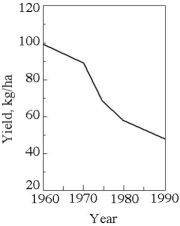 -If you were the county agriculture agent, what would be the best advice you could give the farmer who owns the field under study in the above figure?
 (Multiple Choice)
4.9/5  (75)
(75) Which two elements make up more than 90% of the dry weight of plants?
(Multiple Choice)
4.8/5 (79)
(79) If an African violet has chlorosis, which of the following elements might be a useful addition to the soil?
(Multiple Choice)
4.9/5 (74)
(74) Which of the following, if used as a fertilizer, would be most immediately available for plant uptake?
(Multiple Choice)
4.8/5 (72)
(72) Which of the following elements is incorrectly paired with its function in a plant?
(Multiple Choice)
5.0/5 (74)
(74) Which of the following habitats would most likely have a high proportion of species of plants that are in symbiotic association with nitrogen-fixing bacteria?
(Multiple Choice)
4.8/5 (65)
(65) In what way do nitrogen compounds differ from other minerals needed by plants?
(Multiple Choice)
4.9/5 (74)
(74) Synthesis of which of the following compounds in a mature leaf would be least impacted by a temporary soil nitrogen deficiency?
(Multiple Choice)
4.8/5 (77)
(77) Two groups of tomatoes were grown under laboratory conditions, one with humus added to the soil and one a control without humus. The leaves of the plants grown without humus were yellowish (less green)compared with those of the plants grown in humus-enriched soil. The best explanation for this difference is that
(Multiple Choice)
4.9/5 (88)
(88) Which of the following essential nutrients plays an essential role in the opening and closing of the stomatal aperture?
(Multiple Choice)
4.9/5 (80)
(80) All of the following contributed to the dust bowl in the American southwest during the 1930s except
(Multiple Choice)
4.8/5 (68)
(68) How would you determine if certain minerals are essential for plant growth?
(Multiple Choice)
4.9/5 (84)
(84) In the 1640s, Jan Baptista van Helmont planted a small willow in a pot that contained 90.9 kg of soil. After five years, the plant weighed 76.8 kg, but only 0.06 kg of soil had disappeared from the pot. What did van Helmont conclude from this experiment?
(Multiple Choice)
4.9/5 (102)
(102) A group of 10 tomato plants are germinated and maintained in a large tray with no drainage. After several weeks they all begin to wilt and die despite repeated watering and fertilization. The most likely cause of this die-off is
(Multiple Choice)
4.9/5 (85)
(85) Rhizobacteria aid plant growth in all the following ways, except
(Multiple Choice)
4.9/5 (81)
(81) Which of the following elements, if increased in concentration, would increase the stability of cell walls?
(Multiple Choice)
4.9/5 (74)
(74) 
Filters
- Essay(0)
- Multiple Choice(0)
- Short Answer(0)
- True False(0)
- Matching(0)