



 Chat with AI
Exam 34: The Origin and Evolution of Vertebrates

Exam 1: Introduction: Evolution and Themes of Biology70 Questions
Exam 2: The Chemical Context of Life90 Questions
Exam 3: Water and Life80 Questions
Exam 4: Carbon and the Molecular Diversity of Life78 Questions
Exam 5: The Structure and Function of Large Biological Molecules117 Questions
Exam 6: A Tour of the Cell96 Questions
Exam 7: Membrane Structure and Function78 Questions
Exam 8: An Introduction to Metabolism88 Questions
Exam 9: Cellular Respiration and Fermentation117 Questions
Exam 10: Photosynthesis89 Questions
Exam 11: Cell Communication77 Questions
Exam 12: The Cell Cycle83 Questions
Exam 13: Meiosis and Sexual Life Cycles74 Questions
Exam 14: Mendel and the Gene Idea82 Questions
Exam 15: The Chromosomal Basis of Inheritance66 Questions
Exam 16: The Molecular Basis of Inheritance67 Questions
Exam 17: From Gene to Protein91 Questions
Exam 18: Regulation of Gene Expression107 Questions
Exam 19: Viruses53 Questions
Exam 20: Dna Tools and Biotechnology72 Questions
Exam 21: Genomes and Their Evolution52 Questions
Exam 22: Descent With Modification: a Darwinian View of Life63 Questions
Exam 23: The Evolution of Populations86 Questions
Exam 24: The Origin of Species71 Questions
Exam 25: The History of Life on Earth83 Questions
Exam 26: Phylogeny and the Tree of Life81 Questions
Exam 27: Bacteria and Archaea86 Questions
Exam 28: Protists84 Questions
Exam 29: Plant Diversity I: How Plants Colonized Land82 Questions
Exam 30: Plant Diversity Ii: the Evolution of Seed Plants110 Questions
Exam 31: Fungi97 Questions
Exam 32: An Overview of Animal Diversity82 Questions
Exam 33: An Introduction to Invertebrates101 Questions
Exam 34: The Origin and Evolution of Vertebrates117 Questions
Exam 35: Plant Structure, Growth, and Development75 Questions
Exam 36: Resource Acquisition and Transport in Vascular Plants89 Questions
Exam 37: Soil and Plant Nutrition91 Questions
Exam 38: Angiosperm Reproduction and Biotechnology94 Questions
Exam 39: Plant Responses to Internal and External Signals116 Questions
Exam 40: Basic Principles of Animal Form and Function86 Questions
Exam 41: Animal Nutrition73 Questions
Exam 42: Circulation and Gas Exchange100 Questions
Exam 43: The Immune System110 Questions
Exam 44: Osmoregulation and Excretion79 Questions
Exam 45: Hormones and the Endocrine System82 Questions
Exam 46: Animal Reproduction104 Questions
Exam 47: Animal Development98 Questions
Exam 48: Neurons, Synapses, and Signalling81 Questions
Exam 49: Nervous Systems73 Questions
Exam 50: Sensory and Motor Mechanisms91 Questions
Exam 51: Animal Behaviour79 Questions
Exam 52: An Introduction to Ecology and the Biosphere81 Questions
Exam 53: Population Ecology87 Questions
Exam 54: Community Ecology85 Questions
Exam 55: Ecosystems and Restoration Ecology89 Questions
Exam 56: Conservation Biology and Global Change75 Questions
Select questions type


At 5, 10, and 15 hours in the graph below, which of the following statements should be true? 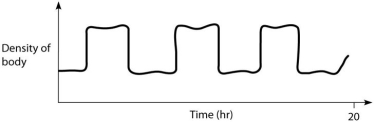
(Multiple Choice)
4.8/5  (81)
(81) Which of the following represents the strongest evidence that two of the three middle ear bones of mammals are homologous to certain reptilian jawbones?
(Multiple Choice)
4.8/5 (84)
(84) What is a key factor in the evolution of jaws that led to the diversification of vertebrates?
(Multiple Choice)
4.8/5 (74)
(74) The lamprey species whose larvae live in freshwater streams, but whose adults live most of their lives in sea water, are similar in this respect to certain species of
(Multiple Choice)
4.9/5 (62)
(62) Regarding its position in the water column, the same thing that happens to a shark when it stops swimming also happens to a
(Multiple Choice)
4.9/5 (73)
(73) Which of the following is the most inclusive (most general)group, all of whose members have foramina magna centrally positioned in the base of the cranium?
(Multiple Choice)
4.9/5 (73)
(73) Which of the following is the most inclusive (most general)group, all of whose members have fully opposable thumbs?
(Multiple Choice)
4.8/5 (82)
(82) Which of the following is characteristic of most extant reptiles and most extant mammals?
(Multiple Choice)
4.9/5 (67)
(67) Which of the following is not considered an adaptation that benefits flight in birds?
(Multiple Choice)
4.9/5 (69)
(69) Which of the following are the only extant animals that descended directly from dinosaurs?
(Multiple Choice)
4.9/5 (85)
(85) The following questions refer to the description below.
Terry catches a ray-finned fish from the ocean and notices that attached to its flank is an equally long, snakelike organism. The attached organism has no external segmentation, no scales, a round mouth surrounded by a sucker, and two small eyes. Terry thinks it might be a marine leech, a hagfish, or a lamprey.
-The snakelike organism turned out to be a hagfish. Consequently, why should Terry throw the fish to which the hagfish was attached overboard, rather than having it for dinner?
(Multiple Choice)
4.8/5 (66)
(66) Which of these species is currently thought to have coexisted (at the same time and places)with H. neanderthalensis?
(Multiple Choice)
4.8/5 (91)
(91) Which of these traits is most strongly associated with the adoption of bipedalism?
(Multiple Choice)
4.8/5 (68)
(68) The following questions refer to the phylogenetic tree shown below.
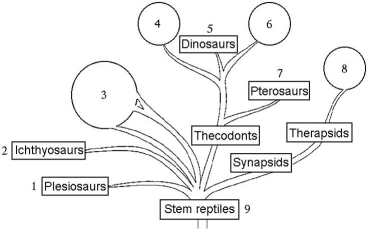 -Which number represents the birds?
 (Multiple Choice)
4.9/5 (74)
(74) In coelacanths, a swim bladder is present, but the swim bladder is full of adipose tissue (fat), which is there on a fairly permanent basis. If such a swim bladder is used by coelacanths to affect buoyancy, then it does so in much the same way as does the
(Multiple Choice)
4.7/5 (84)
(84) When a shark stops swimming, it does which of the following? 1. sinks
2. quickly dies
3. oxygenates its blood less effectively
(Multiple Choice)
4.8/5 (72)
(72) The following questions refer to the description below.
Terry catches a ray-finned fish from the ocean and notices that attached to its flank is an equally long, snakelike organism. The attached organism has no external segmentation, no scales, a round mouth surrounded by a sucker, and two small eyes. Terry thinks it might be a marine leech, a hagfish, or a lamprey.
-Terry detaches the snakelike organism from the fish and uses a knife to cut off its head. In doing so, its brain slides out onto the deck of the boat. Terry peers into the cut end of the head and notices that the brain had lain in a sort of panlike structure that only partially surrounded the brain. What is the structure Terry is observing, and what is it made of?
(Multiple Choice)
4.8/5 (79)
(79) A team of researchers has developed a poison that has proven effective against lamprey larvae in freshwater cultures. The poison is ingested and causes paralysis by detaching segmental muscles from the skeletal elements. The team wants to test the poison's effectiveness in streams feeding Lake Michigan, but one critic worries about potential effects on lancelets, which are similar to lampreys in many ways. Why is this concern misplaced?
(Multiple Choice)
4.7/5 (83)
(83) Some animals that lived 530 million years ago resembled lancelets but had a brain and a skull. These animals may represent
(Multiple Choice)
5.0/5 (81)
(81) 
Filters
- Essay(0)
- Multiple Choice(0)
- Short Answer(0)
- True False(0)
- Matching(0)