



 Chat with AI
Exam 34: The Origin and Evolution of Vertebrates

Exam 1: Introduction: Evolution and Themes of Biology70 Questions
Exam 2: The Chemical Context of Life90 Questions
Exam 3: Water and Life80 Questions
Exam 4: Carbon and the Molecular Diversity of Life78 Questions
Exam 5: The Structure and Function of Large Biological Molecules117 Questions
Exam 6: A Tour of the Cell96 Questions
Exam 7: Membrane Structure and Function78 Questions
Exam 8: An Introduction to Metabolism88 Questions
Exam 9: Cellular Respiration and Fermentation117 Questions
Exam 10: Photosynthesis89 Questions
Exam 11: Cell Communication77 Questions
Exam 12: The Cell Cycle83 Questions
Exam 13: Meiosis and Sexual Life Cycles74 Questions
Exam 14: Mendel and the Gene Idea82 Questions
Exam 15: The Chromosomal Basis of Inheritance66 Questions
Exam 16: The Molecular Basis of Inheritance67 Questions
Exam 17: From Gene to Protein91 Questions
Exam 18: Regulation of Gene Expression107 Questions
Exam 19: Viruses53 Questions
Exam 20: Dna Tools and Biotechnology72 Questions
Exam 21: Genomes and Their Evolution52 Questions
Exam 22: Descent With Modification: a Darwinian View of Life63 Questions
Exam 23: The Evolution of Populations86 Questions
Exam 24: The Origin of Species71 Questions
Exam 25: The History of Life on Earth83 Questions
Exam 26: Phylogeny and the Tree of Life81 Questions
Exam 27: Bacteria and Archaea86 Questions
Exam 28: Protists84 Questions
Exam 29: Plant Diversity I: How Plants Colonized Land82 Questions
Exam 30: Plant Diversity Ii: the Evolution of Seed Plants110 Questions
Exam 31: Fungi97 Questions
Exam 32: An Overview of Animal Diversity82 Questions
Exam 33: An Introduction to Invertebrates101 Questions
Exam 34: The Origin and Evolution of Vertebrates117 Questions
Exam 35: Plant Structure, Growth, and Development75 Questions
Exam 36: Resource Acquisition and Transport in Vascular Plants89 Questions
Exam 37: Soil and Plant Nutrition91 Questions
Exam 38: Angiosperm Reproduction and Biotechnology94 Questions
Exam 39: Plant Responses to Internal and External Signals116 Questions
Exam 40: Basic Principles of Animal Form and Function86 Questions
Exam 41: Animal Nutrition73 Questions
Exam 42: Circulation and Gas Exchange100 Questions
Exam 43: The Immune System110 Questions
Exam 44: Osmoregulation and Excretion79 Questions
Exam 45: Hormones and the Endocrine System82 Questions
Exam 46: Animal Reproduction104 Questions
Exam 47: Animal Development98 Questions
Exam 48: Neurons, Synapses, and Signalling81 Questions
Exam 49: Nervous Systems73 Questions
Exam 50: Sensory and Motor Mechanisms91 Questions
Exam 51: Animal Behaviour79 Questions
Exam 52: An Introduction to Ecology and the Biosphere81 Questions
Exam 53: Population Ecology87 Questions
Exam 54: Community Ecology85 Questions
Exam 55: Ecosystems and Restoration Ecology89 Questions
Exam 56: Conservation Biology and Global Change75 Questions
Select questions type


The following questions refer to the phylogenetic tree shown below.
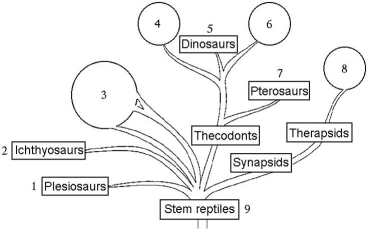 -Whose DNA would have had the most sequence homologies with amphibian DNA?
 (Multiple Choice)
4.8/5  (85)
(85) Which graph below best represents the way that density changes over time in a physoclistus fish and in a physostomus fish, respectively?
(Multiple Choice)
4.9/5 (83)
(83) For the following items, match the extant vertebrate groups with the descriptions.
-Internal fertilization, leathery amniotic egg, and skin that resists drying are characteristics of
(Multiple Choice)
4.7/5 (97)
(97) Use the following information to answer the questions below.
Due to its system of nine air sacs connected to the lungs, the respiratory system of birds is arguably the most effective respiratory system of all air-breathers. Upon inhalation, air first flows into posterior air sacs, then into the lungs, and then into anterior air sacs on the way to being exhaled. Thus, there is one-way flow of air through the lungs, along thousands of tubules called parabronchi.
-Birds generate a lot of heat, especially during flight. Yet the adipose tissue under their skin and the feathers atop their skin make it difficult to eliminate excess heat across the skin. Which of the following alternatives can absorb body heat and eliminate it from the bird most effectively?
(Multiple Choice)
4.7/5 (75)
(75) Which group's members have had both lungs and gills during their adult lives?
(Multiple Choice)
5.0/5 (63)
(63) Why is the discovery of the fossil Archaeopteryx significant? It supports the
(Multiple Choice)
4.9/5 (74)
(74) The following questions refer to the description below.
While on an intersession course in tropical ecology, Kris pulls a large, snakelike organism from a burrow (the class was granted a collecting permit). The 1-metre-long organism has smooth skin, which appears to be segmented. It has two tiny eyes that are hard to see because they seem to be covered by skin. Kris brings it back to the lab at the field station, where it is a source of puzzlement to the class. Kris says that it is a giant oligochaete worm; Shaun suggests it is a legless amphibian; Kelly proposes it belongs to a snake species that is purely fossorial (lives in a burrow).
-The class decided to humanely euthanize the organism and subsequently dissect it. Having decided that it was probably not a reptile, two of their original hypotheses regarding its identity remained. Which of the following, if observed, should help them arrive at a conclusive answer?
(Multiple Choice)
5.0/5 (70)
(70) Why is the amniotic egg considered an important evolutionary breakthrough?
(Multiple Choice)
4.9/5 (82)
(82) In the United States and Canada, bats use one of two strategies to survive winter: They either migrate south, or they hibernate. Recently, those that hibernate seem to have come under attack by a fungus, Geomyces destructans (Gd), an attack that is occurring from Missouri to southern Canada. Many infected bats have a delicate, white filamentous mat on their muzzles, which is referred to as white-nose syndrome (WNS). The fungus invades the bat tissues, causes discomfort, and awakens the bat from its hibernation. The bat fidgets and wastes calories, using up its stored fat. The bat then behaves abnormally, leaving its cave during daytime in winter to search for food. Their food, primarily insects, is scarce during the winter, and the bats ultimately starve to death. Since 2007, it is estimated that up to 1 million bats have perished from WNS.
-Gd is a cold-loving fungus. Thus, which characteristics of normal bat behaviour can be most expected to favour the spread of this fungus to uninfected bats?
(Multiple Choice)
4.8/5 (94)
(94) The following questions refer to the description below.
While on an intersession course in tropical ecology, Kris pulls a large, snakelike organism from a burrow (the class was granted a collecting permit). The 1-metre-long organism has smooth skin, which appears to be segmented. It has two tiny eyes that are hard to see because they seem to be covered by skin. Kris brings it back to the lab at the field station, where it is a source of puzzlement to the class. Kris says that it is a giant oligochaete worm; Shaun suggests it is a legless amphibian; Kelly proposes it belongs to a snake species that is purely fossorial (lives in a burrow).
-The organism was found to have two lungs, but the left lung was much smaller than the right lung. Kelly added that the herpetology instructor had said that in most snakes, the same condition exists. If the size difference between the lungs in this organism is not a shared ancestral characteristic with its occurrence in snakes, then its existence in this organism is explained as which of the following? 1. a result of convergent evolution
2. an example of homologous structures
3. a similar adaptation to a shared lifestyle or body plan
4. a result of having identical Hox genes
5. a homoplasy
(Multiple Choice)
4.9/5 (64)
(64) The following questions refer to the description below.
Terry catches a ray-finned fish from the ocean and notices that attached to its flank is an equally long, snakelike organism. The attached organism has no external segmentation, no scales, a round mouth surrounded by a sucker, and two small eyes. Terry thinks it might be a marine leech, a hagfish, or a lamprey.
-Which feature excludes the organism from possibly being a leech?
(Multiple Choice)
4.9/5 (89)
(89) A new species of aquatic chordate is discovered that closely resembles an ancient form. It has the following characteristics: external armour of bony plates, no paired lateral fins, and a suspension-feeding mode of nutrition. In addition to these, it will probably have which of the following characteristics?
(Multiple Choice)
4.8/5 (91)
(91) Among extant vertebrates, a sheet of muscle called the diaphragm is found in
(Multiple Choice)
4.9/5 (81)
(81) Almost all North American bats are insectivores, with one notable exception being a bat that bites and then laps blood from the wound. The blood-lapping bats are limited to the warm, southwestern United States. Thus, if WNS continues to decimate bat populations in the United States and Canada, then we can expect
(Multiple Choice)
4.8/5 (76)
(76) How many of the following statements about craniates is (are)correct? 1. Craniates are more highly cephalized than are noncraniates.
2. Craniates' genomic evolution includes duplication of clusters of genes that code for transcription factors.
3. The craniate clade is synonymous with the vertebrate clade.
4. Pharyngeal slits that play important roles in gas exchange originated in craniates.
5. The two-chambered heart originated with the early craniates.
(Multiple Choice)
5.0/5 (76)
(76) Which of these species was the first to have been adapted for long-distance bipedalism?
(Multiple Choice)
5.0/5 (79)
(79) With which of the following statements would a biologist be most inclined to agree?
(Multiple Choice)
4.8/5 (84)
(84) Which of these statements accurately describes a similarity between sharks and ray-finned fishes?
(Multiple Choice)
4.8/5 (90)
(90) 
Filters
- Essay(0)
- Multiple Choice(0)
- Short Answer(0)
- True False(0)
- Matching(0)