



 Chat with AI
Exam 31: Fungi

Exam 1: Introduction: Evolution and Themes of Biology70 Questions
Exam 2: The Chemical Context of Life90 Questions
Exam 3: Water and Life80 Questions
Exam 4: Carbon and the Molecular Diversity of Life78 Questions
Exam 5: The Structure and Function of Large Biological Molecules117 Questions
Exam 6: A Tour of the Cell96 Questions
Exam 7: Membrane Structure and Function78 Questions
Exam 8: An Introduction to Metabolism88 Questions
Exam 9: Cellular Respiration and Fermentation117 Questions
Exam 10: Photosynthesis89 Questions
Exam 11: Cell Communication77 Questions
Exam 12: The Cell Cycle83 Questions
Exam 13: Meiosis and Sexual Life Cycles74 Questions
Exam 14: Mendel and the Gene Idea82 Questions
Exam 15: The Chromosomal Basis of Inheritance66 Questions
Exam 16: The Molecular Basis of Inheritance67 Questions
Exam 17: From Gene to Protein91 Questions
Exam 18: Regulation of Gene Expression107 Questions
Exam 19: Viruses53 Questions
Exam 20: Dna Tools and Biotechnology72 Questions
Exam 21: Genomes and Their Evolution52 Questions
Exam 22: Descent With Modification: a Darwinian View of Life63 Questions
Exam 23: The Evolution of Populations86 Questions
Exam 24: The Origin of Species71 Questions
Exam 25: The History of Life on Earth83 Questions
Exam 26: Phylogeny and the Tree of Life81 Questions
Exam 27: Bacteria and Archaea86 Questions
Exam 28: Protists84 Questions
Exam 29: Plant Diversity I: How Plants Colonized Land82 Questions
Exam 30: Plant Diversity Ii: the Evolution of Seed Plants110 Questions
Exam 31: Fungi97 Questions
Exam 32: An Overview of Animal Diversity82 Questions
Exam 33: An Introduction to Invertebrates101 Questions
Exam 34: The Origin and Evolution of Vertebrates117 Questions
Exam 35: Plant Structure, Growth, and Development75 Questions
Exam 36: Resource Acquisition and Transport in Vascular Plants89 Questions
Exam 37: Soil and Plant Nutrition91 Questions
Exam 38: Angiosperm Reproduction and Biotechnology94 Questions
Exam 39: Plant Responses to Internal and External Signals116 Questions
Exam 40: Basic Principles of Animal Form and Function86 Questions
Exam 41: Animal Nutrition73 Questions
Exam 42: Circulation and Gas Exchange100 Questions
Exam 43: The Immune System110 Questions
Exam 44: Osmoregulation and Excretion79 Questions
Exam 45: Hormones and the Endocrine System82 Questions
Exam 46: Animal Reproduction104 Questions
Exam 47: Animal Development98 Questions
Exam 48: Neurons, Synapses, and Signalling81 Questions
Exam 49: Nervous Systems73 Questions
Exam 50: Sensory and Motor Mechanisms91 Questions
Exam 51: Animal Behaviour79 Questions
Exam 52: An Introduction to Ecology and the Biosphere81 Questions
Exam 53: Population Ecology87 Questions
Exam 54: Community Ecology85 Questions
Exam 55: Ecosystems and Restoration Ecology89 Questions
Exam 56: Conservation Biology and Global Change75 Questions
Select questions type


Lichens are older than plants. Is it possible that lichens were an important component in aiding the colonization of land by plants?
(Multiple Choice)
4.8/5  (72)
(72) Mycorrhizae are to the roots of vascular plants as endophytes are to vascular plants'
(Multiple Choice)
4.8/5 (71)
(71) If all fungi in an environment that perform decomposition were to suddenly die, then which group of organisms should benefit most, due to the fact that their fungal competitors have been removed?
(Multiple Choice)
5.0/5 (75)
(75) Which of the following characteristics is shared by both chytrids and other kinds of fungi?
(Multiple Choice)
4.7/5 (92)
(92) Which of the following cells or structures are associated with asexual reproduction in fungi?
(Multiple Choice)
4.8/5 (81)
(81) Which of the following terms refers to symbiotic relationships that involve fungi living between the cells in plant leaves?
(Multiple Choice)
4.9/5 (83)
(83) 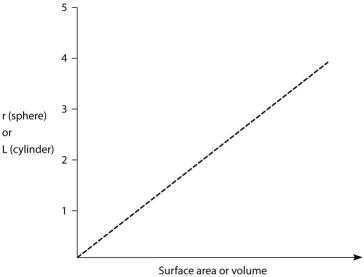 -Both axes of the graph are linear. Thus, the shape of the line plotted on this graph most accurately depicts the
 (Multiple Choice)
4.9/5 (74)
(74) The functional significance of porous septa in certain fungal hyphae is most similar to that represented by which pair of structures in animal cells and plant cells, respectively?
(Multiple Choice)
4.8/5 (85)
(85) The next few questions refer to the following phylogenetic trees.
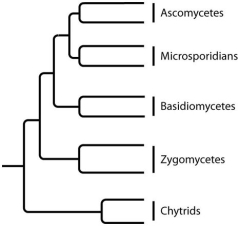 I.
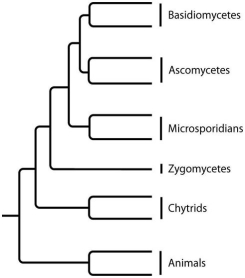 II.
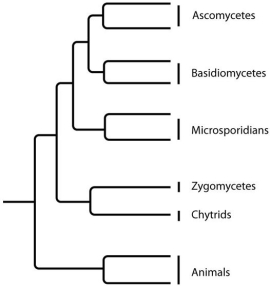 III.
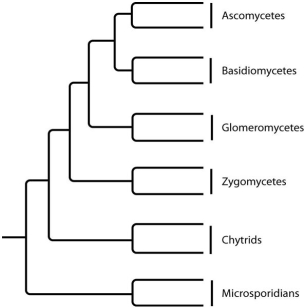 IV.
-Which tree depicts the microsporidians as a sister group of the fungi, rather than as a fungus?
I.
II.
III.
IV.
-Which tree depicts the microsporidians as a sister group of the fungi, rather than as a fungus? (Multiple Choice)
5.0/5 (65)
(65) Arrange the following from largest to smallest. 1. ascospore
2. ascocarp
3. ascomycete
4. ascus
(Multiple Choice)
5.0/5 (85)
(85) Please refer to the following information to answer the next few questions.
Diploid nuclei of the ascomycete, Neurospora crassa, contain 14 chromosomes. A single diploid cell in an ascus will undergo one round of meiosis, followed in each of the daughter cells by one round of mitosis, producing a total of eight ascospores.
-What is the ploidy of a single mature ascospore?
(Multiple Choice)
4.8/5 (87)
(87) Please refer to the following information to answer the next few questions.
Diploid nuclei of the ascomycete, Neurospora crassa, contain 14 chromosomes. A single diploid cell in an ascus will undergo one round of meiosis, followed in each of the daughter cells by one round of mitosis, producing a total of eight ascospores.
-Each of the eight ascospores present at the end of mitosis has the same chromosome number and DNA content (ng)as each of the four cells at the end of meiosis. What must have occurred in each spore between the round of meiosis and the round of mitosis?
(Multiple Choice)
4.9/5 (84)
(84) A researcher took water in which a Jl population had been thriving, filtered the water to remove all bacterial cells, and then applied the water to the skins of adult amphibians to see if there would subsequently be a reduced infection rate by Bd when frog skins were inoculated with Bd. For which of the following hypotheses is the procedure described a potential test?
(Multiple Choice)
5.0/5 (98)
(98)
-Surface area represents the area available for exchange with the environment, whereas volume represents the cytoplasm which requires nutrients and from which waste products (usually toxic)must be removed. Which of the following should provide the most favourable conditions for effective exchange?
-Surface area represents the area available for exchange with the environment, whereas volume represents the cytoplasm which requires nutrients and from which waste products (usually toxic)must be removed. Which of the following should provide the most favourable conditions for effective exchange? (Multiple Choice)
4.8/5 (81)
(81) When pathogenic fungi are found growing on the roots of grape vines, grape farmers sometimes respond by covering the ground around their vines with plastic sheeting and pumping a gaseous fungicide into the soil. The most important concern of grape farmers who engage in this practice should be that the
(Multiple Choice)
4.9/5 (80)
(80) Which process occurs in fungi and has the opposite effect on a cell's chromosome number than does meiosis I?
(Multiple Choice)
4.9/5 (85)
(85) Use the following information to answer the questions below.
For several decades now, amphibian species worldwide have been in decline. A significant proportion of the decline seems to be due to the spread of the chytrid fungus, Batrachochytrium dendrobatidis (Bd). Chytrid sporangia reside within the epidermal cells of infected animals, animals that consequently show areas of sloughed skin. They can also be lethargic, which is expressed through failure to hide and failure to flee. The infection cycle typically takes four to five days, at the end of which zoospores are released from sporangia into the environment. In some amphibian species, mortality rates approach 100%; other species seem able to survive the infection.
-The chytrid sporangia reside within the amphibian epidermal cells. Consequently, which term(s)apply to Bd? 1. ectosymbionts
2. parasites
3. commensals
4. pathogens
5. endosymbionts
(Multiple Choice)
4.8/5 (93)
(93) Among sac fungi, which of these correctly distinguishes ascospores from conidia?
(Multiple Choice)
4.8/5 (73)
(73) 
Filters
- Essay(0)
- Multiple Choice(0)
- Short Answer(0)
- True False(0)
- Matching(0)