



 Chat with AI
Exam 31: Fungi

Exam 1: Introduction: Evolution and Themes of Biology70 Questions
Exam 2: The Chemical Context of Life90 Questions
Exam 3: Water and Life80 Questions
Exam 4: Carbon and the Molecular Diversity of Life78 Questions
Exam 5: The Structure and Function of Large Biological Molecules117 Questions
Exam 6: A Tour of the Cell96 Questions
Exam 7: Membrane Structure and Function78 Questions
Exam 8: An Introduction to Metabolism88 Questions
Exam 9: Cellular Respiration and Fermentation117 Questions
Exam 10: Photosynthesis89 Questions
Exam 11: Cell Communication77 Questions
Exam 12: The Cell Cycle83 Questions
Exam 13: Meiosis and Sexual Life Cycles74 Questions
Exam 14: Mendel and the Gene Idea82 Questions
Exam 15: The Chromosomal Basis of Inheritance66 Questions
Exam 16: The Molecular Basis of Inheritance67 Questions
Exam 17: From Gene to Protein91 Questions
Exam 18: Regulation of Gene Expression107 Questions
Exam 19: Viruses53 Questions
Exam 20: Dna Tools and Biotechnology72 Questions
Exam 21: Genomes and Their Evolution52 Questions
Exam 22: Descent With Modification: a Darwinian View of Life63 Questions
Exam 23: The Evolution of Populations86 Questions
Exam 24: The Origin of Species71 Questions
Exam 25: The History of Life on Earth83 Questions
Exam 26: Phylogeny and the Tree of Life81 Questions
Exam 27: Bacteria and Archaea86 Questions
Exam 28: Protists84 Questions
Exam 29: Plant Diversity I: How Plants Colonized Land82 Questions
Exam 30: Plant Diversity Ii: the Evolution of Seed Plants110 Questions
Exam 31: Fungi97 Questions
Exam 32: An Overview of Animal Diversity82 Questions
Exam 33: An Introduction to Invertebrates101 Questions
Exam 34: The Origin and Evolution of Vertebrates117 Questions
Exam 35: Plant Structure, Growth, and Development75 Questions
Exam 36: Resource Acquisition and Transport in Vascular Plants89 Questions
Exam 37: Soil and Plant Nutrition91 Questions
Exam 38: Angiosperm Reproduction and Biotechnology94 Questions
Exam 39: Plant Responses to Internal and External Signals116 Questions
Exam 40: Basic Principles of Animal Form and Function86 Questions
Exam 41: Animal Nutrition73 Questions
Exam 42: Circulation and Gas Exchange100 Questions
Exam 43: The Immune System110 Questions
Exam 44: Osmoregulation and Excretion79 Questions
Exam 45: Hormones and the Endocrine System82 Questions
Exam 46: Animal Reproduction104 Questions
Exam 47: Animal Development98 Questions
Exam 48: Neurons, Synapses, and Signalling81 Questions
Exam 49: Nervous Systems73 Questions
Exam 50: Sensory and Motor Mechanisms91 Questions
Exam 51: Animal Behaviour79 Questions
Exam 52: An Introduction to Ecology and the Biosphere81 Questions
Exam 53: Population Ecology87 Questions
Exam 54: Community Ecology85 Questions
Exam 55: Ecosystems and Restoration Ecology89 Questions
Exam 56: Conservation Biology and Global Change75 Questions
Select questions type


In what structures do both Penicillium and Aspergillus produce asexual spores?
(Multiple Choice)
4.7/5  (79)
(79) Consider two hyphae having equal dimensions: one from a septate species and the other from a coenocytic species. Compared with the septate species, the coenocytic species should have
(Multiple Choice)
4.9/5 (76)
(76) If all of their nuclei are equally active transcriptionally, then the cells of both dikaryotic and heterokaryotic fungi, in terms of the gene products they can make, are essentially
(Multiple Choice)
4.9/5 (76)
(76) Use the following information to answer the questions below.
For several decades now, amphibian species worldwide have been in decline. A significant proportion of the decline seems to be due to the spread of the chytrid fungus, Batrachochytrium dendrobatidis (Bd). Chytrid sporangia reside within the epidermal cells of infected animals, animals that consequently show areas of sloughed skin. They can also be lethargic, which is expressed through failure to hide and failure to flee. The infection cycle typically takes four to five days, at the end of which zoospores are released from sporangia into the environment. In some amphibian species, mortality rates approach 100%; other species seem able to survive the infection.
-If Bd cannot grow properly at temperatures above 28°C (82°F), then, assuming the amphibians can survive, in which time or place should the chytrid infection proceed most rapidly? 1. cooler months
2. warmer months
3. lower altitudes
4. higher altitudes
(Multiple Choice)
4.7/5 (70)
(70) The following statements about mycorrizhae are true, with the exception of
(Multiple Choice)
4.7/5 (70)
(70) Which of the following best describes the physical relationship of the partners involved in lichens?
(Multiple Choice)
4.9/5 (72)
(72) Which of the following statements is true of deuteromycetes?
(Multiple Choice)
4.9/5 (82)
(82) Fungi differ from other heterotrophic organisms in which way?
(Multiple Choice)
4.8/5 (82)
(82) In both lichens and mycorrhizae, what does the fungal partner provide to its photosynthetic partner?
(Multiple Choice)
4.8/5 (77)
(77) When adult amphibian skin harbours populations of the bacterium, Janthinobacterium lividum (Jl), chytrid infection seems to be inhibited. Which of the following represents the best experimental design for conclusively determining whether this inhibition is real?
(Multiple Choice)
5.0/5 (88)
(88) The hydrolytic digestion of which of the following should produce monomers that are aminated (i.e., have an amine group attached)molecules of β-glucose?
(Multiple Choice)
4.9/5 (93)
(93) The following figure depicts the outline of a large fairy ring that has appeared overnight in an open meadow, as viewed from above. The fairy ring represents the furthest advance of this mycelium through the soil. Locations A-D are all 0.5 metres below the soil surface. Responses may be used once, more than once, or not at all.
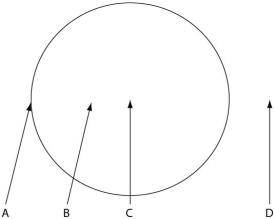 -Which location is nearest to basidiocarps?
 (Multiple Choice)
4.9/5 (70)
(70) The following questions refer to the description below.
A lichen is a mutualistic association between a fungus and a green algae or cyanobacteria. There are clear morphological differences in lichen body form; some have flat bodies and are very close together, others have leaf-like bodies, and still others grow upright. The association between the two organisms is so complete that lichens are classified as a single organism.
-Lichens are found in a wide variety of habitats, including rocks, soil, tree bark, buildings, etc. Aging of lichens has shown that some are thousands of years old; how is this possible when you see that some of these lichens are very small?
(Multiple Choice)
5.0/5 (76)
(76) Use the following information to answer the questions below.
For several decades now, amphibian species worldwide have been in decline. A significant proportion of the decline seems to be due to the spread of the chytrid fungus, Batrachochytrium dendrobatidis (Bd). Chytrid sporangia reside within the epidermal cells of infected animals, animals that consequently show areas of sloughed skin. They can also be lethargic, which is expressed through failure to hide and failure to flee. The infection cycle typically takes four to five days, at the end of which zoospores are released from sporangia into the environment. In some amphibian species, mortality rates approach 100%; other species seem able to survive the infection.
-Sexual reproduction has not been observed in Bd. If its morphology and genetics did not identify it as a chytridiomycete, then to which fungal group would Bd be assigned?
(Multiple Choice)
4.9/5 (78)
(78) The microsporidian, Brachiola gambiae, parasitizes the mosquito, Anopheles gambiae. Adult female mosquitoes must take blood meals in order for their eggs to develop, and it is while they take blood that they transmit malarial parasites to humans. Male mosquitoes drink flower nectar. If humans are to safely and effectively use Brachiola gambiae as a biological control to reduce human deaths from malaria, then how many of the following statements should be true? 1. Brachiola should kill the mosquitoes before the malarial parasite they carry reaches maturity.
2. The microsporidian should not be harmful to other insects.
3. Microsporidians should infect mosquito larvae, rather than mosquito adults.
4. The subsequent decline in anopheline mosquitoes should not significantly disrupt human food resources or other food webs.
5. Brachiola must be harmful to male mosquitoes, but not to female mosquitoes.
(Multiple Choice)
4.9/5 (75)
(75) Many infected animals are induced by the parasitic microsporidians to develop huge cells, known as xenomas, which are full of spores. Given their large size, what should be true of the xenomas?
(Multiple Choice)
4.8/5 (72)
(72) A fungal spore germinates, giving rise to a mycelium that grows outward into the soil surrounding the site where the spore originally landed. Which of the following accounts for the fungal movement, as described here?
(Multiple Choice)
4.8/5 (95)
(95) What is the importance of a high surface area to volume ratio of mycelia?
(Multiple Choice)
4.9/5 (85)
(85) Use the following information to answer the questions below.
Rose-picker's disease is caused by the yeast, Sporothrix schenkii. The yeast grows on the exteriors of rose-bush thorns. If a human gets pricked by such a thorn, the yeasts can be introduced under the skin. The yeasts then assume a hyphal morphology and grow along the interiors of lymphatic vessels until they reach a lymph node. This often results in the accumulation of pus in the lymph node, which subsequently ulcerates through the skin surface and then drains.
-The answer to which of these questions would be of most assistance to one who is attempting to assign the genus Sporothrix to the correct fungal phylum?
(Multiple Choice)
4.8/5 (72)
(72) 
Filters
- Essay(0)
- Multiple Choice(0)
- Short Answer(0)
- True False(0)
- Matching(0)