



 Chat with AI
Exam 31: Fungi

Exam 1: Introduction: Evolution and Themes of Biology70 Questions
Exam 2: The Chemical Context of Life90 Questions
Exam 3: Water and Life80 Questions
Exam 4: Carbon and the Molecular Diversity of Life78 Questions
Exam 5: The Structure and Function of Large Biological Molecules117 Questions
Exam 6: A Tour of the Cell96 Questions
Exam 7: Membrane Structure and Function78 Questions
Exam 8: An Introduction to Metabolism88 Questions
Exam 9: Cellular Respiration and Fermentation117 Questions
Exam 10: Photosynthesis89 Questions
Exam 11: Cell Communication77 Questions
Exam 12: The Cell Cycle83 Questions
Exam 13: Meiosis and Sexual Life Cycles74 Questions
Exam 14: Mendel and the Gene Idea82 Questions
Exam 15: The Chromosomal Basis of Inheritance66 Questions
Exam 16: The Molecular Basis of Inheritance67 Questions
Exam 17: From Gene to Protein91 Questions
Exam 18: Regulation of Gene Expression107 Questions
Exam 19: Viruses53 Questions
Exam 20: Dna Tools and Biotechnology72 Questions
Exam 21: Genomes and Their Evolution52 Questions
Exam 22: Descent With Modification: a Darwinian View of Life63 Questions
Exam 23: The Evolution of Populations86 Questions
Exam 24: The Origin of Species71 Questions
Exam 25: The History of Life on Earth83 Questions
Exam 26: Phylogeny and the Tree of Life81 Questions
Exam 27: Bacteria and Archaea86 Questions
Exam 28: Protists84 Questions
Exam 29: Plant Diversity I: How Plants Colonized Land82 Questions
Exam 30: Plant Diversity Ii: the Evolution of Seed Plants110 Questions
Exam 31: Fungi97 Questions
Exam 32: An Overview of Animal Diversity82 Questions
Exam 33: An Introduction to Invertebrates101 Questions
Exam 34: The Origin and Evolution of Vertebrates117 Questions
Exam 35: Plant Structure, Growth, and Development75 Questions
Exam 36: Resource Acquisition and Transport in Vascular Plants89 Questions
Exam 37: Soil and Plant Nutrition91 Questions
Exam 38: Angiosperm Reproduction and Biotechnology94 Questions
Exam 39: Plant Responses to Internal and External Signals116 Questions
Exam 40: Basic Principles of Animal Form and Function86 Questions
Exam 41: Animal Nutrition73 Questions
Exam 42: Circulation and Gas Exchange100 Questions
Exam 43: The Immune System110 Questions
Exam 44: Osmoregulation and Excretion79 Questions
Exam 45: Hormones and the Endocrine System82 Questions
Exam 46: Animal Reproduction104 Questions
Exam 47: Animal Development98 Questions
Exam 48: Neurons, Synapses, and Signalling81 Questions
Exam 49: Nervous Systems73 Questions
Exam 50: Sensory and Motor Mechanisms91 Questions
Exam 51: Animal Behaviour79 Questions
Exam 52: An Introduction to Ecology and the Biosphere81 Questions
Exam 53: Population Ecology87 Questions
Exam 54: Community Ecology85 Questions
Exam 55: Ecosystems and Restoration Ecology89 Questions
Exam 56: Conservation Biology and Global Change75 Questions
Select questions type


If the fungus that produced the fairy ring can also produce arbuscules, then which of the following is most likely to be buried at location "C"?
(Multiple Choice)
4.8/5  (74)
(74) Please refer to the following information to answer the next few questions.
Diploid nuclei of the ascomycete, Neurospora crassa, contain 14 chromosomes. A single diploid cell in an ascus will undergo one round of meiosis, followed in each of the daughter cells by one round of mitosis, producing a total of eight ascospores.
-If a single, diploid G₂ nucleus in an ascus contains 400 nanograms (ng)of DNA, then a single ascospore nucleus of this species should contain how much DNA (ng), carried on how many chromosomes?
(Multiple Choice)
4.9/5 (79)
(79)  -Some fungi can exist either as unicellular yeasts or as filamentous hyphae. Which of these forms would be most favourable in an environment where nutrients are limited?
 (Multiple Choice)
4.7/5 (83)
(83) Use the following information to answer the questions below.
For several decades now, amphibian species worldwide have been in decline. A significant proportion of the decline seems to be due to the spread of the chytrid fungus, Batrachochytrium dendrobatidis (Bd). Chytrid sporangia reside within the epidermal cells of infected animals, animals that consequently show areas of sloughed skin. They can also be lethargic, which is expressed through failure to hide and failure to flee. The infection cycle typically takes four to five days, at the end of which zoospores are released from sporangia into the environment. In some amphibian species, mortality rates approach 100%; other species seem able to survive the infection.
-Sexual reproduction has not been observed in Bd. A Bd sporangium initially contains a single, haploid cell. Which of the following processes must be involved in generating the multiple zoospores eventually produced by each sporangium? 1. S phase
2. cytokinesis
3. mitosis
4. meiosis
(Multiple Choice)
4.8/5 (77)
(77) Fossil fungi date back to the origin and early evolution of plants. What combination of environmental and morphological change is similar in the evolution of both fungi and plants?
(Multiple Choice)
5.0/5 (96)
(96) Use the following information to answer the questions below.
Recent genetic studies of the structure of microsporidian genomes, as well as the sequences of their tubulin genes and the gene for RNA polymerase II, indicate that microsporidians are closely related to the fungi. Microsporidians lack flagella, centrioles, peroxisomes, and mitochondria (although they do have degenerate mitochondria, called mitosomes). They have the smallest genome of any eukaryote, and it is a genome that changes quickly. The genome is contained within two haploid nuclei. All microsporidians are obligate intracellular parasites. They use a unique organelle called a polar filament to gain access to the cells of their hosts. One species causes chronic diarrhea in AIDS patients. Another parasitizes Anopheles gambiae, the mosquito that transmits a fatal form of malaria to humans.
-Given the eukaryotic structures they lack, it should be expected that microsporidians also lack
(Multiple Choice)
4.9/5 (73)
(73) Use the following information to answer the questions below.
For several decades now, amphibian species worldwide have been in decline. A significant proportion of the decline seems to be due to the spread of the chytrid fungus, Batrachochytrium dendrobatidis (Bd). Chytrid sporangia reside within the epidermal cells of infected animals, animals that consequently show areas of sloughed skin. They can also be lethargic, which is expressed through failure to hide and failure to flee. The infection cycle typically takes four to five days, at the end of which zoospores are released from sporangia into the environment. In some amphibian species, mortality rates approach 100%; other species seem able to survive the infection.
-Which of the following are protists, the organisms thought to share the closest ancestor with the chytrids?
(Multiple Choice)
5.0/5 (77)
(77) Which of the following conditions is caused by a fungus that is accidentally consumed along with rye flour?
(Multiple Choice)
4.8/5 (82)
(82) The adaptive advantage associated with the filamentous nature of fungal mycelia is primarily related to
(Multiple Choice)
4.8/5 (68)
(68) Use the following information to answer the questions below.
Rose-picker's disease is caused by the yeast, Sporothrix schenkii. The yeast grows on the exteriors of rose-bush thorns. If a human gets pricked by such a thorn, the yeasts can be introduced under the skin. The yeasts then assume a hyphal morphology and grow along the interiors of lymphatic vessels until they reach a lymph node. This often results in the accumulation of pus in the lymph node, which subsequently ulcerates through the skin surface and then drains.
-Say S. schenkii had initially been classified as a deuteromycete. Asci were later discovered in the pus that oozed from an ulcerated lymph node, and the spores therein germinated, giving rise to S. schenkii yeasts. Which two of these are conclusions that make sense on the basis of this information? 1. S. schenkii produces asexual spores within lymph nodes.
2. S. schenkii should be reclassified.
3. S. schenkii continues to have no known sexual stage.
4. The hyphae growing in lymphatic vessels probably belonged to a different fungal species.
5. S. schenkii yeasts belonging to two different mating strains were introduced by the same thorn prick.
(Multiple Choice)
4.9/5 (92)
(92) Use the following information to answer the questions below.
For several decades now, amphibian species worldwide have been in decline. A significant proportion of the decline seems to be due to the spread of the chytrid fungus, Batrachochytrium dendrobatidis (Bd). Chytrid sporangia reside within the epidermal cells of infected animals, animals that consequently show areas of sloughed skin. They can also be lethargic, which is expressed through failure to hide and failure to flee. The infection cycle typically takes four to five days, at the end of which zoospores are released from sporangia into the environment. In some amphibian species, mortality rates approach 100%; other species seem able to survive the infection.
-Apart from direct amphibian-to-amphibian contact, what is the most likely means by which the zoospores spread from one free-living amphibian to another?
(Multiple Choice)
4.9/5 (73)
(73) The following questions refer to the description below.
A lichen is a mutualistic association between a fungus and a green algae or cyanobacteria. There are clear morphological differences in lichen body form; some have flat bodies and are very close together, others have leaf-like bodies, and still others grow upright. The association between the two organisms is so complete that lichens are classified as a single organism.
-Biologists have noted that lichen structure differs substantially from the fungus component grown separately. What is the most plausible explanation for this?
(Multiple Choice)
4.8/5 (77)
(77) Which of the following has the least affiliation with all of the others?
(Multiple Choice)
5.0/5 (90)
(90) You are given an organism to identify. It has a fruiting body that contains many structures with eight haploid spores lined up in a row. What kind of a fungus is this?
(Multiple Choice)
5.0/5 (86)
(86) Which of the following is a characteristic of hyphate fungi (fungi featuring hyphae)?
(Multiple Choice)
4.7/5 (70)
(70) In most fungi, karyogamy does not immediately follow plasmogamy, which consequently
(Multiple Choice)
4.9/5 (83)
(83) Both fungus-farming ants and their fungi can synthesize the same structural polysaccharide from the β-glucose. What is this polysaccharide?
(Multiple Choice)
4.9/5 (78)
(78) The following figure depicts the outline of a large fairy ring that has appeared overnight in an open meadow, as viewed from above. The fairy ring represents the furthest advance of this mycelium through the soil. Locations A-D are all 0.5 metres below the soil surface. Responses may be used once, more than once, or not at all.
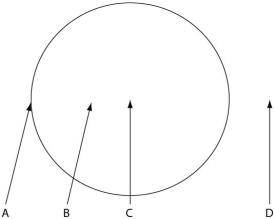 -At which location should one find the lowest concentration of fungal enzymes, assuming that the enzymes do not diffuse far from their source, and that no other fungi are present in this habitat?
 (Multiple Choice)
4.8/5 (91)
(91) The following figure depicts the outline of a large fairy ring that has appeared overnight in an open meadow, as viewed from above. The fairy ring represents the furthest advance of this mycelium through the soil. Locations A-D are all 0.5 metres below the soil surface. Responses may be used once, more than once, or not at all.
-What is the most probable location of the oldest portion of this mycelium?
-What is the most probable location of the oldest portion of this mycelium? (Multiple Choice)
4.7/5 (79)
(79) 
Filters
- Essay(0)
- Multiple Choice(0)
- Short Answer(0)
- True False(0)
- Matching(0)