



 Chat with AI
Exam 11: Perfect Competition

Exam 1: Getting Started337 Questions
Exam 2: The Us and Global Economies201 Questions
Exam 3: The Economic Problem273 Questions
Exam 4: Demand and Supply322 Questions
Exam 5: Elasticities of Demand and Supply335 Questions
Exam 6: Efficiency and Fairness of Markets352 Questions
Exam 7: Government Actions in Markets349 Questions
Exam 8: Global Markets in Action276 Questions
Exam 9: Externalities: Pollution, Education, and Health Care290 Questions
Exam 10: Production and Cost266 Questions
Exam 11: Perfect Competition275 Questions
Exam 12: Monopoly377 Questions
Exam 13: Monopolistic Competition and Oligopoly316 Questions
Exam 14: Gdp: a Measure of Total Production and Income253 Questions
Exam 15: Jobs and Unemployment283 Questions
Exam 16: The Cpi and the Cost of Living263 Questions
Exam 17: Potential Gdp and Economic Growth328 Questions
Exam 18: Money and the Monetary System360 Questions
Exam 19: Aggregate Supply and Aggregate Demand301 Questions
Exam 20: Fiscal Policy and Monetary Policy223 Questions
Select questions type


Suppose that each of 10,000 perfectly competitive firm in an industry produces 1,000 units of a good and earns an economic profit when the price of the good is $10. In the long run, definitely
(Multiple Choice)
4.8/5  (80)
(80) The market supply in the short run for the perfectly competitive industry is
(Multiple Choice)
4.8/5 (81)
(81) Cynthia is an Oklahoma wheat farmer. The demand for her wheat is
(Multiple Choice)
4.9/5 (81)
(81) A firm maximizes its profit by producing the amount of output such that
(Multiple Choice)
4.9/5 (77)
(77) Why does the profit-maximizing level of production occur at the point where marginal revenue equals marginal cost?
(Essay)
5.0/5 (69)
(69) Can a perfectly competitive firm make an economic profit in the short run?
Can it incur an economic loss?
(Essay)
4.8/5 (82)
(82) A perfectly competitive firm definitely makes an economic profit in the short run if price is
(Multiple Choice)
4.9/5 (81)
(81) If a perfectly competitive firm finds that the price exceeds its ATC, then the firm
(Multiple Choice)
4.8/5 (79)
(79) If the market price is less than a perfectly competitive firm's average total cost, what sort of profit or loss is the firm earning?
(Essay)
4.9/5 (78)
(78)  -The above figure shows a perfectly competitive firm. If the market price is $15 per unit, the firm
 (Multiple Choice)
5.0/5 (93)
(93) If a perfectly competitive firm raised the price of its product,
(Multiple Choice)
4.8/5 (74)
(74) The firm in the figure above has a total revenue equal to ________.
(Multiple Choice)
4.9/5 (82)
(82) 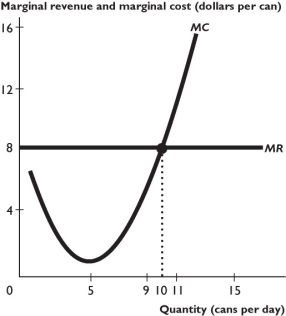 The figure above shows a firm's marginal revenue and marginal cost curves.
-Suppose the firm's marginal cost of producing a can increases by $1 per can. Then the firm would
The figure above shows a firm's marginal revenue and marginal cost curves.
-Suppose the firm's marginal cost of producing a can increases by $1 per can. Then the firm would (Multiple Choice)
4.9/5 (81)
(81) If a perfectly competitive firm manufacturing chairs produces 100 more chairs, what happens to the market price of a chair?
(Essay)
4.8/5 (88)
(88) If a firm in a perfectly competitive market faces an equilibrium price of $5, its marginal revenue
(Multiple Choice)
4.8/5 (80)
(80)  -Bill owns a lawn-care company in Windermere, Florida, whose cost curves are illustrated in the above figure. The market equilibrium price in this perfectly competitive market equals $32 per lawn mowed. Bill's average total cost curve is ATC, so his total cost of production equals
 (Multiple Choice)
4.8/5 (94)
(94) 
Filters
- Essay(0)
- Multiple Choice(0)
- Short Answer(0)
- True False(0)
- Matching(0)