



 Chat with AI
Exam 11: Perfect Competition

Exam 1: Getting Started337 Questions
Exam 2: The Us and Global Economies201 Questions
Exam 3: The Economic Problem273 Questions
Exam 4: Demand and Supply322 Questions
Exam 5: Elasticities of Demand and Supply335 Questions
Exam 6: Efficiency and Fairness of Markets352 Questions
Exam 7: Government Actions in Markets349 Questions
Exam 8: Global Markets in Action276 Questions
Exam 9: Externalities: Pollution, Education, and Health Care290 Questions
Exam 10: Production and Cost266 Questions
Exam 11: Perfect Competition275 Questions
Exam 12: Monopoly377 Questions
Exam 13: Monopolistic Competition and Oligopoly316 Questions
Exam 14: Gdp: a Measure of Total Production and Income253 Questions
Exam 15: Jobs and Unemployment283 Questions
Exam 16: The Cpi and the Cost of Living263 Questions
Exam 17: Potential Gdp and Economic Growth328 Questions
Exam 18: Money and the Monetary System360 Questions
Exam 19: Aggregate Supply and Aggregate Demand301 Questions
Exam 20: Fiscal Policy and Monetary Policy223 Questions
Select questions type


Based on the figure above, if the firm produces 7 cans per day, the firm ________ maximizing its profit and is ________.
(Multiple Choice)
4.9/5  (96)
(96) In which market structure are there a small number of firms competing?
(Multiple Choice)
4.7/5 (87)
(87) A perfectly competitive firm should shut down in the short-run if price falls below the minimum of
(Multiple Choice)
4.8/5 (79)
(79)  -Bill owns a lawn-care company in Windermere, Florida, whose cost curves are illustrated in the above figure. The market equilibrium price in this perfectly competitive market equals $32 per lawn mowed. At this price, how many lawns will Bill mow per week?
 (Multiple Choice)
4.7/5 (68)
(68)  The figure above shows the cost curves and marginal revenue curve for a perfectly competitive firm.
-Based on the figure above, what is the price of a can?
The figure above shows the cost curves and marginal revenue curve for a perfectly competitive firm.
-Based on the figure above, what is the price of a can? (Multiple Choice)
4.8/5 (79)
(79) Suppose a perfectly competitive market is in long-run equilibrium with a price of $12. Then there is a permanent increase in demand. As a result, in the short run the market price ________ and in the long run the number of firms ________ and the price is ________ the price was in the short run.
(Multiple Choice)
4.9/5 (81)
(81) Quantity (wafers per hour) Average variable cost (dollars) Average total cost (dollars) 0 0 1 1900 7900 2 1400 4400 3 1300 3300 4 1400 2900 5 1600 2800 6 2000 3000
-Computer memory chips are produced on wafers, each wafer having many separate chips that are separated and sold. The above table shows costs for a perfectly competitive producer of computer memory chips. This firm will produce as long as the market price of a wafer is above
(Multiple Choice)
4.9/5 (84)
(84) Quantity (bushels of rutabagas) Total revenue (dollars) Total cost (dollars) 0 0 12 1 10 22 2 20 28 3 30 30 4 40 31 5 50 34 6 60 45 7 70 59 8 80 80
-The above table has the total revenue and total cost schedule for Omar, a perfectly competitive grower of rutabagas. Omar's total profit is maximized when he produces ________ bushels of rutabagas.
(Multiple Choice)
4.9/5 (86)
(86)  -The above figure shows a perfectly competitive firm. If the market price is $15, the firm
 (Multiple Choice)
4.8/5 (89)
(89) The firm in the figure above has a total revenue equal to ________.
(Multiple Choice)
5.0/5 (85)
(85) When new firms enter the perfectly competitive Miami bagel market, the market
(Multiple Choice)
4.9/5 (86)
(86) 11.4 Chapter Figures
 The figure above shows a firm's total revenue and total cost curves.
-To maximize its profit, the firm in the figure above produces ________ cans per day and ________.
The figure above shows a firm's total revenue and total cost curves.
-To maximize its profit, the firm in the figure above produces ________ cans per day and ________. (Multiple Choice)
4.8/5 (75)
(75) If there are 1,000 identical rice farmers who are each willing to supply 200 bushels of rice at $2 per bushel, what price and quantity combination is a point on the market supply curve for rice?
(Multiple Choice)
4.7/5 (76)
(76) The rutabaga market is perfectly competitive. Research is published claiming that eating rutabagas leads to gaining weight and so the demand for rutabagas permanently decreases. The permanent decrease in demand results in a
(Multiple Choice)
4.9/5 (80)
(80) 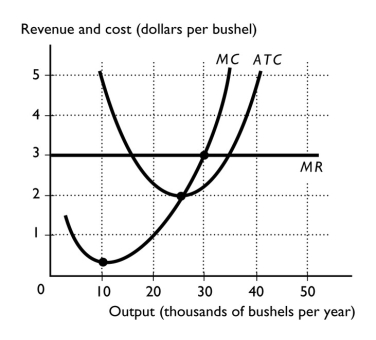 -The above figure illustrates a perfectly competitive wheat farmer.
a. What will be the firm's profit-maximizing price and output?
b. When the farmer produces 25,000 bushels of wheat, the difference between the firm's average total cost and the price is at its maximum. Explain why this amount of wheat either is or is not the profit-maximizing quantity.
-The above figure illustrates a perfectly competitive wheat farmer.
a. What will be the firm's profit-maximizing price and output?
b. When the farmer produces 25,000 bushels of wheat, the difference between the firm's average total cost and the price is at its maximum. Explain why this amount of wheat either is or is not the profit-maximizing quantity. (Essay)
4.8/5 (77)
(77) Quantity (wafers per hour) Average variable cost (dollars) Average total cost (dollars) 0 0 1 1900 7900 2 1400 4400 3 1300 3300 4 1400 2900 5 1600 2800 6 2000 3000
-Computer memory chips are produced on wafers, each wafer having many separate chips that are separated and sold. The above table shows costs for a perfectly competitive producer of computer memory chips. If the market price of a wafer is $2,400 dollars, how many wafers will the firm produce?
(Multiple Choice)
4.8/5 (82)
(82) 
Filters
- Essay(0)
- Multiple Choice(0)
- Short Answer(0)
- True False(0)
- Matching(0)