



 Chat with AI
Exam 12: Firms in Perfectly Competitive Markets

Exam 1: Economics: Foundations and Models234 Questions
Exam 2: Trade-Offs, Comparative Advantage, and the Market System258 Questions
Exam 3: Where Prices Come From: the Interaction of Demand and Supply242 Questions
Exam 4: Economic Efficiency, Government Price Setting, and Taxes208 Questions
Exam 5: Externalities, Environmental Policy, and Public Goods263 Questions
Exam 6: Elasticity: the Responsiveness of Demand and Supply295 Questions
Exam 7: The Economics of Health Care171 Questions
Exam 8: Firms, the Stock Market, and Corporate Governance264 Questions
Exam 9: Comparative Advantage and the Gains From International Trade188 Questions
Exam 10: Consumer Choice and Behavioral Economics300 Questions
Exam 11: Technology, Production, and Costs328 Questions
Exam 12: Firms in Perfectly Competitive Markets296 Questions
Exam 13: Monopolistic Competition: the Competitive Model in a More Realistic Setting274 Questions
Exam 14: Oligopoly: Firms in Less Competitive Markets259 Questions
Exam 15: Monopoly and Antitrust Policy279 Questions
Exam 16: Pricing Strategy261 Questions
Exam 17: The Markets for Labor and Other Factors of Production281 Questions
Exam 18: Public Choice, Taxes, and the Distribution of Income258 Questions
Select questions type


Firms in perfect competition produce the allocatively efficient output in the short run and in the long run.
(True/False)
4.8/5  (79)
(79) Suppose the equilibrium price in a perfectly competitive industry is $10 and a firm in the industry charges $12.Which of the following will happen?
(Multiple Choice)
4.7/5 (90)
(90) Figure 12-19
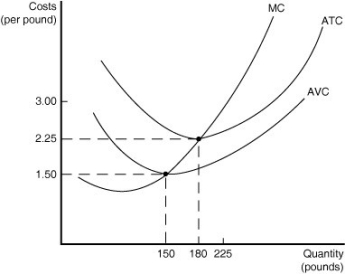 -Refer to Figure 12-19.The figure above shows the cost curves of a perfectly competitive firm in the coffee market.Use the graph in Figure 12-19 to answer the following questions.Assume the market price is $3 per pound.
a.What is the lowest price at which the coffee grower will supply output in the short run?
b.In the diagram draw the firm's demand curve (label this "MR" for marginal revenue).
c.What is the firm's profit-maximizing output?
d.Is the firm earning a profit or a loss? Identify the area in the graph that represents the firm's profit or loss.
e.Explain how entry or exit will occur in the market to ensure that firms will break even in the long run.
-Refer to Figure 12-19.The figure above shows the cost curves of a perfectly competitive firm in the coffee market.Use the graph in Figure 12-19 to answer the following questions.Assume the market price is $3 per pound.
a.What is the lowest price at which the coffee grower will supply output in the short run?
b.In the diagram draw the firm's demand curve (label this "MR" for marginal revenue).
c.What is the firm's profit-maximizing output?
d.Is the firm earning a profit or a loss? Identify the area in the graph that represents the firm's profit or loss.
e.Explain how entry or exit will occur in the market to ensure that firms will break even in the long run. (Essay)
4.8/5 (69)
(69) Max Shreck, an accountant, quit his $80,000-a-year job and bought an existing tattoo parlor from its previous owner, Sylvia Sidney.The lease has five years remaining and requires a monthly payment of $4,000.Max's explicit cost amounts to $3,000 per month more than his revenue.Should Max continue operating his business?
(Multiple Choice)
4.8/5 (70)
(70) Figure 12-3
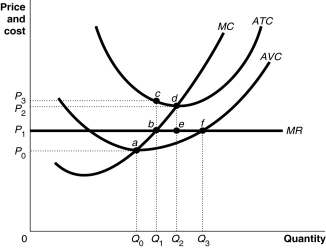 -Refer to Figure 12-3.Suppose the prevailing price is P₁ and the firm is currently producing its loss-minimizing quantity.Identify the area that represents the loss.
 (Multiple Choice)
4.9/5 (90)
(90) Article Summary
According to the Department of Agriculture, net farm income will fall from $91.1 billion in 2014 to $58.3 billion in 2015, a 36 percent drop and the largest percentage decline since 1983.Falling prices on corn and soybeans are responsible for a portion of the decline in income, as are lower prices for dairy products, hogs, and chickens.The USDA is, however, predicting lower production costs due to falling prices for energy, seed, fertilizer, and pesticides.
Source: Jesse Newman, "U.S.Farm Income to Fall to Lowest Level in Nine Years," Wall Street Journal, August 25, 2015.
-Refer to the Article Summary above.Assume that after the record decline in U.S.farm income in 2015, farmers are expected to break even in 2016.This means that at the quantity being produced in 2016
(Multiple Choice)
5.0/5 (78)
(78) A perfectly competitive market is in long-run equilibrium.At present there are 100 identical firms each producing 5,000 units of output.The prevailing market price is $20.Assume that each firm faces increasing marginal cost.Now suppose there is a sudden increase in demand for the industry's product which causes the price of the good to rise to $24.Which of the following describes the effect of this increase in demand on a typical firm in the industry?
(Multiple Choice)
4.8/5 (81)
(81) Figure 12-15
 -Refer to Figure 12-15.Suppose a typical firm in a perfectly competitive market is earning economic profits in the short run.Which of the diagrams in the figure depicts what happens in the industry as it transitions to a long-run equilibrium?
 (Multiple Choice)
4.8/5 (67)
(67) Figure 12-5
 Figure 12-5 shows cost and demand curves facing a typical firm in a constant-cost, perfectly competitive industry.
-Refer to Figure 12-5.If the market price is $20, what is the firm's profit-maximizing output?
Figure 12-5 shows cost and demand curves facing a typical firm in a constant-cost, perfectly competitive industry.
-Refer to Figure 12-5.If the market price is $20, what is the firm's profit-maximizing output? (Multiple Choice)
4.9/5 (82)
(82) If a firm in a perfectly competitive industry introduces a lower-cost way of producing an existing product, the firm will be able to earn economic profits in the long run.
(True/False)
4.9/5 (71)
(71) Perfectly competitive firms produce up to the point where the price of the good equals the marginal cost of producing the last unit.This condition is referred to as
(Multiple Choice)
4.7/5 (86)
(86) The market demand curve in a perfectly competitive market is downward sloping.
(True/False)
5.0/5 (84)
(84) Figure 12-5
Figure 12-5 shows cost and demand curves facing a typical firm in a constant-cost, perfectly competitive industry.
-Refer to Figure 12-5.The figure shows the cost structure of a firm in a perfectly competitive market.If the firm's fixed cost increases by $1,000 due to a new environmental regulation, what happens to its profit-maximizing output level?
Figure 12-5 shows cost and demand curves facing a typical firm in a constant-cost, perfectly competitive industry.
-Refer to Figure 12-5.The figure shows the cost structure of a firm in a perfectly competitive market.If the firm's fixed cost increases by $1,000 due to a new environmental regulation, what happens to its profit-maximizing output level? (Multiple Choice)
4.7/5 (74)
(74) Figure 12-4
 Figure 12-4 shows the cost and demand curves for a profit-maximizing firm in a perfectly competitive market.
-Refer to Figure 12-4.What is the amount of its total fixed cost?
Figure 12-4 shows the cost and demand curves for a profit-maximizing firm in a perfectly competitive market.
-Refer to Figure 12-4.What is the amount of its total fixed cost? (Multiple Choice)
4.8/5 (87)
(87) In the short run, a firm that incurs losses might choose to produce rather than shut down if the amount of its revenue is less than its fixed cost.
(True/False)
4.9/5 (90)
(90) In the short run, a firm might choose to produce rather than shut down even if its market price is less than its average total cost of production.
(True/False)
4.7/5 (73)
(73) If the long-run average cost curve is U-shaped, the optimal scale of production from society's viewpoint is
(Multiple Choice)
4.7/5 (92)
(92) If total variable cost exceeds total revenue at all output levels, a perfectly competitive firm
(Multiple Choice)
4.8/5 (88)
(88) Figure 12-16
 -Refer to Figure 12-16.Which panel best represents the perfectly competitive organic produce market's transition to the long run when some firms in the market are earning economic profits?
 (Multiple Choice)
5.0/5 (71)
(71) 
Filters
- Essay(0)
- Multiple Choice(0)
- Short Answer(0)
- True False(0)
- Matching(0)