



 Chat with AI
Exam 12: Firms in Perfectly Competitive Markets

Exam 1: Economics: Foundations and Models234 Questions
Exam 2: Trade-Offs, Comparative Advantage, and the Market System258 Questions
Exam 3: Where Prices Come From: the Interaction of Demand and Supply242 Questions
Exam 4: Economic Efficiency, Government Price Setting, and Taxes208 Questions
Exam 5: Externalities, Environmental Policy, and Public Goods263 Questions
Exam 6: Elasticity: the Responsiveness of Demand and Supply295 Questions
Exam 7: The Economics of Health Care171 Questions
Exam 8: Firms, the Stock Market, and Corporate Governance264 Questions
Exam 9: Comparative Advantage and the Gains From International Trade188 Questions
Exam 10: Consumer Choice and Behavioral Economics300 Questions
Exam 11: Technology, Production, and Costs328 Questions
Exam 12: Firms in Perfectly Competitive Markets296 Questions
Exam 13: Monopolistic Competition: the Competitive Model in a More Realistic Setting274 Questions
Exam 14: Oligopoly: Firms in Less Competitive Markets259 Questions
Exam 15: Monopoly and Antitrust Policy279 Questions
Exam 16: Pricing Strategy261 Questions
Exam 17: The Markets for Labor and Other Factors of Production281 Questions
Exam 18: Public Choice, Taxes, and the Distribution of Income258 Questions
Select questions type


Figure 12-17
 The graphs in Figure 12-17 represent the perfectly competitive market demand and supply curves for the apple industry and demand and cost curves for a typical firm in the industry.
-Refer to Figure 12-17.Which of the following statements is true?
The graphs in Figure 12-17 represent the perfectly competitive market demand and supply curves for the apple industry and demand and cost curves for a typical firm in the industry.
-Refer to Figure 12-17.Which of the following statements is true? (Multiple Choice)
4.9/5  (91)
(91) Which of the following describes a situation in which a good or service is produced at the lowest possible cost?
(Multiple Choice)
4.9/5 (69)
(69) Figure 12-6
 Figure 12-6 shows the demand, marginal cost (MC)and average total cost (ATC)curves for Jason's House of Apples.
-Refer to Figure 12-6.If Jason maximizes his profit he will produce the output rate indicated by point ________ and his average profit will equal ________.
Figure 12-6 shows the demand, marginal cost (MC)and average total cost (ATC)curves for Jason's House of Apples.
-Refer to Figure 12-6.If Jason maximizes his profit he will produce the output rate indicated by point ________ and his average profit will equal ________. (Multiple Choice)
4.8/5 (93)
(93) Mark Frost grows apples in a perfectly competitive market.If we drew a line in a graph that illustrates Mark's total revenue from selling apples, it would be
(Multiple Choice)
4.7/5 (85)
(85) A perfectly competitive apple farm produces 1,000 bushels of apples at a total cost of $36,000.The price of each bushel is $50.Calculate the firm's short-run profit or loss.
(Multiple Choice)
4.8/5 (68)
(68) Figure 12-9
 Figure 12-9 shows cost and demand curves facing a profit-maximizing, perfectly competitive firm.
-Refer to Figure 12-9.At price P₄, the firm would produce
Figure 12-9 shows cost and demand curves facing a profit-maximizing, perfectly competitive firm.
-Refer to Figure 12-9.At price P₄, the firm would produce (Multiple Choice)
4.8/5 (64)
(64) Figure 12-1
 -Refer to Figure 12-3.If the firm is producing 500 units, what is the amount of its profit or loss?
 (Multiple Choice)
4.9/5 (91)
(91) Producing where marginal revenue equals marginal cost is equivalent to producing where
(Multiple Choice)
4.9/5 (79)
(79) All of the following can be used to compute average profit except
(Multiple Choice)
4.7/5 (80)
(80) Apple introduced its iPhone 3G in July 2008 and within a month sales had topped 3 million units.By April 2009, more than 25,000 apps for the iPhone 3G were available in the iTunes store, an indication that in a competitive market
(Multiple Choice)
4.8/5 (80)
(80) Table 12-4
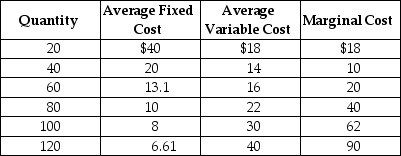 Table 12-4 shows the short-run cost data of a perfectly competitive firm.Assume that output can only be increased in batches of 20 units.
-Refer to Table 12-4.If the market price is $45 the firm will produce
Table 12-4 shows the short-run cost data of a perfectly competitive firm.Assume that output can only be increased in batches of 20 units.
-Refer to Table 12-4.If the market price is $45 the firm will produce (Multiple Choice)
4.9/5 (80)
(80) A very large number of small sellers who sell identical products imply
(Multiple Choice)
4.8/5 (72)
(72) In a perfectly competitive market the term "price taker" applies to
(Multiple Choice)
4.9/5 (84)
(84) What is the relationship among the following variables for a perfectly competitive firm: the market price, average revenue and marginal revenue?
(Multiple Choice)
4.9/5 (88)
(88) If, as a perfectly competitive industry expands, it can supply larger quantities at the same long-run market price, it is
(Multiple Choice)
5.0/5 (82)
(82) Figure 12-9
Figure 12-9 shows cost and demand curves facing a profit-maximizing, perfectly competitive firm.
-Refer to Figure 12-9.At price P₂, the firm would
Figure 12-9 shows cost and demand curves facing a profit-maximizing, perfectly competitive firm.
-Refer to Figure 12-9.At price P₂, the firm would (Multiple Choice)
4.9/5 (80)
(80) 
Filters
- Essay(0)
- Multiple Choice(0)
- Short Answer(0)
- True False(0)
- Matching(0)