



 Chat with AI
Exam 34: The Trade-Off Between Inflation and Unemployment

Exam 1: What Is Economics232 Questions
Exam 2: The Economy: Myth and Reality155 Questions
Exam 3: The Fundamental Economic Problem: Scarcity and Choice255 Questions
Exam 4: Supply and Demand: an Initial Look313 Questions
Exam 5: Consumer Choice: Individual and Market Demand206 Questions
Exam 6: Demand and Elasticity214 Questions
Exam 7: Production, Inputs, and Cost: Building Blocks for Supply Analysis221 Questions
Exam 8: Output, Price, and Profit: the Importance of Marginal Analysis194 Questions
Exam 9: Securities: Business Finance and the Economy: the Tail That Wags the Dog203 Questions
Exam 10: The Firm and the Industry Under Perfect Competition212 Questions
Exam 11: Monopoly208 Questions
Exam 12: Between Competition and Monopoly230 Questions
Exam 13: Limiting Market Power: Regulation and Antitrust155 Questions
Exam 14: The Case for Free Markets: the Price System225 Questions
Exam 15: The Shortcomings of Free Markets219 Questions
Exam 16: Externalities, the Environment, and Natural Resources222 Questions
Exam 17: Taxation and Resource Allocation221 Questions
Exam 18: Pricing the Factors of Production233 Questions
Exam 19: Labor and Entrepreneurship: the Human Inputs271 Questions
Exam 20: Poverty, Inequality, and Discrimination172 Questions
Exam 21: Is Useconomic Leadership Threatened75 Questions
Exam 22: An Introduction to Macroeconomics216 Questions
Exam 23: The Goals of Macroeconomic Policy212 Questions
Exam 24: Economic Growth: Theory and Policy228 Questions
Exam 25: Aggregate Demand and the Powerful Consumer219 Questions
Exam 26: Demand-Side Equilibrium: Unemployment or Inflation216 Questions
Exam 27: Bringing in the Supply Side: Unemployment and Inflation228 Questions
Exam 28: Managing Aggregate Demand: Fiscal Policy210 Questions
Exam 29: Money and the Banking System224 Questions
Exam 30: Monetary Policy: Conventional and Unconventional210 Questions
Exam 31: He Financial Crisis and the Great Recession66 Questions
Exam 32: The Debate Over Monetary and Fiscal Policy219 Questions
Exam 33: Budget Deficits in the Short and Long Run215 Questions
Exam 34: The Trade-Off Between Inflation and Unemployment219 Questions
Exam 35: International Trade and Comparative Advantage223 Questions
Exam 36: The International Monetary System: Order or Disorder218 Questions
Exam 37: Exchange Rates and the Macroeconomy219 Questions
Select questions type


Figure 17-2
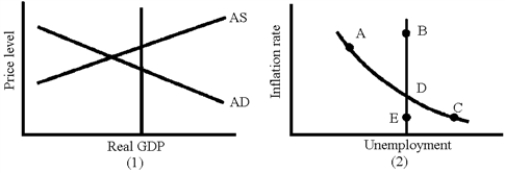 -Given the situation in graph (1) in Figure 17-2, what action could be expected from the economy's self-correcting mechanism?
 (Multiple Choice)
4.7/5  (86)
(86) The Phillips curve is a statistical relationship that was misrepresented as showing
(Multiple Choice)
4.8/5 (65)
(65) Figure 17-8
 -In Figure 17-8, which of the following movements illustrates the response of the economy to an increase in aggregate demand when expectations are "rational"?
 (Multiple Choice)
4.8/5 (74)
(74) The Phillips curve shows the relationship between the rate of inflation and the rate of growth of real GDP.
(True/False)
4.9/5 (64)
(64) Which of the following is most likely to result in inflation?
(Multiple Choice)
4.9/5 (92)
(92) If the fluctuations in the economy's real growth rate from year to year are caused primarily by variations in the rate at which aggregate demand increases, then data would show the
(Multiple Choice)
4.7/5 (74)
(74) If you believe that expectations react quickly, you are likely:
(Multiple Choice)
4.8/5 (82)
(82) If policy makers do nothing in a recessionary gap, the most likely outcome is a
(Multiple Choice)
4.8/5 (84)
(84) The rapid advance in computer technology is one of the reasons given for the shift of the
(Multiple Choice)
4.8/5 (66)
(66) The rational expectations theory claims that workers and firms will not make systematic errors when they forecast inflation.
(True/False)
4.9/5 (68)
(68) At the natural rate of unemployment, the long-run Phillips curve has a(n)
(Multiple Choice)
4.9/5 (73)
(73) If AD increases at a faster rate than AS, the result will be
(Multiple Choice)
4.9/5 (56)
(56) Which of the following could trigger demand-side inflation?
(Multiple Choice)
4.8/5 (80)
(80) The origin of the Phillips curve is the idea that an increase in
(Multiple Choice)
4.8/5 (74)
(74) A decrease in AS will trigger less inflation under which of the following conditions?
(Multiple Choice)
4.9/5 (63)
(63) If workers expect inflation, and negotiate wage increases that exactly match price increases, the result is a
(Multiple Choice)
4.8/5 (84)
(84) Figure 17-6
 -If Figure 17-6 (a) illustrates the elimination of a recessionary gap, then the economy should move to what point on the curves shown in Figure 17-6 (b)?
 (Multiple Choice)
4.8/5 (71)
(71) 
Filters
- Essay(0)
- Multiple Choice(0)
- Short Answer(0)
- True False(0)
- Matching(0)