



 Chat with AI
Exam 34: The Trade-Off Between Inflation and Unemployment

Exam 1: What Is Economics232 Questions
Exam 2: The Economy: Myth and Reality155 Questions
Exam 3: The Fundamental Economic Problem: Scarcity and Choice255 Questions
Exam 4: Supply and Demand: an Initial Look313 Questions
Exam 5: Consumer Choice: Individual and Market Demand206 Questions
Exam 6: Demand and Elasticity214 Questions
Exam 7: Production, Inputs, and Cost: Building Blocks for Supply Analysis221 Questions
Exam 8: Output, Price, and Profit: the Importance of Marginal Analysis194 Questions
Exam 9: Securities: Business Finance and the Economy: the Tail That Wags the Dog203 Questions
Exam 10: The Firm and the Industry Under Perfect Competition212 Questions
Exam 11: Monopoly208 Questions
Exam 12: Between Competition and Monopoly230 Questions
Exam 13: Limiting Market Power: Regulation and Antitrust155 Questions
Exam 14: The Case for Free Markets: the Price System225 Questions
Exam 15: The Shortcomings of Free Markets219 Questions
Exam 16: Externalities, the Environment, and Natural Resources222 Questions
Exam 17: Taxation and Resource Allocation221 Questions
Exam 18: Pricing the Factors of Production233 Questions
Exam 19: Labor and Entrepreneurship: the Human Inputs271 Questions
Exam 20: Poverty, Inequality, and Discrimination172 Questions
Exam 21: Is Useconomic Leadership Threatened75 Questions
Exam 22: An Introduction to Macroeconomics216 Questions
Exam 23: The Goals of Macroeconomic Policy212 Questions
Exam 24: Economic Growth: Theory and Policy228 Questions
Exam 25: Aggregate Demand and the Powerful Consumer219 Questions
Exam 26: Demand-Side Equilibrium: Unemployment or Inflation216 Questions
Exam 27: Bringing in the Supply Side: Unemployment and Inflation228 Questions
Exam 28: Managing Aggregate Demand: Fiscal Policy210 Questions
Exam 29: Money and the Banking System224 Questions
Exam 30: Monetary Policy: Conventional and Unconventional210 Questions
Exam 31: He Financial Crisis and the Great Recession66 Questions
Exam 32: The Debate Over Monetary and Fiscal Policy219 Questions
Exam 33: Budget Deficits in the Short and Long Run215 Questions
Exam 34: The Trade-Off Between Inflation and Unemployment219 Questions
Exam 35: International Trade and Comparative Advantage223 Questions
Exam 36: The International Monetary System: Order or Disorder218 Questions
Exam 37: Exchange Rates and the Macroeconomy219 Questions
Select questions type


The period from the late 1990s to the winter of 2000 was marked by falling unemployment rates and falling inflation rates as well.How does economic theory explain this apparent violation of the Phillips curve model?
(Essay)
4.8/5  (78)
(78) Fiscal and monetary policy can reduce unemployment with no negative side effects.
(True/False)
4.8/5 (78)
(78) What are some of the possible ways in which we could reduce the natural rate of unemployment?
(Essay)
5.0/5 (81)
(81) Figure 17-8
 -In Figure 17-8, policy makers can choose any of the following points as sustainable inflation-unemployment combinations:
 (Multiple Choice)
4.9/5 (77)
(77) If strong monetary policy stimulus is used to combat a recessionary gap, what will happen?
(Multiple Choice)
4.9/5 (89)
(89) An increase in AD will trigger more inflation under which of the following conditions?
(Multiple Choice)
4.8/5 (75)
(75) If the short-run Phillips curve has a very steep slope, the
(Multiple Choice)
4.9/5 (80)
(80) The suggestion that the Fed concentrate only on reducing inflation is an attempt to
(Multiple Choice)
4.8/5 (82)
(82) If unemployment and inflation always move in the same direction, then we can infer that business fluctuations are
(Multiple Choice)
4.9/5 (88)
(88) A study of the U.S.price level and real GDP from 1972 to 2007 reveals a clear upward march toward higher prices and greater output.What explains this?
(Multiple Choice)
4.8/5 (75)
(75) If the fluctuations in the economy's real growth rate from year to year are caused primarily by variations in the rate at which aggregate supply increases, then data would show
(Multiple Choice)
4.8/5 (96)
(96) Figure 17-6
 -If the economy in 34-6 (b) is experiencing an inflationary gap (point g), the economy's self-correcting process will move unemployment to ____ and inflation to ____.
 (Multiple Choice)
4.8/5 (87)
(87) If rational expectations are assumed, inflation can be reduced with no corresponding increase in unemployment.
(True/False)
4.8/5 (79)
(79) Figure 17-5
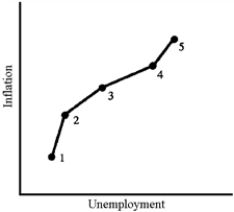 -Over a five-year period, economists observed that the unemployment-inflation relationship appeared as in Figure 17-5.Economic theory would conclude that the period
 (Multiple Choice)
4.8/5 (78)
(78) The economy's self-correcting mechanism tends to push the unemployment rate back to a specific rate of unemployment.How?
(Essay)
4.8/5 (87)
(87) Figure 17-8
-In Figure 17-8, which of the following movements would you associate with a "negative supply shock"?
-In Figure 17-8, which of the following movements would you associate with a "negative supply shock"? (Multiple Choice)
4.9/5 (77)
(77) Workers expecting inflation will expect wage increases to be built into their wage contracts.
(True/False)
4.9/5 (81)
(81) Inflation can come from the demand side or from the supply side of the economy.
(True/False)
4.7/5 (81)
(81) 
Filters
- Essay(0)
- Multiple Choice(0)
- Short Answer(0)
- True False(0)
- Matching(0)