



 Chat with AI
Exam 34: The Trade-Off Between Inflation and Unemployment

Exam 1: What Is Economics232 Questions
Exam 2: The Economy: Myth and Reality155 Questions
Exam 3: The Fundamental Economic Problem: Scarcity and Choice255 Questions
Exam 4: Supply and Demand: an Initial Look313 Questions
Exam 5: Consumer Choice: Individual and Market Demand206 Questions
Exam 6: Demand and Elasticity214 Questions
Exam 7: Production, Inputs, and Cost: Building Blocks for Supply Analysis221 Questions
Exam 8: Output, Price, and Profit: the Importance of Marginal Analysis194 Questions
Exam 9: Securities: Business Finance and the Economy: the Tail That Wags the Dog203 Questions
Exam 10: The Firm and the Industry Under Perfect Competition212 Questions
Exam 11: Monopoly208 Questions
Exam 12: Between Competition and Monopoly230 Questions
Exam 13: Limiting Market Power: Regulation and Antitrust155 Questions
Exam 14: The Case for Free Markets: the Price System225 Questions
Exam 15: The Shortcomings of Free Markets219 Questions
Exam 16: Externalities, the Environment, and Natural Resources222 Questions
Exam 17: Taxation and Resource Allocation221 Questions
Exam 18: Pricing the Factors of Production233 Questions
Exam 19: Labor and Entrepreneurship: the Human Inputs271 Questions
Exam 20: Poverty, Inequality, and Discrimination172 Questions
Exam 21: Is Useconomic Leadership Threatened75 Questions
Exam 22: An Introduction to Macroeconomics216 Questions
Exam 23: The Goals of Macroeconomic Policy212 Questions
Exam 24: Economic Growth: Theory and Policy228 Questions
Exam 25: Aggregate Demand and the Powerful Consumer219 Questions
Exam 26: Demand-Side Equilibrium: Unemployment or Inflation216 Questions
Exam 27: Bringing in the Supply Side: Unemployment and Inflation228 Questions
Exam 28: Managing Aggregate Demand: Fiscal Policy210 Questions
Exam 29: Money and the Banking System224 Questions
Exam 30: Monetary Policy: Conventional and Unconventional210 Questions
Exam 31: He Financial Crisis and the Great Recession66 Questions
Exam 32: The Debate Over Monetary and Fiscal Policy219 Questions
Exam 33: Budget Deficits in the Short and Long Run215 Questions
Exam 34: The Trade-Off Between Inflation and Unemployment219 Questions
Exam 35: International Trade and Comparative Advantage223 Questions
Exam 36: The International Monetary System: Order or Disorder218 Questions
Exam 37: Exchange Rates and the Macroeconomy219 Questions
Select questions type


If inflationary expectations are quite sluggish (that is, they do not adapt quickly), then the short-run Phillips curve will
(Multiple Choice)
4.8/5  (68)
(68) When the Phillips curve was first formulated (late 1960s), many economists thought that it showed a
(Multiple Choice)
4.8/5 (85)
(85) Figure 17-7
 -In Figure 17-7, the case for restrictive monetary and fiscal policy is strongest at point
 (Multiple Choice)
4.8/5 (85)
(85) Most economists agree that the self-correcting mechanism works
(Multiple Choice)
4.7/5 (73)
(73) If unemployment and inflation move inversely, then we can infer that business fluctuations are
(Multiple Choice)
4.8/5 (88)
(88) One explanation for the increase in the natural rate of unemployment in 2010 was a mismatch between the skills of the American labor force and the skills that the modern job market demanded.
(True/False)
4.9/5 (76)
(76) During the 1960s and early 1970s, economists believed that the Phillips curve indicated
(Multiple Choice)
4.8/5 (69)
(69) An example of indexing is a "cost of living" adjustment clause in a wage contract.
(True/False)
4.7/5 (90)
(90) According to the theory of rational expectations, the government can influence output
(Multiple Choice)
4.8/5 (83)
(83) If AS increases at a faster rate than AD, the result will be
(Multiple Choice)
4.7/5 (68)
(68) Figure 17-1
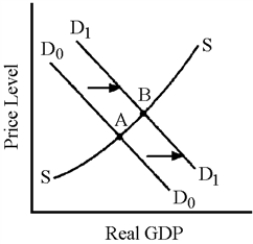 -Which of the following is true about the economy depicted in Figure 17-1?
 (Multiple Choice)
4.9/5 (78)
(78) Demand-side inflation differs from supply-side inflation in the following way:
(Multiple Choice)
4.7/5 (91)
(91) If the fluctuations in the economy's real growth rate from year to year are caused primarily by variations in the rate at which aggregate demand increases, then data would show
(Multiple Choice)
4.9/5 (75)
(75) If aggregate demand had grown faster than it did from 2009 to 2010, then the U.S.economy would have experienced
(Multiple Choice)
5.0/5 (61)
(61) The U.S.economy in the 1990s benefited from an aggregate supply curve shifting outward.
(True/False)
4.7/5 (83)
(83) If actual inflation differs from expected inflation, what is the slope of the Phillips curve?
(Multiple Choice)
4.9/5 (82)
(82) What is the crucial difference between inflation generated on the demand side versus inflation generated on the supply side?
(Multiple Choice)
4.9/5 (98)
(98) If expectations are "rational," can the Fed control unemployment?
(Multiple Choice)
4.8/5 (73)
(73) Figure 17-5
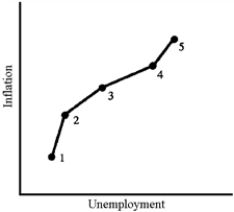 -The data illustrated in Figure 17-5 would be most representative of which decade?
 (Multiple Choice)
4.9/5 (87)
(87) 
Filters
- Essay(0)
- Multiple Choice(0)
- Short Answer(0)
- True False(0)
- Matching(0)