



 Chat with AI
Exam 11: A: Price-Searcher Markets With High Entry Barriers

Exam 1: The Economic Approach210 Questions
Exam 2: A: Some Tools of the Economist224 Questions
Exam 2: B: Some Tools of the Economist33 Questions
Exam 3: A: Supply, Demand, and the Market Process225 Questions
Exam 3: B: Supply, Demand, and the Market Process180 Questions
Exam 4: A: Supply and Demand: Applications and Extensions233 Questions
Exam 4: B: Supply and Demand: Applications and Extensions98 Questions
Exam 5: Difficult Cases for the Market and the Role of Government168 Questions
Exam 6: The Economics of Collective Decision-Making180 Questions
Exam 7: Consumer Choice and Elasticity223 Questions
Exam 8: A: Costs and the Supply of Goods223 Questions
Exam 8: B: Costs and the Supply of Goods8 Questions
Exam 9: A: Price Takers and the Competitive Process237 Questions
Exam 9: B: Price Takers and the Competitive Process23 Questions
Exam 10: Price-Searcher Markets With Low Entry Barriers216 Questions
Exam 11: A: Price-Searcher Markets With High Entry Barriers229 Questions
Exam 11: B: Price-Searcher Markets With High Entry Barriers25 Questions
Exam 12: The Supply of and Demand for Productive Resources200 Questions
Exam 13: Earnings, Productivity, and the Job Market109 Questions
Exam 14: Investment, the Capital Market, and the Wealth of Nations129 Questions
Exam 15: Income Inequality and Poverty136 Questions
Exam 16: Appendix: Government Spending and Taxation79 Questions
Exam 17: Appendix: the Economics of Social Security54 Questions
Exam 18: Appendix: the Stock Market: Its Function, Performance, and Potential As an Investment Opportunity70 Questions
Exam 19: Appendix: Great Debates in Economics: Keynes Versus Hayek8 Questions
Exam 20: Appendix: the Crisis of 2008: Causes and Lessons for the Future64 Questions
Exam 21: Appendix: Lessons From the Great Depression60 Questions
Exam 22: Appendix: the Economics of Healthcare68 Questions
Exam 23: Appendix:education: Problems and Performance60 Questions
Exam 24: Appendix: Earnings Differences Between Men and Women47 Questions
Exam 26: Appendix: the Question of Resource Exhaustion61 Questions
Exam 25: Appendix: Do Labor Unions Increase the Wages of Workers74 Questions
Exam 27: Appendix: Difficult Environmental Cases and the Role of Government63 Questions
Select questions type


Figure 11-20
 -The production level that will maximize the profit for the monopoly in Figure 11-20 is
 (Multiple Choice)
5.0/5  (72)
(72) A market situation where a small number of sellers compose the entire industry is called
(Multiple Choice)
5.0/5 (77)
(77) Other things constant, production of an identical product in an oligopolistic industry
(Multiple Choice)
4.7/5 (96)
(96) New York City limits the number of taxi cabs that can legally operate in the city. The most likely result of this practice is that
(Multiple Choice)
4.8/5 (81)
(81) Which of the following are illegal under the antitrust laws of the United States?
(Multiple Choice)
4.8/5 (77)
(77) An organization of sellers designed to coordinate their supply decisions to maximize joint profits is called a
(Multiple Choice)
4.8/5 (81)
(81) Under which one of the following market structures are sellers most likely to consider the reaction of rival sellers when they set the price of their product?
(Multiple Choice)
5.0/5 (86)
(86) Economists generally criticize high barriers to market entry because
(Multiple Choice)
4.8/5 (82)
(82) Which of the following is true of a monopolist's demand curve?
(Multiple Choice)
4.7/5 (89)
(89) An expansion in the number of plumbers in a local area has resulted in lower profits. The local plumbing contractors have called a meeting to discuss ways to improve their long-run profitability. Of the four plans being discussed seriously, which would most likely increase their long-run profits?
(Multiple Choice)
4.9/5 (83)
(83) Monopolists are criticized because they are inefficient. What is meant by this statement?
(Multiple Choice)
4.9/5 (89)
(89) Figure 11-21
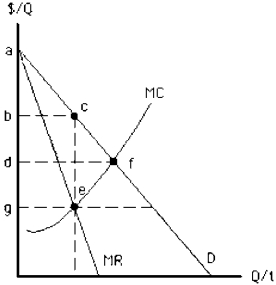 -In Figure 11-21, the increase in consumer surplus that occurs when price is set equal to marginal cost rather than at the profit-maximizing level, as it would be in an unregulated monopoly, is shown by area
 (Multiple Choice)
4.8/5 (78)
(78) Figure 11-17
 -Refer to Figure 11-17. If the monopoly firm is currently producing Q₃ units of output, then a decrease in output will necessarily cause profit to
 (Multiple Choice)
4.8/5 (88)
(88) If a local ready-mix cement company is the only producer of cement in the local market, the monopoly power of the firm will
(Multiple Choice)
4.9/5 (80)
(80) Figure 11-5
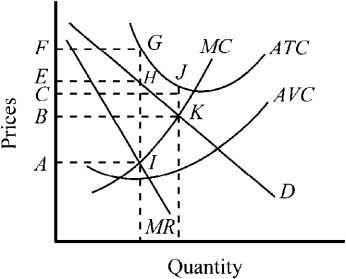 -Indicate the maximum profit (or minimum loss) a pure monopolist with the cost and demand conditions depicted in Figure 11-5 would be able to achieve.
 (Multiple Choice)
4.8/5 (86)
(86) Figure 11-7
 -If the output in the industry is produced by a monopolist, at what price will the good sell and what quantity will be produced in Figure 11-7?
 (Multiple Choice)
4.9/5 (88)
(88) Which one of the following factors reduces the likelihood that a cartel agreement will lead to higher producer profit?
(Multiple Choice)
4.9/5 (72)
(72) 
Filters
- Essay(0)
- Multiple Choice(0)
- Short Answer(0)
- True False(0)
- Matching(0)