



 Chat with AI
Exam 11: A: Price-Searcher Markets With High Entry Barriers

Exam 1: The Economic Approach210 Questions
Exam 2: A: Some Tools of the Economist224 Questions
Exam 2: B: Some Tools of the Economist33 Questions
Exam 3: A: Supply, Demand, and the Market Process225 Questions
Exam 3: B: Supply, Demand, and the Market Process180 Questions
Exam 4: A: Supply and Demand: Applications and Extensions233 Questions
Exam 4: B: Supply and Demand: Applications and Extensions98 Questions
Exam 5: Difficult Cases for the Market and the Role of Government168 Questions
Exam 6: The Economics of Collective Decision-Making180 Questions
Exam 7: Consumer Choice and Elasticity223 Questions
Exam 8: A: Costs and the Supply of Goods223 Questions
Exam 8: B: Costs and the Supply of Goods8 Questions
Exam 9: A: Price Takers and the Competitive Process237 Questions
Exam 9: B: Price Takers and the Competitive Process23 Questions
Exam 10: Price-Searcher Markets With Low Entry Barriers216 Questions
Exam 11: A: Price-Searcher Markets With High Entry Barriers229 Questions
Exam 11: B: Price-Searcher Markets With High Entry Barriers25 Questions
Exam 12: The Supply of and Demand for Productive Resources200 Questions
Exam 13: Earnings, Productivity, and the Job Market109 Questions
Exam 14: Investment, the Capital Market, and the Wealth of Nations129 Questions
Exam 15: Income Inequality and Poverty136 Questions
Exam 16: Appendix: Government Spending and Taxation79 Questions
Exam 17: Appendix: the Economics of Social Security54 Questions
Exam 18: Appendix: the Stock Market: Its Function, Performance, and Potential As an Investment Opportunity70 Questions
Exam 19: Appendix: Great Debates in Economics: Keynes Versus Hayek8 Questions
Exam 20: Appendix: the Crisis of 2008: Causes and Lessons for the Future64 Questions
Exam 21: Appendix: Lessons From the Great Depression60 Questions
Exam 22: Appendix: the Economics of Healthcare68 Questions
Exam 23: Appendix:education: Problems and Performance60 Questions
Exam 24: Appendix: Earnings Differences Between Men and Women47 Questions
Exam 26: Appendix: the Question of Resource Exhaustion61 Questions
Exam 25: Appendix: Do Labor Unions Increase the Wages of Workers74 Questions
Exam 27: Appendix: Difficult Environmental Cases and the Role of Government63 Questions
Select questions type


If a firm has substantial market power, it must be operating in an industry that would be classified as
(Multiple Choice)
4.9/5  (81)
(81) Suppose Ford, GM, and Dodge make the majority of pick-up trucks sold in the United States If they all sell for approximately the same price, and Ford offers a $2,000 rebate on new truck sales, what can Ford expect to see?
(Multiple Choice)
4.8/5 (68)
(68) Figure 11-18
 -The total cost for the firm in Figure 11-18, a monopolist that maximizes profit while charging all customers the same price, is
 (Multiple Choice)
4.9/5 (91)
(91) Which of the following is most likely to contribute to the presence of monopoly in an industry?
(Multiple Choice)
4.8/5 (84)
(84) Table 11-4
 -The demand and total cost schedules of a monopolist are presented in Table 11-4. What price should a profit-maximizing monopolist charge?
 (Multiple Choice)
4.8/5 (76)
(76) Table 11-2
 -The demand and total cost schedules of a monopolist are presented in Table 11-2. What price should a profit-maximizing monopolist charge?
 (Multiple Choice)
4.9/5 (76)
(76) Which of the following will reduce the likelihood of effective collusion among oligopolistic producers?
(Multiple Choice)
4.8/5 (70)
(70) Figure 11-16
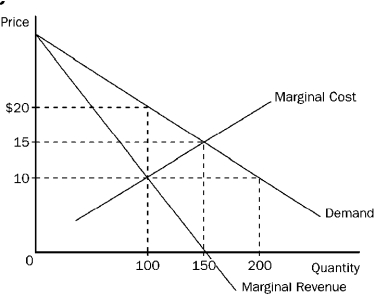 -Refer to Figure 11-16. To maximize its profit, a monopolist would choose which of the following outcomes?
 (Multiple Choice)
4.9/5 (62)
(62) It is difficult to predict the behavior of oligopolistic firms because
(Multiple Choice)
4.8/5 (90)
(90) Assuming that firms maximize profits, how will the price and output policy of an unregulated monopolist compare with ideal market efficiency?
(Multiple Choice)
4.9/5 (81)
(81) For a monopolist that does not price discriminate, economic profit is maximized in the short run at a price of $140. Marginal revenue at that output level is
(Multiple Choice)
4.8/5 (78)
(78) Assuming that firms maximize profits, how will the price and output policy of an unregulated monopolist compare with ideal market efficiency?
(Multiple Choice)
4.8/5 (85)
(85) Figure 11-8
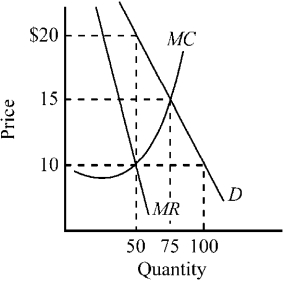 -The demand and cost conditions in an industry are as depicted in Figure 11-8. In the viewpoint of economic efficiency, what would the ideal price and output be?
 (Multiple Choice)
4.8/5 (88)
(88) Figure 11-17
 -Refer to Figure 11-17. The demand curve for a monopoly firm is depicted by curve
 (Multiple Choice)
4.8/5 (67)
(67) Table 11-3
 -The demand and total cost schedules of a monopolist are presented in Table 11-3. What price should a profit-maximizing monopolist charge?
 (Multiple Choice)
4.8/5 (88)
(88) Under which one of the following market structures are firms most likely to enter into a price-fixing agreement designed to maximize their joint profit?
(Multiple Choice)
4.8/5 (84)
(84) 
Filters
- Essay(0)
- Multiple Choice(0)
- Short Answer(0)
- True False(0)
- Matching(0)