



 Chat with AI
Exam 11: A: Price-Searcher Markets With High Entry Barriers

Exam 1: The Economic Approach210 Questions
Exam 2: A: Some Tools of the Economist224 Questions
Exam 2: B: Some Tools of the Economist33 Questions
Exam 3: A: Supply, Demand, and the Market Process225 Questions
Exam 3: B: Supply, Demand, and the Market Process180 Questions
Exam 4: A: Supply and Demand: Applications and Extensions233 Questions
Exam 4: B: Supply and Demand: Applications and Extensions98 Questions
Exam 5: Difficult Cases for the Market and the Role of Government168 Questions
Exam 6: The Economics of Collective Decision-Making180 Questions
Exam 7: Consumer Choice and Elasticity223 Questions
Exam 8: A: Costs and the Supply of Goods223 Questions
Exam 8: B: Costs and the Supply of Goods8 Questions
Exam 9: A: Price Takers and the Competitive Process237 Questions
Exam 9: B: Price Takers and the Competitive Process23 Questions
Exam 10: Price-Searcher Markets With Low Entry Barriers216 Questions
Exam 11: A: Price-Searcher Markets With High Entry Barriers229 Questions
Exam 11: B: Price-Searcher Markets With High Entry Barriers25 Questions
Exam 12: The Supply of and Demand for Productive Resources200 Questions
Exam 13: Earnings, Productivity, and the Job Market109 Questions
Exam 14: Investment, the Capital Market, and the Wealth of Nations129 Questions
Exam 15: Income Inequality and Poverty136 Questions
Exam 16: Appendix: Government Spending and Taxation79 Questions
Exam 17: Appendix: the Economics of Social Security54 Questions
Exam 18: Appendix: the Stock Market: Its Function, Performance, and Potential As an Investment Opportunity70 Questions
Exam 19: Appendix: Great Debates in Economics: Keynes Versus Hayek8 Questions
Exam 20: Appendix: the Crisis of 2008: Causes and Lessons for the Future64 Questions
Exam 21: Appendix: Lessons From the Great Depression60 Questions
Exam 22: Appendix: the Economics of Healthcare68 Questions
Exam 23: Appendix:education: Problems and Performance60 Questions
Exam 24: Appendix: Earnings Differences Between Men and Women47 Questions
Exam 26: Appendix: the Question of Resource Exhaustion61 Questions
Exam 25: Appendix: Do Labor Unions Increase the Wages of Workers74 Questions
Exam 27: Appendix: Difficult Environmental Cases and the Role of Government63 Questions
Select questions type


Assuming that firms maximize profits, how will the price and output policy of an unregulated monopolist compare with ideal market efficiency?
(Multiple Choice)
4.9/5  (84)
(84) Which of the following is an obstacle that would reduce the likelihood of effective collusion among oligopolists?
(Multiple Choice)
4.9/5 (78)
(78) Figure 11-10
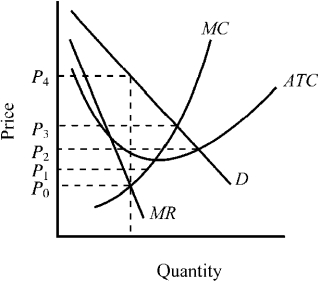 -If the monopolist is regulated by the "marginal cost pricing" technique, what price in Figure 11-10 will be charged?
 (Multiple Choice)
4.7/5 (75)
(75) Figure 11-4
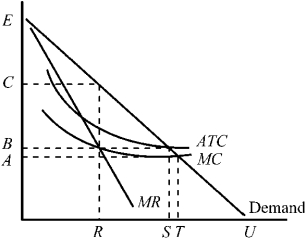 -What output would a monopolist with the demand and cost conditions depicted in Figure 11-4 produce if ordered by regulators to serve the entire market at average cost?
 (Multiple Choice)
4.8/5 (89)
(89) In the case where a natural monopoly exists in an industry,
(Multiple Choice)
4.8/5 (86)
(86) The oil industry is dominated by a cartel known as OPEC, and the cocaine industry is dominated by the Columbian cocaine cartel. If these cartels are being successful,
(Multiple Choice)
4.9/5 (71)
(71) Figure 11-17
 -Refer to Figure 11-17. Profit will be maximized by charging a price equal to
 (Multiple Choice)
4.8/5 (94)
(94) A monopolist earning short-run economic profit determines that at its present level of output, marginal revenue is $23 and marginal cost is $30. Which of the following should the firm do to increase profit?
(Multiple Choice)
4.8/5 (72)
(72) Under which of the following market conditions is it most difficult to maintain a cartel agreement?
(Multiple Choice)
4.8/5 (78)
(78) To maximize profits, the monopolist shown in the figure would produce output of 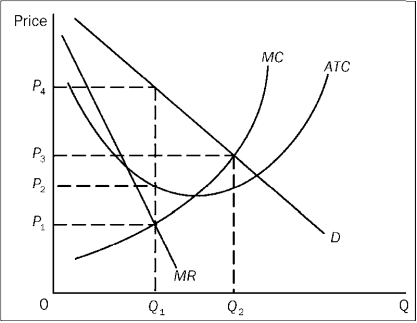
(Multiple Choice)
4.8/5 (68)
(68) When significant economies of scale are present in the production process, an industry will tend naturally toward monopoly because
(Multiple Choice)
4.9/5 (76)
(76) Figure 11-20
 -At the profit-maximizing level of production, the monopoly in Figure 11-20 will have total revenue of
 (Multiple Choice)
4.9/5 (90)
(90) When firms use resources in an attempt to secure and maintain grants of market protection from the government, it is called
(Multiple Choice)
4.8/5 (80)
(80) Which of the following provides the most secure protection for a firm with monopoly power?
(Multiple Choice)
4.9/5 (71)
(71) Figure 11-17
-Refer to Figure 11-17. The marginal cost curve for a monopoly firm is depicted by curve
-Refer to Figure 11-17. The marginal cost curve for a monopoly firm is depicted by curve (Multiple Choice)
4.9/5 (85)
(85) Table 11-1
 -Refer to Table 11-1. The marginal revenue of the second unit is
 (Multiple Choice)
4.9/5 (77)
(77) If pizza used to be produced in a competitive price-taker market, and now the pizza market has become a monopoly, we can expect
(Multiple Choice)
4.7/5 (83)
(83) 
Filters
- Essay(0)
- Multiple Choice(0)
- Short Answer(0)
- True False(0)
- Matching(0)