



 Chat with AI
Exam 11: A: Price-Searcher Markets With High Entry Barriers

Exam 1: The Economic Approach210 Questions
Exam 2: A: Some Tools of the Economist224 Questions
Exam 2: B: Some Tools of the Economist33 Questions
Exam 3: A: Supply, Demand, and the Market Process225 Questions
Exam 3: B: Supply, Demand, and the Market Process180 Questions
Exam 4: A: Supply and Demand: Applications and Extensions233 Questions
Exam 4: B: Supply and Demand: Applications and Extensions98 Questions
Exam 5: Difficult Cases for the Market and the Role of Government168 Questions
Exam 6: The Economics of Collective Decision-Making180 Questions
Exam 7: Consumer Choice and Elasticity223 Questions
Exam 8: A: Costs and the Supply of Goods223 Questions
Exam 8: B: Costs and the Supply of Goods8 Questions
Exam 9: A: Price Takers and the Competitive Process237 Questions
Exam 9: B: Price Takers and the Competitive Process23 Questions
Exam 10: Price-Searcher Markets With Low Entry Barriers216 Questions
Exam 11: A: Price-Searcher Markets With High Entry Barriers229 Questions
Exam 11: B: Price-Searcher Markets With High Entry Barriers25 Questions
Exam 12: The Supply of and Demand for Productive Resources200 Questions
Exam 13: Earnings, Productivity, and the Job Market109 Questions
Exam 14: Investment, the Capital Market, and the Wealth of Nations129 Questions
Exam 15: Income Inequality and Poverty136 Questions
Exam 16: Appendix: Government Spending and Taxation79 Questions
Exam 17: Appendix: the Economics of Social Security54 Questions
Exam 18: Appendix: the Stock Market: Its Function, Performance, and Potential As an Investment Opportunity70 Questions
Exam 19: Appendix: Great Debates in Economics: Keynes Versus Hayek8 Questions
Exam 20: Appendix: the Crisis of 2008: Causes and Lessons for the Future64 Questions
Exam 21: Appendix: Lessons From the Great Depression60 Questions
Exam 22: Appendix: the Economics of Healthcare68 Questions
Exam 23: Appendix:education: Problems and Performance60 Questions
Exam 24: Appendix: Earnings Differences Between Men and Women47 Questions
Exam 26: Appendix: the Question of Resource Exhaustion61 Questions
Exam 25: Appendix: Do Labor Unions Increase the Wages of Workers74 Questions
Exam 27: Appendix: Difficult Environmental Cases and the Role of Government63 Questions
Select questions type


As a group, oligopolists would always earn the highest profit if they would
(Multiple Choice)
4.9/5  (75)
(75) Breaking a monopoly firm into several rival firms will be unlikely to improve economic efficiency when economies of scale are important because
(Multiple Choice)
4.9/5 (85)
(85) If entry-restricting legal barriers effectively organized the funeral home industry of a large city into a monopoly cartel, economic theory indicates that, compared to the previously competitive situation,
(Multiple Choice)
5.0/5 (81)
(81) Figure 11-18
 -The profit-maximizing output and price for the firm in Figure 11-18, which charges the same price to all customers, are
 (Multiple Choice)
4.9/5 (78)
(78) A profit-maximizing monopolist will continue expanding output as long as
(Multiple Choice)
4.8/5 (74)
(74) Which of the following would increase the likelihood that firms in an industry could successfully collude?
(Multiple Choice)
4.8/5 (76)
(76) When members of an oligopolistic industry agree to collude, raising their product price substantially above average cost, the passage of time (months and years)
(Multiple Choice)
4.8/5 (78)
(78) Since patent laws create monopoly power in the short run and thus provide a strong incentive for firms to undertake the risk and effort involved in the development of a technological improvement, we can expect that patent laws
(Multiple Choice)
4.9/5 (79)
(79) Figure 11-18
-The total revenue for the firm in Figure 11-18, a monopolist that maximizes profit while charging all customers the same price, is
-The total revenue for the firm in Figure 11-18, a monopolist that maximizes profit while charging all customers the same price, is (Multiple Choice)
4.9/5 (74)
(74) The prisoners' dilemma is used to illustrate the basic idea that
(Multiple Choice)
4.8/5 (90)
(90) Which of the following is true under unregulated monopoly?
(Multiple Choice)
4.8/5 (90)
(90) Which of the following statements accurately describes a difference between a firm that is a monopolist and one that is in a competitive, open price-taker market?
(Multiple Choice)
4.9/5 (66)
(66) Figure 11-11
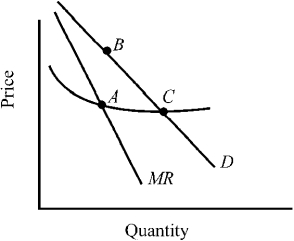 -According to the graph of an oligopolistic industry in Figure 11-11 (points A and C lie on the MC curve), which of the following statements is correct?
 (Multiple Choice)
4.9/5 (87)
(87) Figure 11-1
 -If a regulatory agency were using the "normal return" (zero economic profit) criteria to impose a price on a monopolist with the cost and demand conditions depicted in Figure 11-1, what price would the regulators set, and what output would the monopolist produce?
 (Multiple Choice)
4.9/5 (86)
(86) Regulating natural monopolies according to the "rate of return" criterion is likely to
(Multiple Choice)
4.9/5 (89)
(89) Which of the following best explains why the monopolist's marginal revenue is less than the sales price?
(Multiple Choice)
4.9/5 (73)
(73) Laws designed to prevent monopoly and promote competition are known as
(Multiple Choice)
4.8/5 (88)
(88) 
Filters
- Essay(0)
- Multiple Choice(0)
- Short Answer(0)
- True False(0)
- Matching(0)