



 Chat with AI
Exam 11: A: Price-Searcher Markets With High Entry Barriers

Exam 1: The Economic Approach210 Questions
Exam 2: A: Some Tools of the Economist224 Questions
Exam 2: B: Some Tools of the Economist33 Questions
Exam 3: A: Supply, Demand, and the Market Process225 Questions
Exam 3: B: Supply, Demand, and the Market Process180 Questions
Exam 4: A: Supply and Demand: Applications and Extensions233 Questions
Exam 4: B: Supply and Demand: Applications and Extensions98 Questions
Exam 5: Difficult Cases for the Market and the Role of Government168 Questions
Exam 6: The Economics of Collective Decision-Making180 Questions
Exam 7: Consumer Choice and Elasticity223 Questions
Exam 8: A: Costs and the Supply of Goods223 Questions
Exam 8: B: Costs and the Supply of Goods8 Questions
Exam 9: A: Price Takers and the Competitive Process237 Questions
Exam 9: B: Price Takers and the Competitive Process23 Questions
Exam 10: Price-Searcher Markets With Low Entry Barriers216 Questions
Exam 11: A: Price-Searcher Markets With High Entry Barriers229 Questions
Exam 11: B: Price-Searcher Markets With High Entry Barriers25 Questions
Exam 12: The Supply of and Demand for Productive Resources200 Questions
Exam 13: Earnings, Productivity, and the Job Market109 Questions
Exam 14: Investment, the Capital Market, and the Wealth of Nations129 Questions
Exam 15: Income Inequality and Poverty136 Questions
Exam 16: Appendix: Government Spending and Taxation79 Questions
Exam 17: Appendix: the Economics of Social Security54 Questions
Exam 18: Appendix: the Stock Market: Its Function, Performance, and Potential As an Investment Opportunity70 Questions
Exam 19: Appendix: Great Debates in Economics: Keynes Versus Hayek8 Questions
Exam 20: Appendix: the Crisis of 2008: Causes and Lessons for the Future64 Questions
Exam 21: Appendix: Lessons From the Great Depression60 Questions
Exam 22: Appendix: the Economics of Healthcare68 Questions
Exam 23: Appendix:education: Problems and Performance60 Questions
Exam 24: Appendix: Earnings Differences Between Men and Women47 Questions
Exam 26: Appendix: the Question of Resource Exhaustion61 Questions
Exam 25: Appendix: Do Labor Unions Increase the Wages of Workers74 Questions
Exam 27: Appendix: Difficult Environmental Cases and the Role of Government63 Questions
Select questions type


"Market power" is an expression used to indicate that a firm has
(Multiple Choice)
4.8/5  (75)
(75) (I) Oligopolistic firms have an incentive to collude to increase profits. (II) Oligopolistic firms have an incentive to cheat on collusive agreements to increase profits.
(Multiple Choice)
4.7/5 (76)
(76) A law that requires hairdressers to undergo many hours of training and acquire a license before they can offer haircuts to the public, is an example of a
(Multiple Choice)
4.8/5 (80)
(80) When oligopolistic firms collude to maximize their joint profits, in comparison with the situation in competitive markets, their actions generally lead to
(Multiple Choice)
4.9/5 (80)
(80) When a monopolist is producing at the profit-maximizing output level, the value to consumers of one additional unit of output will
(Multiple Choice)
4.8/5 (79)
(79) Which of the following conditions would increase the likelihood of successful collusion among American automobile producers?
(Multiple Choice)
4.9/5 (78)
(78) Because each oligopolist cares about its own profit rather than the collective profit of all the oligopolists together,
(Multiple Choice)
4.7/5 (89)
(89) Which of the following indicates the major difference between monopolists and competitive price searchers?
(Multiple Choice)
4.9/5 (77)
(77) Figure 11-8
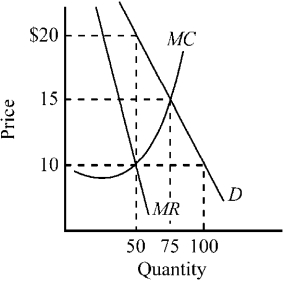 -If the output in the industry is produced by a monopolist, at what price will the good sell and what quantity will be produced in Figure 11-8?
 (Multiple Choice)
4.9/5 (74)
(74) Figure 11-16
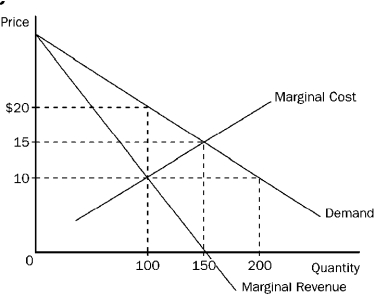 -Refer to Figure 11-16. The allocative inefficiency caused by a profit-maximizing monopoly amounts to
 (Multiple Choice)
4.8/5 (78)
(78) When a single firm has control over the market supply of a resource that is essential to the production of a good,
(Multiple Choice)
4.9/5 (94)
(94) In general, an organization of sellers designed to coordinate supply decisions so that the joint profits of the members is maximized is called a(n) ____. If they are successful, the total market output and price will most closely approximate the output and price in a(n) ____ market. (Fill in the blanks.)
(Multiple Choice)
4.9/5 (76)
(76) A monopolist has less to gain from cost-saving measures in the production process when
(Multiple Choice)
4.9/5 (76)
(76) When the government imposes a barrier to entry in a market,
(Multiple Choice)
4.8/5 (80)
(80) Figure 11-13
 -If the firms in the industry depicted in Figure 11-13 compete with each other, what would the industry's price and output be?
 (Multiple Choice)
4.8/5 (88)
(88) When economies of scale are important, imposing competition by splitting a monopolistic firm into many rival units will
(Multiple Choice)
5.0/5 (83)
(83) Which of the following statements accurately describes a difference between a firm that is a monopolist and one that is in a competitive price-searcher market?
(Multiple Choice)
4.8/5 (83)
(83) Figure 11-17
 -Refer to Figure 11-17. If the monopoly firm wants to maximize its profit, it should operate at a level of output equal to
 (Multiple Choice)
4.7/5 (85)
(85) 
Filters
- Essay(0)
- Multiple Choice(0)
- Short Answer(0)
- True False(0)
- Matching(0)