



 Chat with AI
Exam 11: A: Price-Searcher Markets With High Entry Barriers

Exam 1: The Economic Approach210 Questions
Exam 2: A: Some Tools of the Economist224 Questions
Exam 2: B: Some Tools of the Economist33 Questions
Exam 3: A: Supply, Demand, and the Market Process225 Questions
Exam 3: B: Supply, Demand, and the Market Process180 Questions
Exam 4: A: Supply and Demand: Applications and Extensions233 Questions
Exam 4: B: Supply and Demand: Applications and Extensions98 Questions
Exam 5: Difficult Cases for the Market and the Role of Government168 Questions
Exam 6: The Economics of Collective Decision-Making180 Questions
Exam 7: Consumer Choice and Elasticity223 Questions
Exam 8: A: Costs and the Supply of Goods223 Questions
Exam 8: B: Costs and the Supply of Goods8 Questions
Exam 9: A: Price Takers and the Competitive Process237 Questions
Exam 9: B: Price Takers and the Competitive Process23 Questions
Exam 10: Price-Searcher Markets With Low Entry Barriers216 Questions
Exam 11: A: Price-Searcher Markets With High Entry Barriers229 Questions
Exam 11: B: Price-Searcher Markets With High Entry Barriers25 Questions
Exam 12: The Supply of and Demand for Productive Resources200 Questions
Exam 13: Earnings, Productivity, and the Job Market109 Questions
Exam 14: Investment, the Capital Market, and the Wealth of Nations129 Questions
Exam 15: Income Inequality and Poverty136 Questions
Exam 16: Appendix: Government Spending and Taxation79 Questions
Exam 17: Appendix: the Economics of Social Security54 Questions
Exam 18: Appendix: the Stock Market: Its Function, Performance, and Potential As an Investment Opportunity70 Questions
Exam 19: Appendix: Great Debates in Economics: Keynes Versus Hayek8 Questions
Exam 20: Appendix: the Crisis of 2008: Causes and Lessons for the Future64 Questions
Exam 21: Appendix: Lessons From the Great Depression60 Questions
Exam 22: Appendix: the Economics of Healthcare68 Questions
Exam 23: Appendix:education: Problems and Performance60 Questions
Exam 24: Appendix: Earnings Differences Between Men and Women47 Questions
Exam 26: Appendix: the Question of Resource Exhaustion61 Questions
Exam 25: Appendix: Do Labor Unions Increase the Wages of Workers74 Questions
Exam 27: Appendix: Difficult Environmental Cases and the Role of Government63 Questions
Select questions type


Which of the following is a problem that arises when regulations force "natural monopolies," like electric utilities, to charge a price that is equal to their marginal cost (MC)?
(Multiple Choice)
4.9/5  (84)
(84) If zinc suppliers are successful in forming an international zinc cartel, they will
(Multiple Choice)
4.7/5 (85)
(85) At a given output level, a monopolist earns a profit only if the
(Multiple Choice)
4.9/5 (90)
(90) Why do oligopolists (or cartel members) have an incentive to cheat on collusive agreements designed to maximize the joint profits of the firms in the industry?
(Multiple Choice)
4.7/5 (90)
(90) When barriers to entry are high, a monopolist (or cartel) will often be able to increase their profits by
(Multiple Choice)
4.8/5 (67)
(67) Figure 11-6
 -The demand and cost conditions in an industry are as depicted in Figure 11-6. In the viewpoint of economic efficiency, what would the ideal price and output be?
 (Multiple Choice)
4.7/5 (77)
(77) When a regulatory agency uses marginal cost pricing to regulate a monopolist,
(Multiple Choice)
4.8/5 (67)
(67) The difficulty in analyzing oligopolistic behavior arises from the
(Multiple Choice)
4.9/5 (73)
(73) Cartel members have an incentive to cheat on cartel agreements because
(Multiple Choice)
4.9/5 (83)
(83) Figure 11-13
 -If the firms in the industry depicted in Figure 11-13 can effectively operate as a cartel, what would the industry's price and output be?
 (Multiple Choice)
4.9/5 (86)
(86) Figure 11-20
 -The firm in Figure 11-20 will have an economic
 (Multiple Choice)
4.9/5 (87)
(87) Figure 11-10
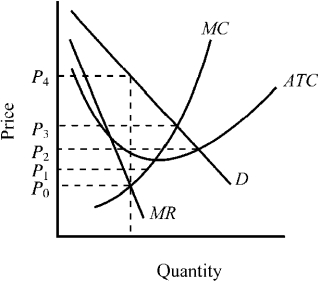 -Given the cost and revenue curves illustrated in Figure 11-10, what price will a profit-maximizing monopolist charge?
 (Multiple Choice)
5.0/5 (92)
(92) At the long-run equilibrium level of output, the monopolist's marginal cost will
(Multiple Choice)
4.9/5 (78)
(78) Which of the following constitutes a barrier limiting the entry of potential competitors into a market?
(Multiple Choice)
4.8/5 (81)
(81) Table 11-6
 -The demand and cost schedules of a monopolist are presented in Table 11-6. What price should a profit-maximizing monopolist charge?
 (Multiple Choice)
4.9/5 (77)
(77) Which of the following increases the likelihood that a group of sellers can increase profits as the result of collusion?
(Multiple Choice)
4.8/5 (79)
(79) Figure 11-12
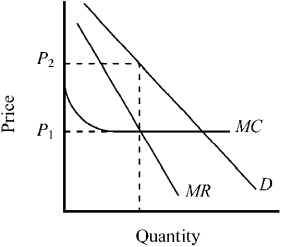 -Figure 11-12 indicates the industry cost and demand conditions for a product produced in an oligopolistic industry. The price of this product is most likely to be
 (Multiple Choice)
4.8/5 (74)
(74) Which of the following best explains why economists are generally critical of unregulated monopolists?
(Multiple Choice)
4.9/5 (93)
(93) What problem does the government have that makes price regulation less than an ideal solution?
(Multiple Choice)
4.8/5 (83)
(83) A market situation in which the average total costs of production continually decline with increased output until the entire market is supplied is called
(Multiple Choice)
4.9/5 (79)
(79) 
Filters
- Essay(0)
- Multiple Choice(0)
- Short Answer(0)
- True False(0)
- Matching(0)