



 Chat with AI
Exam 9: A: Price Takers and the Competitive Process

Exam 1: The Economic Approach210 Questions
Exam 2: A: Some Tools of the Economist224 Questions
Exam 2: B: Some Tools of the Economist33 Questions
Exam 3: A: Supply, Demand, and the Market Process225 Questions
Exam 3: B: Supply, Demand, and the Market Process180 Questions
Exam 4: A: Supply and Demand: Applications and Extensions233 Questions
Exam 4: B: Supply and Demand: Applications and Extensions98 Questions
Exam 5: Difficult Cases for the Market and the Role of Government168 Questions
Exam 6: The Economics of Collective Decision-Making180 Questions
Exam 7: Consumer Choice and Elasticity223 Questions
Exam 8: A: Costs and the Supply of Goods223 Questions
Exam 8: B: Costs and the Supply of Goods8 Questions
Exam 9: A: Price Takers and the Competitive Process237 Questions
Exam 9: B: Price Takers and the Competitive Process23 Questions
Exam 10: Price-Searcher Markets With Low Entry Barriers216 Questions
Exam 11: A: Price-Searcher Markets With High Entry Barriers229 Questions
Exam 11: B: Price-Searcher Markets With High Entry Barriers25 Questions
Exam 12: The Supply of and Demand for Productive Resources200 Questions
Exam 13: Earnings, Productivity, and the Job Market109 Questions
Exam 14: Investment, the Capital Market, and the Wealth of Nations129 Questions
Exam 15: Income Inequality and Poverty136 Questions
Exam 16: Appendix: Government Spending and Taxation79 Questions
Exam 17: Appendix: the Economics of Social Security54 Questions
Exam 18: Appendix: the Stock Market: Its Function, Performance, and Potential As an Investment Opportunity70 Questions
Exam 19: Appendix: Great Debates in Economics: Keynes Versus Hayek8 Questions
Exam 20: Appendix: the Crisis of 2008: Causes and Lessons for the Future64 Questions
Exam 21: Appendix: Lessons From the Great Depression60 Questions
Exam 22: Appendix: the Economics of Healthcare68 Questions
Exam 23: Appendix:education: Problems and Performance60 Questions
Exam 24: Appendix: Earnings Differences Between Men and Women47 Questions
Exam 26: Appendix: the Question of Resource Exhaustion61 Questions
Exam 25: Appendix: Do Labor Unions Increase the Wages of Workers74 Questions
Exam 27: Appendix: Difficult Environmental Cases and the Role of Government63 Questions
Select questions type


In the price-taker model, what impact does the individual firm have on the price of its product?
(Multiple Choice)
4.8/5  (73)
(73) If a firm in a price-taker market is earning zero economic profit, it
(Multiple Choice)
5.0/5 (82)
(82) When a law is passed that requires businesses to obtain permission from government officials in order to enter a market, this is an example of
(Multiple Choice)
4.8/5 (70)
(70) When price is greater than marginal cost for a firm in a competitive market,
(Multiple Choice)
4.8/5 (97)
(97) A firm is currently operating where the MC of the last unit produced is $84, and the MR of this unit is $70. What would you advise this firm to do?
(Multiple Choice)
4.7/5 (83)
(83) Which of the following is always true in competitive price-taker markets?
(Multiple Choice)
4.8/5 (73)
(73) The following table gives the average total cost of production for various levels of output for a competitive price-taker firm 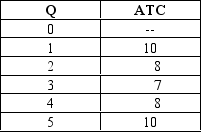 If the firm's fixed cost of production is $3 and the market price is $10, how many units should the firm produce to maximize its profit?
 (Multiple Choice)
4.9/5 (77)
(77) If an amusement park that is highly profitable during the summer months is unable to cover its variable costs during the winter months, it should
(Multiple Choice)
5.0/5 (82)
(82) Refer to Scenario 9-1. At Q = 999, the firm's profit amounts to
(Multiple Choice)
4.8/5 (85)
(85) Other things constant, if wheat production is a price-taker industry, a decrease in the price of fertilizer used to grow wheat will
(Multiple Choice)
4.8/5 (91)
(91) Which of the following best explains why a firm in a competitive price-taker market must take the price determined in the market?
(Multiple Choice)
5.0/5 (70)
(70) A competitive price-taker market in long-run equilibrium is described as efficient because firms
(Multiple Choice)
4.8/5 (73)
(73) If a competitive price-taker firm is currently producing a level of output at which marginal cost exceeds marginal revenue, then
(Multiple Choice)
4.9/5 (81)
(81) A price-taker market tends toward a state of long-run equilibrium in which firms earn only a normal rate of return (zero economic profits) because
(Multiple Choice)
4.8/5 (79)
(79) Historically, most economists have referred to markets where firms are price takers as
(Multiple Choice)
4.9/5 (69)
(69) When the marginal cost of a price-taker firm is more than the market price of its product, the firm should
(Multiple Choice)
4.8/5 (77)
(77) When entry barriers into a market are low, firms will tend to earn zero economic profit in the long run because
(Multiple Choice)
4.9/5 (78)
(78) Harry Smith sells wheat in a price-taker market. With regard to Smith's price and output choices, which of the following is true?
(Multiple Choice)
4.9/5 (82)
(82) The schedule of total costs for a chair-manufacturing firm is presented in the table below. If the market price of chairs is $100, which of the output levels should this price-taker firm produce in order to maximize profit? 
(Multiple Choice)
4.9/5 (83)
(83) 
Filters
- Essay(0)
- Multiple Choice(0)
- Short Answer(0)
- True False(0)
- Matching(0)