



 Chat with AI
Exam 9: A: Price Takers and the Competitive Process

Exam 1: The Economic Approach210 Questions
Exam 2: A: Some Tools of the Economist224 Questions
Exam 2: B: Some Tools of the Economist33 Questions
Exam 3: A: Supply, Demand, and the Market Process225 Questions
Exam 3: B: Supply, Demand, and the Market Process180 Questions
Exam 4: A: Supply and Demand: Applications and Extensions233 Questions
Exam 4: B: Supply and Demand: Applications and Extensions98 Questions
Exam 5: Difficult Cases for the Market and the Role of Government168 Questions
Exam 6: The Economics of Collective Decision-Making180 Questions
Exam 7: Consumer Choice and Elasticity223 Questions
Exam 8: A: Costs and the Supply of Goods223 Questions
Exam 8: B: Costs and the Supply of Goods8 Questions
Exam 9: A: Price Takers and the Competitive Process237 Questions
Exam 9: B: Price Takers and the Competitive Process23 Questions
Exam 10: Price-Searcher Markets With Low Entry Barriers216 Questions
Exam 11: A: Price-Searcher Markets With High Entry Barriers229 Questions
Exam 11: B: Price-Searcher Markets With High Entry Barriers25 Questions
Exam 12: The Supply of and Demand for Productive Resources200 Questions
Exam 13: Earnings, Productivity, and the Job Market109 Questions
Exam 14: Investment, the Capital Market, and the Wealth of Nations129 Questions
Exam 15: Income Inequality and Poverty136 Questions
Exam 16: Appendix: Government Spending and Taxation79 Questions
Exam 17: Appendix: the Economics of Social Security54 Questions
Exam 18: Appendix: the Stock Market: Its Function, Performance, and Potential As an Investment Opportunity70 Questions
Exam 19: Appendix: Great Debates in Economics: Keynes Versus Hayek8 Questions
Exam 20: Appendix: the Crisis of 2008: Causes and Lessons for the Future64 Questions
Exam 21: Appendix: Lessons From the Great Depression60 Questions
Exam 22: Appendix: the Economics of Healthcare68 Questions
Exam 23: Appendix:education: Problems and Performance60 Questions
Exam 24: Appendix: Earnings Differences Between Men and Women47 Questions
Exam 26: Appendix: the Question of Resource Exhaustion61 Questions
Exam 25: Appendix: Do Labor Unions Increase the Wages of Workers74 Questions
Exam 27: Appendix: Difficult Environmental Cases and the Role of Government63 Questions
Select questions type


Figure 9-8
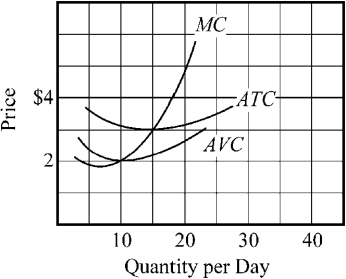 -If the market price in Figure 9-8 increases to $4, indicate the firm's profit-maximizing output and total revenue.
 (Multiple Choice)
4.9/5  (74)
(74) Farmer Fanny sells her crops in a competitive price-taker market. If she produces 500 bushels for total revenue of $2,500 and if harvesting the 501st bushel would raise her total cost from $2,500 to $2,505, her
(Multiple Choice)
4.9/5 (84)
(84) Figure 9-7
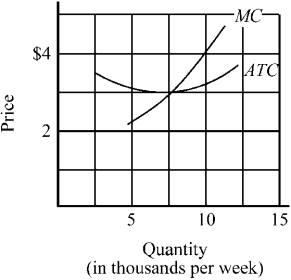 -If the market price in Figure 9-7 increases to $4, what should the firm do?
 (Multiple Choice)
4.9/5 (77)
(77) Competition as a dynamic process implies that individual firms in a market
(Multiple Choice)
4.8/5 (85)
(85) Suppose that price is below the minimum average total cost (ATC) but above the minimum average variable cost (AVC) and that the market price is expected to rise at least to ATC in the near future. In the short run, a firm that is a price taker would
(Multiple Choice)
4.8/5 (82)
(82) Figure 9-18
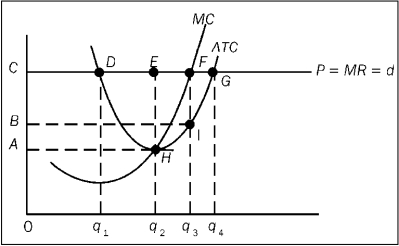 -The figure shows a representative firm in a price-taker market. Which of the following is true regarding the situation depicted in the figure?
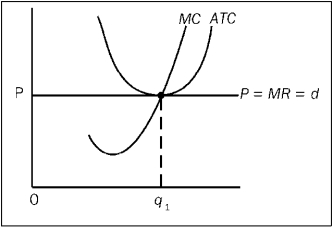
-The figure shows a representative firm in a price-taker market. Which of the following is true regarding the situation depicted in the figure? (Multiple Choice)
4.7/5 (77)
(77) Which of the following is a primary difference between price searchers and price takers?
(Multiple Choice)
4.8/5 (91)
(91) Which of the following best explains why price in competitive price-taker markets will tend to be driven to the minimum per-unit cost?
(Multiple Choice)
4.8/5 (74)
(74) Which of the following is a necessary condition for the presence of competition in a market?
(Multiple Choice)
4.8/5 (81)
(81) In the short run, a profit-maximizing price taker will expand output as long as the market price exceeds
(Multiple Choice)
5.0/5 (69)
(69) Claude's Copper Clappers sells clappers for $40 each in a competitive price-taker market. At its present rate of output, Claude's marginal cost is $39, average variable cost is $25, and average total cost is $45. To improve his profit/loss situation, Claude should
(Multiple Choice)
4.8/5 (84)
(84) The short-run supply curve in a price-taking industry is the
(Multiple Choice)
4.9/5 (72)
(72) In competitive price-taker markets, if one firm raises its price,
(Multiple Choice)
4.8/5 (75)
(75) Suppose Thelma and Louise both sell fried green tomatoes in a competitive price-taker market. If Louise increases her output,
(Multiple Choice)
4.7/5 (87)
(87) Figure 9-7
-When the market price in Figure 9-7 is $4, the firm's maximum weekly profit will be approximately
-When the market price in Figure 9-7 is $4, the firm's maximum weekly profit will be approximately (Multiple Choice)
4.7/5 (82)
(82) When market conditions in a price-taker market are such that firms cannot cover their production costs,
(Multiple Choice)
4.9/5 (83)
(83) 
Filters
- Essay(0)
- Multiple Choice(0)
- Short Answer(0)
- True False(0)
- Matching(0)