



 Chat with AI
Exam 9: A: Price Takers and the Competitive Process

Exam 1: The Economic Approach210 Questions
Exam 2: A: Some Tools of the Economist224 Questions
Exam 2: B: Some Tools of the Economist33 Questions
Exam 3: A: Supply, Demand, and the Market Process225 Questions
Exam 3: B: Supply, Demand, and the Market Process180 Questions
Exam 4: A: Supply and Demand: Applications and Extensions233 Questions
Exam 4: B: Supply and Demand: Applications and Extensions98 Questions
Exam 5: Difficult Cases for the Market and the Role of Government168 Questions
Exam 6: The Economics of Collective Decision-Making180 Questions
Exam 7: Consumer Choice and Elasticity223 Questions
Exam 8: A: Costs and the Supply of Goods223 Questions
Exam 8: B: Costs and the Supply of Goods8 Questions
Exam 9: A: Price Takers and the Competitive Process237 Questions
Exam 9: B: Price Takers and the Competitive Process23 Questions
Exam 10: Price-Searcher Markets With Low Entry Barriers216 Questions
Exam 11: A: Price-Searcher Markets With High Entry Barriers229 Questions
Exam 11: B: Price-Searcher Markets With High Entry Barriers25 Questions
Exam 12: The Supply of and Demand for Productive Resources200 Questions
Exam 13: Earnings, Productivity, and the Job Market109 Questions
Exam 14: Investment, the Capital Market, and the Wealth of Nations129 Questions
Exam 15: Income Inequality and Poverty136 Questions
Exam 16: Appendix: Government Spending and Taxation79 Questions
Exam 17: Appendix: the Economics of Social Security54 Questions
Exam 18: Appendix: the Stock Market: Its Function, Performance, and Potential As an Investment Opportunity70 Questions
Exam 19: Appendix: Great Debates in Economics: Keynes Versus Hayek8 Questions
Exam 20: Appendix: the Crisis of 2008: Causes and Lessons for the Future64 Questions
Exam 21: Appendix: Lessons From the Great Depression60 Questions
Exam 22: Appendix: the Economics of Healthcare68 Questions
Exam 23: Appendix:education: Problems and Performance60 Questions
Exam 24: Appendix: Earnings Differences Between Men and Women47 Questions
Exam 26: Appendix: the Question of Resource Exhaustion61 Questions
Exam 25: Appendix: Do Labor Unions Increase the Wages of Workers74 Questions
Exam 27: Appendix: Difficult Environmental Cases and the Role of Government63 Questions
Select questions type


Which of the following is the best example of a business firm operating in a competitive price-taker market?
(Multiple Choice)
4.8/5  (79)
(79) When consumer demand for a good produced in a price-taker market decreases,
(Multiple Choice)
4.7/5 (76)
(76) Figure 9-9
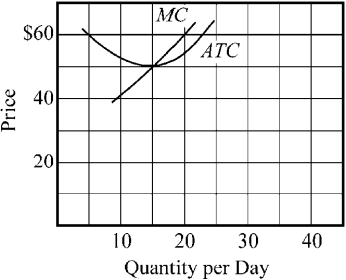 -When the market price is $60 in Figure 9-9, the firm's maximum daily profit will be approximately
 (Multiple Choice)
4.8/5 (74)
(74) Suppose the equilibrium price in a competitive price-taker market is $10 and a firm in the industry charges $9. Which of the following is true?
(Multiple Choice)
4.9/5 (90)
(90) (I) A firm's short-run supply curve is equal to its average variable cost curve above marginal revenue. (II) The short-run supply curve for a price-taker market is the horizontal sum of the supply curves of all firms in the industry.
(Multiple Choice)
5.0/5 (80)
(80) As the period for firms to expand output is lengthened, the elasticity of the market supply curve will
(Multiple Choice)
4.9/5 (82)
(82) Suppose product price is $24; MR = MC at Q = 200; AFC = $6; AVC = $16. What do you advise this competitive price-taker firm to do?
(Multiple Choice)
4.8/5 (83)
(83) Fun Time Inc. uses the same property and equipment to provide skiing services for six months during the winter and mountain roller boarding for six months during the summer. Monthly revenue and cost figures during the summer and winter months for Fun Time are shown below. Fun Time's $1,000 monthly fixed costs will be incurred as long as it remains in business.  Which of the following should Fun Time do if it wants to maximize its profit?
 (Multiple Choice)
4.9/5 (82)
(82) The supply curve of a price-taker firm in the short run is the
(Multiple Choice)
5.0/5 (84)
(84) Figure 9-3
 -Figure 9-3 depicts the cost curves of a firm in a price-taker industry. At what output would the firm's per-unit cost be at a minimum?
 (Multiple Choice)
4.8/5 (80)
(80) Firms that can choose what price they will charge for their product and can increase the number of units sold by reducing price are called
(Multiple Choice)
4.9/5 (85)
(85) A profit-maximizing entrepreneur will produce and sell an additional unit of output as long as
(Multiple Choice)
4.9/5 (70)
(70) The main difference between a firm that is a price searcher and a firm that is a price taker is that a
(Multiple Choice)
4.9/5 (95)
(95) "I have been making furniture for 27 years. I have never heard of either marginal cost or marginal revenue. Fancy economic theories mean nothing to me. I just know how to do well in business. Whenever I can sell something for more than it cost me to produce it, I make it, and whenever I can't sell it for enough to cover my cost, I don't. That's how I stay in business and earn income for my family. Common sense and watching the market are good enough for me." For producers like this, economic models
(Multiple Choice)
4.9/5 (82)
(82) If marginal revenue exceeds marginal cost, a price-taker firm should
(Multiple Choice)
4.9/5 (71)
(71) Fun Time Inc. uses the same property and equipment to provide skiing services for six months during the winter and mountain roller boarding for six months during the summer. Monthly revenue and cost figures during the summer and winter months for Fun Time are shown below. Fun Time's $1,000 monthly fixed costs will be incurred as long as it remains in business.  Which of the following should Fun Time do if it wants to maximize its annual profit?
 (Multiple Choice)
4.8/5 (67)
(67) 
Filters
- Essay(0)
- Multiple Choice(0)
- Short Answer(0)
- True False(0)
- Matching(0)