



 Chat with AI
Exam 9: A: Price Takers and the Competitive Process

Exam 1: The Economic Approach210 Questions
Exam 2: A: Some Tools of the Economist224 Questions
Exam 2: B: Some Tools of the Economist33 Questions
Exam 3: A: Supply, Demand, and the Market Process225 Questions
Exam 3: B: Supply, Demand, and the Market Process180 Questions
Exam 4: A: Supply and Demand: Applications and Extensions233 Questions
Exam 4: B: Supply and Demand: Applications and Extensions98 Questions
Exam 5: Difficult Cases for the Market and the Role of Government168 Questions
Exam 6: The Economics of Collective Decision-Making180 Questions
Exam 7: Consumer Choice and Elasticity223 Questions
Exam 8: A: Costs and the Supply of Goods223 Questions
Exam 8: B: Costs and the Supply of Goods8 Questions
Exam 9: A: Price Takers and the Competitive Process237 Questions
Exam 9: B: Price Takers and the Competitive Process23 Questions
Exam 10: Price-Searcher Markets With Low Entry Barriers216 Questions
Exam 11: A: Price-Searcher Markets With High Entry Barriers229 Questions
Exam 11: B: Price-Searcher Markets With High Entry Barriers25 Questions
Exam 12: The Supply of and Demand for Productive Resources200 Questions
Exam 13: Earnings, Productivity, and the Job Market109 Questions
Exam 14: Investment, the Capital Market, and the Wealth of Nations129 Questions
Exam 15: Income Inequality and Poverty136 Questions
Exam 16: Appendix: Government Spending and Taxation79 Questions
Exam 17: Appendix: the Economics of Social Security54 Questions
Exam 18: Appendix: the Stock Market: Its Function, Performance, and Potential As an Investment Opportunity70 Questions
Exam 19: Appendix: Great Debates in Economics: Keynes Versus Hayek8 Questions
Exam 20: Appendix: the Crisis of 2008: Causes and Lessons for the Future64 Questions
Exam 21: Appendix: Lessons From the Great Depression60 Questions
Exam 22: Appendix: the Economics of Healthcare68 Questions
Exam 23: Appendix:education: Problems and Performance60 Questions
Exam 24: Appendix: Earnings Differences Between Men and Women47 Questions
Exam 26: Appendix: the Question of Resource Exhaustion61 Questions
Exam 25: Appendix: Do Labor Unions Increase the Wages of Workers74 Questions
Exam 27: Appendix: Difficult Environmental Cases and the Role of Government63 Questions
Select questions type


Figure 9-11
 -Which of the following represents the firm's total cost of producing the profit-maximizing output in Figure 9-11?
 (Multiple Choice)
4.9/5  (82)
(82) Figure 9-8
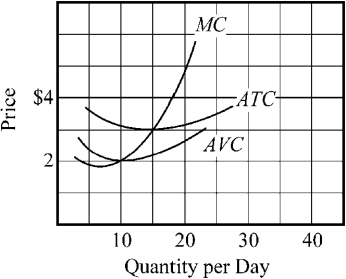 -The average total cost (ATC) and marginal costs (MC) of a firm producing in a price-taker industry are depicted in Figure 9-8. If the current market price of the firm's product is $3, what output should this firm produce per day?
 (Multiple Choice)
4.9/5 (73)
(73) Why will the long-run market supply curve for most products slope upward to the right?
(Multiple Choice)
4.9/5 (71)
(71) Figure 9-15
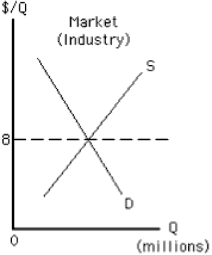
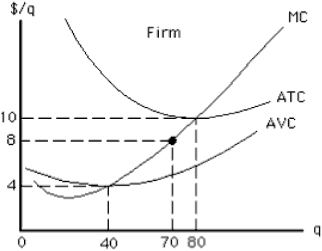 -At which price and quantity is profit maximized for the competitive price-taker firm represented in Figure 9-15?
 (Multiple Choice)
4.9/5 (83)
(83) Figure 9-4
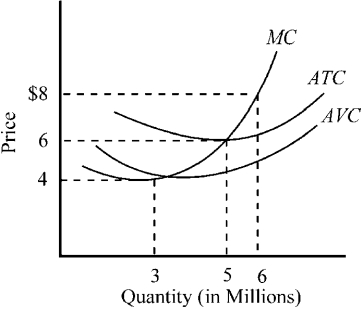 -Figure 9-4 indicates the cost conditions for a firm operating in a price-taker market. If the market price of the firm's product is $6, what action will maximize the firm's profit?
 (Multiple Choice)
4.9/5 (72)
(72) Table 9-1
 -Refer to Table 9-1. If the market price of tomatoes rose to $570 per ton, how many tons per month would the Tuckers produce if they were maximizing profit?
 (Multiple Choice)
4.8/5 (69)
(69) If the market price in a price-taking industry was currently above the average total cost of production for firms in the industry,
(Multiple Choice)
4.8/5 (92)
(92) A competitive price-taker firm's marginal cost curve is regarded as its supply curve because
(Multiple Choice)
4.8/5 (69)
(69) Suppose the development of new drought-resistant hybrid seed corn leads to a 50-percent increase in the average yield per acre without increasing the cost to the farmers who use the new technology. If the conditions in the corn production industry are approximated by the price-taker model, which of the following is most likely to occur?
(Multiple Choice)
4.9/5 (74)
(74) If a profit-maximizing firm shuts down in the short run, it must be true that before the shutdown, at all positive output levels,
(Multiple Choice)
4.7/5 (73)
(73) If a price-taker firm selling in a competitive market offers its product at a higher price than others, it will
(Multiple Choice)
4.8/5 (83)
(83) If you were the owner of a price-taker firm operating at an output level where the marginal cost of producing another unit was $5, and the market price was $7, then you
(Multiple Choice)
4.8/5 (70)
(70) Figure 9-14
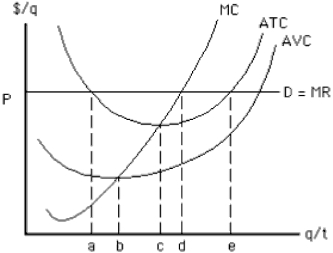 -Consider Figure 9-14. At which quantity will this firm maximize profit?
 (Multiple Choice)
4.8/5 (69)
(69) A perfectly elastic, long-run market supply curve is most likely to be achieved in
(Multiple Choice)
4.8/5 (67)
(67) Figure 9-6
 -The average total cost (ATC) and marginal costs (MC) of a firm producing in a price-taker industry are depicted in Figure 9-6. If the current market price of the firm's product is $15, what output should this firm produce?
 (Multiple Choice)
5.0/5 (81)
(81) Figure 9-18
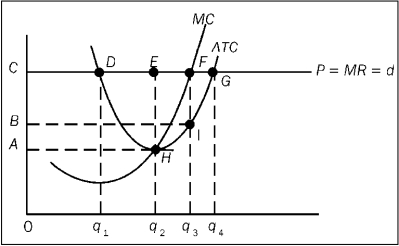 -Refer to Figure 9-18. At the profit-maximizing level of output, the firm will earn an economic (Hint: Areas in the exhibit are referenced by the four letters on the corners of the respective area.)
 (Multiple Choice)
4.7/5 (75)
(75) When the conditions in a competitive price-taker market are such that the firms are consistently unable to cover their production costs,
(Multiple Choice)
4.9/5 (90)
(90) Figure 9-16
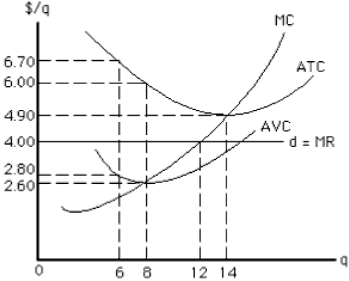 -If the price-taker firm in Figure 9-16 is currently producing 6 units, then to maximize profit in the short run, it should
 (Multiple Choice)
4.8/5 (84)
(84) 
Filters
- Essay(0)
- Multiple Choice(0)
- Short Answer(0)
- True False(0)
- Matching(0)