



 Chat with AI
Exam 11: Monopolistic Competition and Oligopoly

Exam 1: Economics: Foundations and Models444 Questions
Exam 2: Trade-Offs, comparative Advantage, and the Market System498 Questions
Exam 3: Where Prices Come From: the Interaction of Demand and Supply475 Questions
Exam 4: Market Efficiency and Market Failure465 Questions
Exam 5: The Economics of Health Care334 Questions
Exam 6: Firms, the Stock Market, and Corporate Governance250 Questions
Exam 7: Consumer Choice and Elasticity380 Questions
Exam 8: Technology, production, and Costs276 Questions
Exam 9: Firms in Perfectly Competitive Markets297 Questions
Exam 10: Monopoly and Antitrust Policy271 Questions
Exam 11: Monopolistic Competition and Oligopoly414 Questions
Exam 12: Gdp: Measuring Total Production and Income266 Questions
Exam 13: Unemployment and Inflation292 Questions
Exam 14: Economic Growth, the Financial System, and Business Cycles257 Questions
Exam 15: Aggregate Demand and Aggregate Supply Analysis284 Questions
Exam 16: Money, banks, and the Federal Reserve System279 Questions
Exam 17: Monetary Policy277 Questions
Exam 18: Fiscal Policy282 Questions
Exam 19: Comparative Advantage, international Trade, and Exchange Rates446 Questions
Select questions type


Firms are more likely to find themselves in a prisoner's dilemma in sequential games as opposed to simultaneous games.
(True/False)
5.0/5  (73)
(73) Suppose a monopolistically competitive firm sells 25 units at a price of $10.Calculate its marginal revenue per unit of output if it sells 5 more units of output when it reduced its price to $9.
(Multiple Choice)
4.8/5 (83)
(83) Which of the following is not necessarily a consequence of occupational licensing laws?
(Multiple Choice)
5.0/5 (80)
(80) Figure 11-14
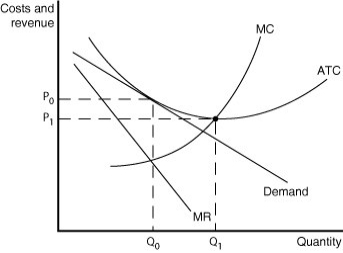 Figure 11-14 illustrates a monopolistically competitive firm.
-Refer to Figure 11-14.Which of the following statements describes the firm depicted in the diagram?
Figure 11-14 illustrates a monopolistically competitive firm.
-Refer to Figure 11-14.Which of the following statements describes the firm depicted in the diagram? (Multiple Choice)
4.9/5 (73)
(73) In most business situations where firms compete,often they can escape the prisoner's dilemma and reach the most profitable outcome.Which of the following is a reason for this?
(Multiple Choice)
4.8/5 (80)
(80) Only one of the following statements is correct.The statements compare perfectly competitive (PC)markets and monopolistically competitive (MC)markets.Which statement is correct?
(Multiple Choice)
4.9/5 (82)
(82) Collusion makes firms better off because if they act as a single entity (a cartel)they can reduce output and increase their prices and profits.But some cartels have failed and others are unstable.Which of the following is a reason why cartels often break down?
(Multiple Choice)
4.8/5 (86)
(86) Figure 11-9
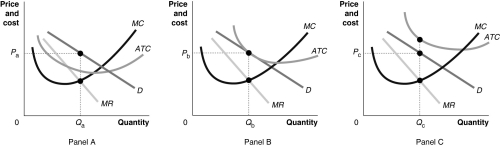 -Refer to Figure 11-9.Which of the graphs in the figure depicts a monopolistically competitive firm that is minimizing its losses?
 (Multiple Choice)
4.8/5 (69)
(69) If economies of scale are relatively unimportant in an industry,the typical firm's long-run average total cost curve will reach a minimum at a level of output that is a ________ fraction of total industry sales.The industry will be ________.
(Multiple Choice)
4.7/5 (68)
(68) The DeBeers Company of South Africa was able to block competition through
(Multiple Choice)
4.7/5 (86)
(86) The economic analysis of monopolistic competition shows that market forces eliminate profits in the long run.However,it is possible for a firm to continue to earn economic profits if the firm
(Multiple Choice)
4.7/5 (80)
(80) In which of the following cartels is total cartel profit likely to be the highest?
(Multiple Choice)
4.8/5 (76)
(76) In both monopolistically competitive and perfectly competitive industries
(Multiple Choice)
4.7/5 (90)
(90) An example of a government-imposed barrier to entry gives a firm the exclusive right to a new product for a period of 20 years from the date the product is invented.This entry barrier is known as
(Multiple Choice)
4.9/5 (68)
(68) Table 11-5
Quantity Price Total Cost 1 \ 18 \ 14 2 16 20 3 14 26 4 12 32 5 10 38 6 8 44
Table 11-5 shows the demand and cost data facing a monopolistically competitive producer of canvas bags.
-Refer to Table 11-5.At the profit-maximizing or loss-minimizing output level
(Multiple Choice)
4.8/5 (87)
(87) If firms are protected by substantial barriers to entry,short-run profits can turn into long-run profits.
(True/False)
4.9/5 (73)
(73) Table 11-15
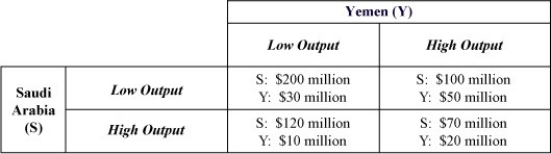 -Refer to Table 11-15.Suppose the payoff matrix in the above figure represents the payoffs to Saudi Arabia and Yemen for the production of oil.Saudi Arabia and Yemen must decide how much oil to produce.Since the demand for oil is inelastic,relatively low production rates drive up prices and profits.Saudi Arabia,the world's largest and lowest cost producer,is able to influence market price; it has an incentive to keep output low.Yemen,on the other hand,is a relatively high cost producer with much smaller reserves.Assume Saudi Arabia now decides to try to further influence the oil market by offering to pay Yemen $25 million to produce a low output.
a.Create a new payoff matrix that reflects Saudi Arabia's willingness to pay Yemen $25 million to produce a low output.
b.What is the dominant strategy for each country in this new game?
c.What is the new Nash equilibrium?
-Refer to Table 11-15.Suppose the payoff matrix in the above figure represents the payoffs to Saudi Arabia and Yemen for the production of oil.Saudi Arabia and Yemen must decide how much oil to produce.Since the demand for oil is inelastic,relatively low production rates drive up prices and profits.Saudi Arabia,the world's largest and lowest cost producer,is able to influence market price; it has an incentive to keep output low.Yemen,on the other hand,is a relatively high cost producer with much smaller reserves.Assume Saudi Arabia now decides to try to further influence the oil market by offering to pay Yemen $25 million to produce a low output.
a.Create a new payoff matrix that reflects Saudi Arabia's willingness to pay Yemen $25 million to produce a low output.
b.What is the dominant strategy for each country in this new game?
c.What is the new Nash equilibrium? (Essay)
4.9/5 (85)
(85) Table 11-13
Power Fuel's (P) Strategy Brawny Juice's (B) Strategy High Price Low Price High Price P: \ 12 P: \ 16 B: \ 12 B: \ 4m Low Price P: \ 4 P: \ 8 B: \ 16 B: \ 8
Two rival oligopolists in the athletic supplements industry, the Power Fuel Company and the Brawny Juice Company, have to decide on their pricing strategy.Each can choose either a high price or a low price.Table 11-13 shows the payoff matrix with the profits that each firm can expect to earn depending on the pricing strategy it adopts.
-Refer to Table 11-13.If the two firms collude,is there an incentive for either to cheat on the collusion agreement?
(Multiple Choice)
5.0/5 (77)
(77) Which of the following is an example of a way in which a firm in oligopoly can escape the prisoner's dilemma?
(Multiple Choice)
4.7/5 (85)
(85) 
Filters
- Essay(0)
- Multiple Choice(0)
- Short Answer(0)
- True False(0)
- Matching(0)