



 Chat with AI
Exam 11: Monopolistic Competition and Oligopoly

Exam 1: Economics: Foundations and Models444 Questions
Exam 2: Trade-Offs, comparative Advantage, and the Market System498 Questions
Exam 3: Where Prices Come From: the Interaction of Demand and Supply475 Questions
Exam 4: Market Efficiency and Market Failure465 Questions
Exam 5: The Economics of Health Care334 Questions
Exam 6: Firms, the Stock Market, and Corporate Governance250 Questions
Exam 7: Consumer Choice and Elasticity380 Questions
Exam 8: Technology, production, and Costs276 Questions
Exam 9: Firms in Perfectly Competitive Markets297 Questions
Exam 10: Monopoly and Antitrust Policy271 Questions
Exam 11: Monopolistic Competition and Oligopoly414 Questions
Exam 12: Gdp: Measuring Total Production and Income266 Questions
Exam 13: Unemployment and Inflation292 Questions
Exam 14: Economic Growth, the Financial System, and Business Cycles257 Questions
Exam 15: Aggregate Demand and Aggregate Supply Analysis284 Questions
Exam 16: Money, banks, and the Federal Reserve System279 Questions
Exam 17: Monetary Policy277 Questions
Exam 18: Fiscal Policy282 Questions
Exam 19: Comparative Advantage, international Trade, and Exchange Rates446 Questions
Select questions type


Table 11-2
Quantity (cases) Price (dollars) Total Revenue (dollars) Total Cost (dollars) 1 \ 75 \ 75 \ 60 2 70 140 85 3 65 195 105 4 60 240 115 5 55 275 130 6 50 300 155 7 45 315 190 8 40 320 230 9 35 315 280
Eco Energy is a monopolistically competitive producer of a sports beverage called Power On. Table 11-2 shows the firm's demand and cost schedules.
-Refer to Table 11-2.What is the output (Q)that maximizes profit and what is the price (P)charged?
(Multiple Choice)
4.8/5  (76)
(76) The key characteristics of a monopolistically competitive market structure include
(Multiple Choice)
4.8/5 (81)
(81) A table that shows the possible payoffs each firm earns from every combination of strategies by all firms is called
(Multiple Choice)
4.9/5 (75)
(75) In theory,in the long run,monopolistically competitive firms earns zero profits.However,in reality there are some ways by which a firm can avoid losing profits.Which of the following is one such way?
(Multiple Choice)
4.9/5 (70)
(70) A monopolistically competitive industry that earns economic profits in the short run will face a more elastic demand curve in the long run.
(True/False)
4.8/5 (77)
(77) Figure 11-19
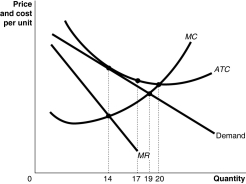 -Refer to Figure 11-19 to answer the following questions.
a.What is the productively efficient output?
b.What is the allocatively efficient output?
c.What is the amount of excess capacity?
d.Suppose the firm is currently producing 14 units.What happens if it increases output to 17 units?
-Refer to Figure 11-19 to answer the following questions.
a.What is the productively efficient output?
b.What is the allocatively efficient output?
c.What is the amount of excess capacity?
d.Suppose the firm is currently producing 14 units.What happens if it increases output to 17 units? (Essay)
4.7/5 (76)
(76) An equilibrium in a game in which players pursue their own self-interests and do not cooperate is called a
(Multiple Choice)
4.8/5 (81)
(81) In the United States,the average person mostly patronizes firms that operate in
(Multiple Choice)
4.9/5 (81)
(81) Sparkle,one of many firms in the market for toothpaste,is in long-run equilibrium.Sparkle has a small market share and has been in business for a long time.
a.Identify the market structure in which Sparkle operates.Explain your answer.
b.What is Sparkle's profit or loss? Explain your answer.If you cannot determine the profit or loss,explain what information is missing.
c.Draw a diagram showing Sparkle's demand curve,marginal revenue curve,average total cost curve and marginal cost curve.Label your diagram.
(Essay)
4.7/5 (82)
(82) Table 11-13
Power Fuel's (P) Strategy Brawny Juice's (B) Strategy High Price Low Price High Price P: \ 12 P: \ 16 B: \ 12 B: \ 4m Low Price P: \ 4 P: \ 8 B: \ 16 B: \ 8
Two rival oligopolists in the athletic supplements industry, the Power Fuel Company and the Brawny Juice Company, have to decide on their pricing strategy.Each can choose either a high price or a low price.Table 11-13 shows the payoff matrix with the profits that each firm can expect to earn depending on the pricing strategy it adopts.
-Refer to Table 11-13.If the firms act out of individual self-interest,which prices will they select?
(Multiple Choice)
5.0/5 (84)
(84) How does the demand curve for an oligopoly firm differ from the demand curves for firms in competitive market structures?
(Essay)
4.7/5 (84)
(84) An oligopoly firm is similar to a monopolistically competitive firm in that
(Multiple Choice)
4.9/5 (73)
(73) Figure 11-18
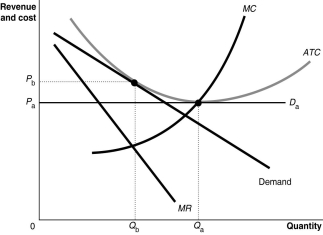 -Refer to Figure 11-18.The diagram demonstrates that
 (Multiple Choice)
4.7/5 (73)
(73) A monopolistic competitor does not earn profits in the long run unless it can successfully differentiate its product in the minds of its consumers.
(True/False)
4.9/5 (89)
(89) A reason why there is more competition among restaurants than among large discount department stores is that restaurants
(Multiple Choice)
4.7/5 (83)
(83) The four-firm concentration ratio of the aircraft industry is over 80 percent.Most economists would consider this industry an oligopoly.
(True/False)
4.7/5 (85)
(85) 
Filters
- Essay(0)
- Multiple Choice(0)
- Short Answer(0)
- True False(0)
- Matching(0)