



 Chat with AI
Exam 11: Monopolistic Competition and Oligopoly

Exam 1: Economics: Foundations and Models444 Questions
Exam 2: Trade-Offs, comparative Advantage, and the Market System498 Questions
Exam 3: Where Prices Come From: the Interaction of Demand and Supply475 Questions
Exam 4: Market Efficiency and Market Failure465 Questions
Exam 5: The Economics of Health Care334 Questions
Exam 6: Firms, the Stock Market, and Corporate Governance250 Questions
Exam 7: Consumer Choice and Elasticity380 Questions
Exam 8: Technology, production, and Costs276 Questions
Exam 9: Firms in Perfectly Competitive Markets297 Questions
Exam 10: Monopoly and Antitrust Policy271 Questions
Exam 11: Monopolistic Competition and Oligopoly414 Questions
Exam 12: Gdp: Measuring Total Production and Income266 Questions
Exam 13: Unemployment and Inflation292 Questions
Exam 14: Economic Growth, the Financial System, and Business Cycles257 Questions
Exam 15: Aggregate Demand and Aggregate Supply Analysis284 Questions
Exam 16: Money, banks, and the Federal Reserve System279 Questions
Exam 17: Monetary Policy277 Questions
Exam 18: Fiscal Policy282 Questions
Exam 19: Comparative Advantage, international Trade, and Exchange Rates446 Questions
Select questions type


A monopolistically competitive firm maximizes profit where
(Multiple Choice)
4.8/5  (79)
(79) Consider two oligopolistic industries selling the same product in different locations.In the first industry,firms always match price changes by any other firm in the industry.In the second industry,firms always ignore price changes by any other firm.which of the following statements is true about these two industries,holding everything else constant?
(Multiple Choice)
4.9/5 (78)
(78) Figure 11-4
 Figure 11-4 shows short-run cost and demand curves for a monopolistically competitive firm in the market for designer watches.
-Refer to Figure 11-4.What is the area that represents the loss made by the firm?
Figure 11-4 shows short-run cost and demand curves for a monopolistically competitive firm in the market for designer watches.
-Refer to Figure 11-4.What is the area that represents the loss made by the firm? (Multiple Choice)
4.8/5 (72)
(72) Figure 11-4
Figure 11-4 shows short-run cost and demand curves for a monopolistically competitive firm in the market for designer watches.
-Refer to Figure 11-4.What is the area that represents the total revenue made by the firm?
Figure 11-4 shows short-run cost and demand curves for a monopolistically competitive firm in the market for designer watches.
-Refer to Figure 11-4.What is the area that represents the total revenue made by the firm? (Multiple Choice)
4.9/5 (71)
(71) In the long-run equilibrium,both the perfectly competitive firm and the monopolistically competitive firm produce the output at which MR=MC and charge a price equal to the average total cost of production.
(True/False)
4.8/5 (74)
(74) Which government agency publishes four-firm concentration ratios?
(Multiple Choice)
4.8/5 (78)
(78) Figure 11-3
 -Refer to Figure 11-3.What is the marginal revenue of the sixth unit of output?
 (Multiple Choice)
4.9/5 (90)
(90) Table 11-1
Quantity Price (dollars) Total Revenue (dollars) 1 \ 7.50 \ 7.50 2 7.00 14.00 3 6.50 19.50 4 6.00 24.00 5 5.50 27.50 6 5.00 30.00
-Refer to Table 11-1.What is the marginal revenue of the 3rd unit?
(Multiple Choice)
5.0/5 (93)
(93) Which of the following characteristics is common to monopolistic competition and perfect competition?
(Multiple Choice)
4.9/5 (78)
(78) Firms such as Caribou Coffee and Diedrich Coffee operate hundreds of coffeehouses nationwide while firms such as Dunn Brothers Coffee operate only in four states.How would you characterize these stores?
(Multiple Choice)
5.0/5 (82)
(82) In the short run,a profit-maximizing firm's decision to produce should be guided by whether
(Multiple Choice)
4.8/5 (77)
(77) Table 11-14
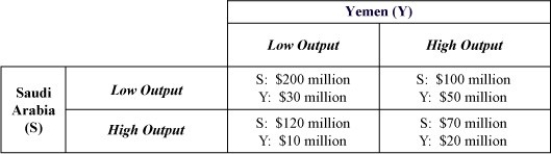 -Refer to Table 11-14.Saudi Arabia and Yemen must decide how much oil to produce.Since the demand for oil is inelastic,relatively low production rates drive up prices and profits.Saudi Arabia,the world's largest and lowest cost producer,is able to influence market price; it has an incentive to keep output low.Yemen,on the other hand,is a relatively high cost producer with much smaller reserves.Use the payoff matrix in Table 11-14 to answer the following questions.
a.What is the dominant strategy for Saudi Arabia?
b.What is the dominant strategy for Yemen?
c.What is the Nash equilibrium?
-Refer to Table 11-14.Saudi Arabia and Yemen must decide how much oil to produce.Since the demand for oil is inelastic,relatively low production rates drive up prices and profits.Saudi Arabia,the world's largest and lowest cost producer,is able to influence market price; it has an incentive to keep output low.Yemen,on the other hand,is a relatively high cost producer with much smaller reserves.Use the payoff matrix in Table 11-14 to answer the following questions.
a.What is the dominant strategy for Saudi Arabia?
b.What is the dominant strategy for Yemen?
c.What is the Nash equilibrium? (Essay)
4.9/5 (85)
(85) Price leadership is a form of explicit collusion where one firm in an oligopoly announces a price change and expects all other firms to follow suit.
(True/False)
4.8/5 (89)
(89) Table 11-2
Quantity (cases) Price (dollars) Total Revenue (dollars) Total Cost (dollars) 1 \ 75 \ 75 \ 60 2 70 140 85 3 65 195 105 4 60 240 115 5 55 275 130 6 50 300 155 7 45 315 190 8 40 320 230 9 35 315 280
Eco Energy is a monopolistically competitive producer of a sports beverage called Power On. Table 11-2 shows the firm's demand and cost schedules.
-Refer to Table 11-2.What is Eco Energy's profit?
(Multiple Choice)
4.8/5 (77)
(77) A fundamental assumption in game theory is that players do not interact with each other.
(True/False)
4.8/5 (86)
(86) What is the profit-maximizing rule for a monopolistically competitive firm?
(Multiple Choice)
4.9/5 (76)
(76) Monopolistically competitive firms achieve allocative efficiency but not productive efficiency.
(True/False)
4.9/5 (83)
(83) In the long run,if the demand curve of a monopolistically competitive firm is tangent to its average total cost curve then
(Multiple Choice)
5.0/5 (91)
(91) 
Filters
- Essay(0)
- Multiple Choice(0)
- Short Answer(0)
- True False(0)
- Matching(0)