



 Chat with AI
Exam 18: Fiscal Policy

Exam 1: Economics: Foundations and Models444 Questions
Exam 2: Trade-Offs, comparative Advantage, and the Market System498 Questions
Exam 3: Where Prices Come From: the Interaction of Demand and Supply475 Questions
Exam 4: Market Efficiency and Market Failure465 Questions
Exam 5: The Economics of Health Care334 Questions
Exam 6: Firms, the Stock Market, and Corporate Governance250 Questions
Exam 7: Consumer Choice and Elasticity380 Questions
Exam 8: Technology, production, and Costs276 Questions
Exam 9: Firms in Perfectly Competitive Markets297 Questions
Exam 10: Monopoly and Antitrust Policy271 Questions
Exam 11: Monopolistic Competition and Oligopoly414 Questions
Exam 12: Gdp: Measuring Total Production and Income266 Questions
Exam 13: Unemployment and Inflation292 Questions
Exam 14: Economic Growth, the Financial System, and Business Cycles257 Questions
Exam 15: Aggregate Demand and Aggregate Supply Analysis284 Questions
Exam 16: Money, banks, and the Federal Reserve System279 Questions
Exam 17: Monetary Policy277 Questions
Exam 18: Fiscal Policy282 Questions
Exam 19: Comparative Advantage, international Trade, and Exchange Rates446 Questions
Select questions type


The problem typically during a recession is not that there is too little money,but too little spending.If the problem was too little money,what would be its cause? If the problem was too little spending,what could be its cause?

Free
(Essay)
4.8/5  (75)
(75) Correct Answer: Verified
Too little money would be caused by too small of a money supply by the Federal Reserve.Too little spending could be caused by a variety of reasons such as a decrease in consumption spending by households because they become pessimistic about the future,a decrease in investment spending by firms because they lower their estimates of the future profitability of new factories and machinery,or a decrease in U.S.exports because a major trading partner is in a recession.
Suppose the federal budget deficit for the year was $100 billion and the economy was in a recession.If the economy had been at potential GDP,it is estimated that tax revenues would have been $60 billion higher and government spending on transfer payments $50 billion lower.Using these estimates,the cyclically adjusted budget
Free
(Multiple Choice)
4.8/5 (92)
(92) Correct Answer:Verified
VerifiedC
A change in consumption spending caused by income changes is ________ change in spending,and a change in government spending that occurs to improve roads and bridges is ________ change in spending.
(Multiple Choice)
4.9/5 (83)
(83) Figure 18-9
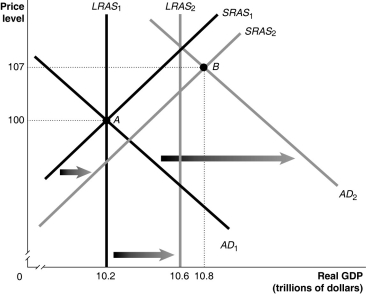 -Refer to Figure 18-9.Given that the economy has moved from A to B in the graph above,which of the following would the appropriate fiscal policy to achieve potential GDP?
 (Multiple Choice)
4.8/5 (76)
(76) A permanent tax cut would likely ________ consumption spending ________ than would a tax rebate like the one issued in 2008.
(Multiple Choice)
4.9/5 (91)
(91) The three categories of federal government expenditures,in addition to government purchases,are
(Multiple Choice)
4.8/5 (69)
(69) Of the $840 billion American Recovery and Reinvestment Act stimulus package which was enacted in 2009,the largest tax cuts occurred in which category?
(Multiple Choice)
4.8/5 (74)
(74) If we include consideration of potential effects of a proposed tax reduction and simplification on the labor supply,we would expect crowding out of investment and net exports brought about by the tax cut to be
(Multiple Choice)
4.9/5 (88)
(88) Explain why the timing of fiscal policy may be more difficult than the timing of monetary policy.
(Essay)
4.9/5 (80)
(80) If the economy is falling below potential real GDP,which of the following would be an appropriate fiscal policy to bring the economy back to long-run aggregate supply? An increase in
(Multiple Choice)
4.8/5 (60)
(60) During most of the years of the Great Depression,the actual federal budget was in ________,and the cyclically adjusted budget was in ________.
(Multiple Choice)
4.9/5 (86)
(86) Accumulating debt poses a problem for the U.S.federal government because
(Multiple Choice)
4.9/5 (77)
(77) In early 2008,the housing crisis and rising oil prices increased the risk of recession in the United States.What fiscal policy action was taken by Congress and the president to counter these events?
(Multiple Choice)
4.8/5 (87)
(87) Borrowing to pay for long-lived capital expenditures makes sense as
(Multiple Choice)
4.7/5 (90)
(90) Suppose that the federal budget is balanced when GDP is at potential GDP.If equilibrium GDP falls below potential
(Multiple Choice)
4.7/5 (94)
(94) To complement actions by the Fed to reduce inflation,Congress and the President can cut spending and/or raise taxes.
(True/False)
4.7/5 (71)
(71) The tax multiplier is smaller in absolute value than the government purchases multiplier because some portion of the
(Multiple Choice)
4.9/5 (83)
(83) 
Filters
- Essay(0)
- Multiple Choice(0)
- Short Answer(0)
- True False(0)
- Matching(0)