



 Chat with AI
Exam 18: Fiscal Policy

Exam 1: Economics: Foundations and Models444 Questions
Exam 2: Trade-Offs, comparative Advantage, and the Market System498 Questions
Exam 3: Where Prices Come From: the Interaction of Demand and Supply475 Questions
Exam 4: Market Efficiency and Market Failure465 Questions
Exam 5: The Economics of Health Care334 Questions
Exam 6: Firms, the Stock Market, and Corporate Governance250 Questions
Exam 7: Consumer Choice and Elasticity380 Questions
Exam 8: Technology, production, and Costs276 Questions
Exam 9: Firms in Perfectly Competitive Markets297 Questions
Exam 10: Monopoly and Antitrust Policy271 Questions
Exam 11: Monopolistic Competition and Oligopoly414 Questions
Exam 12: Gdp: Measuring Total Production and Income266 Questions
Exam 13: Unemployment and Inflation292 Questions
Exam 14: Economic Growth, the Financial System, and Business Cycles257 Questions
Exam 15: Aggregate Demand and Aggregate Supply Analysis284 Questions
Exam 16: Money, banks, and the Federal Reserve System279 Questions
Exam 17: Monetary Policy277 Questions
Exam 18: Fiscal Policy282 Questions
Exam 19: Comparative Advantage, international Trade, and Exchange Rates446 Questions
Select questions type


An appropriate fiscal policy response when aggregate demand is growing at a faster rate than aggregate supply is to decrease the money supply.
(True/False)
4.7/5  (102)
(102) If Congress wanted to counteract the effects of a recession it could
(Multiple Choice)
4.7/5 (77)
(77) Assume a country is required by law to balance the budget every year.Suppose aggregate demand falls,causing a recession and a budget deficit.To balance the budget,what would the government need to do with the level of government spending and taxes? How would these changes in government spending and taxes affect aggregate demand and the economy?
(Essay)
5.0/5 (78)
(78) Fiscal policy actions that are intended to have long-run effects on real GDP attempt to increase ________ through changing ________.
(Multiple Choice)
4.9/5 (84)
(84) Included in government expenditures are government purchases and transfer payments.
(True/False)
4.9/5 (95)
(95) If policy makers implement an expansionary fiscal policy but do not take into account the potential for crowding out,the new equilibrium level of GDP is likely to
(Multiple Choice)
4.7/5 (81)
(81) Figure 18-1
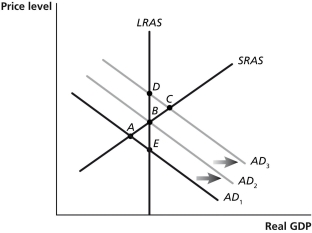 -Refer to Figure 18-1.Suppose the economy is in short-run equilibrium above potential GDP and wages and prices are rising.If contractionary policy is used to move the economy back to long run equilibrium,this would be depicted as a movement from ________ using the static AD-AS model in the figure above.
 (Multiple Choice)
4.8/5 (81)
(81) Figure 18-1
-Refer to Figure 18-1.Suppose the economy is in short-run equilibrium below potential GDP and no fiscal or monetary policy is pursued.Using the static AD-AS model in the figure above,this would be depicted as a movement from
-Refer to Figure 18-1.Suppose the economy is in short-run equilibrium below potential GDP and no fiscal or monetary policy is pursued.Using the static AD-AS model in the figure above,this would be depicted as a movement from (Multiple Choice)
4.9/5 (79)
(79) If real GDP exceeded potential real GDP and inflation was increasing,which of the following would be an appropriate fiscal policy?
(Multiple Choice)
4.8/5 (78)
(78) The federal budget exhibited a $128.7 billion surplus in 2001 but moved to a deficit of $157.8 billion in 2002.Some argued the deficit was opened up because of the Bush 2001 tax cuts,but others argued that the deficit grew because of the recession suffered in 2001.Evaluate the validity of the second argument.
(Essay)
4.9/5 (84)
(84) Consider a tax cut which affects not only consumer disposable income,but also after-tax earnings from labor supplied to labor markets and from financial assets acquired through saving.In the long run we would expect this tax cut to
(Multiple Choice)
4.9/5 (88)
(88) Explain why the tax multiplier is different from the government purchases multiplier,in both sign and relative magnitude.
(Essay)
4.7/5 (65)
(65) Contractionary fiscal policy to prevent real GDP from rising above potential real GDP would cause the inflation rate to be ________ and real GDP to be ________.
(Multiple Choice)
4.9/5 (84)
(84) If the economy is slipping into a recession,which of the following would be an appropriate fiscal policy?
(Multiple Choice)
4.8/5 (62)
(62) A decrease in the marginal income tax rate is a fiscal policy which will increase aggregate demand.
(True/False)
5.0/5 (82)
(82) Active changes in tax and spending by government intended to smooth out the business cycle are called ________,and changes in taxes and spending that occur passively over the business cycle are called ________.
(Multiple Choice)
5.0/5 (65)
(65) 
Filters
- Essay(0)
- Multiple Choice(0)
- Short Answer(0)
- True False(0)
- Matching(0)