



 Chat with AI
Exam 18: Fiscal Policy

Exam 1: Economics: Foundations and Models444 Questions
Exam 2: Trade-Offs, comparative Advantage, and the Market System498 Questions
Exam 3: Where Prices Come From: the Interaction of Demand and Supply475 Questions
Exam 4: Market Efficiency and Market Failure465 Questions
Exam 5: The Economics of Health Care334 Questions
Exam 6: Firms, the Stock Market, and Corporate Governance250 Questions
Exam 7: Consumer Choice and Elasticity380 Questions
Exam 8: Technology, production, and Costs276 Questions
Exam 9: Firms in Perfectly Competitive Markets297 Questions
Exam 10: Monopoly and Antitrust Policy271 Questions
Exam 11: Monopolistic Competition and Oligopoly414 Questions
Exam 12: Gdp: Measuring Total Production and Income266 Questions
Exam 13: Unemployment and Inflation292 Questions
Exam 14: Economic Growth, the Financial System, and Business Cycles257 Questions
Exam 15: Aggregate Demand and Aggregate Supply Analysis284 Questions
Exam 16: Money, banks, and the Federal Reserve System279 Questions
Exam 17: Monetary Policy277 Questions
Exam 18: Fiscal Policy282 Questions
Exam 19: Comparative Advantage, international Trade, and Exchange Rates446 Questions
Select questions type


Article Summary
In a letter to Congress, Treasury Secretary Jacob Lew stated that the United States will run out of borrowed money by Thursday, October 17 unless the $16.7 trillion debt ceiling was raised. Every Thursday, the Treasury typically rolls over $100 billion in debt as bonds mature and investors use the proceeds to buy new bonds, and Lew was concerned that without an increase in the debt ceiling, a crisis could emerge from a massive bond sell-off. Since the government had reached its current debt limit, it would only be able to use daily on-hand revenue to pay its bills without the increase in the ceiling. The Treasury expected the government to have only $30 billion per day in cash on hand by October 17, while its typical daily expenses were $60 billion. "If we have insufficient cash on hand, it would be impossible for the United States of America to meet all of its obligations for the first time in our history," Lew said.
-Refer to the Article Summary.When does the Treasury Department borrow? Why would the Treasury have to borrow more than it estimated,as was indicated by its letter to Congress to raise the debt ceiling? When would the Treasury repay what it borrowed,and who is it repaying?
(Essay)
4.9/5  (80)
(80) A one-time tax rebate,which is not expected to be extended in future years,will
(Multiple Choice)
4.9/5 (86)
(86) Suppose real GDP is $13 trillion,potential real GDP is $13.5 trillion,and Congress and the president plan to use fiscal policy to restore the economy to potential real GDP.Assuming a constant price level,Congress and the president would need to decrease taxes by
(Multiple Choice)
4.8/5 (70)
(70) What economic impact would the closing of a nearby military base have on a town? Would people and businesses that did not directly deal with the military personnel be affected?
(Essay)
4.7/5 (79)
(79) The increase in the amount that the government collects in taxes when the economy expands and the decrease in the amount that the government collects in taxes when the economy goes into a recession is an example of
(Multiple Choice)
4.8/5 (85)
(85) The aggregate demand curve will shift to the right ________ the initial decrease in taxes.
(Multiple Choice)
4.8/5 (74)
(74) The aggregate demand curve will shift to the right ________ the initial increase in government purchases.
(Multiple Choice)
4.9/5 (82)
(82) If the federal budget goes from a budget deficit in Year 1 to a budget surplus in Year 2,does it follow that the federal government acted to raise taxes or cut government spending in Year 2?
(Essay)
4.9/5 (81)
(81) Figure 18-7
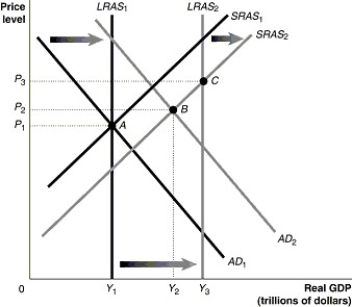 -Refer to Figure 18-7.Given that the economy has moved from A to B in the graph above,which of the following would be the appropriate fiscal policy to achieve potential GDP?
 (Multiple Choice)
5.0/5 (80)
(80) Government transfer payments include which of the following?
(Multiple Choice)
4.8/5 (77)
(77) The federal government debt as a percentage of GDP did not rise
(Multiple Choice)
4.9/5 (81)
(81) Which of the following is considered expansionary fiscal policy?
(Multiple Choice)
4.8/5 (79)
(79) A(n)________ in private expenditures as a result of a(n)________ in government purchases is called crowding out.
(Multiple Choice)
4.8/5 (70)
(70) An equal increase in government purchases and taxes will cause
(Multiple Choice)
4.9/5 (76)
(76) Decreasing government spending ________ the price level and ________ equilibrium real GDP.
(Multiple Choice)
4.8/5 (81)
(81) Expansionary fiscal policy ________ the price level and ________ equilibrium real GDP.
(Multiple Choice)
4.9/5 (70)
(70) 
Filters
- Essay(0)
- Multiple Choice(0)
- Short Answer(0)
- True False(0)
- Matching(0)