



 Chat with AI
Exam 11: Monopolistic Competition and Oligopoly

Exam 1: Economics: Foundations and Models444 Questions
Exam 2: Trade-Offs, comparative Advantage, and the Market System498 Questions
Exam 3: Where Prices Come From: the Interaction of Demand and Supply475 Questions
Exam 4: Market Efficiency and Market Failure465 Questions
Exam 5: The Economics of Health Care334 Questions
Exam 6: Firms, the Stock Market, and Corporate Governance250 Questions
Exam 7: Consumer Choice and Elasticity380 Questions
Exam 8: Technology, production, and Costs276 Questions
Exam 9: Firms in Perfectly Competitive Markets297 Questions
Exam 10: Monopoly and Antitrust Policy271 Questions
Exam 11: Monopolistic Competition and Oligopoly414 Questions
Exam 12: Gdp: Measuring Total Production and Income266 Questions
Exam 13: Unemployment and Inflation292 Questions
Exam 14: Economic Growth, the Financial System, and Business Cycles257 Questions
Exam 15: Aggregate Demand and Aggregate Supply Analysis284 Questions
Exam 16: Money, banks, and the Federal Reserve System279 Questions
Exam 17: Monetary Policy277 Questions
Exam 18: Fiscal Policy282 Questions
Exam 19: Comparative Advantage, international Trade, and Exchange Rates446 Questions
Select questions type


If the painting firms in a city sign a contract outlining a pricing plan,they are involved in

Free
(Multiple Choice)
5.0/5  (82)
(82) Correct Answer: Verified
C
Despite being in a market with ________,from the mid-1990s to the mid-2000s Starbucks was able to significantly differentiate its products from the products of its competitors.
Free
(Multiple Choice)
4.9/5 (81)
(81) Correct Answer:Verified
VerifiedA
Consider two single-malt whiskey distillers,Laphroaig and Knockando.If they advertise,they can both sell more whiskey and increase their revenue.However,the cost of advertising more than offsets the increased revenue so that each distiller ends up with a lower profit than if they do not advertise.On the other hand,if only one advertises,that distiller increases its market share and also its profit.
a.Construct a payoff matrix using the following hypothetical information: If neither distiller advertises,each earns a profit of $35 million per year.If both advertise,each earns a profit of $20 million per year.If one advertises and the other does not,the distiller who advertises earns a profit of $50 million and the distiller who does not advertise earns a profit of $9 million.
b.If Laphroaig wants to maximize profit,will it advertise? Briefly explain.
c.If Knockando wants to maximize profit,will it advertise? Briefly explain.
d.Is there a dominant strategy for each distiller? Briefly explain.
Free
(Essay)
4.8/5 (81)
(81) Correct Answer:Verified
Verifieda. The payoff matrix:
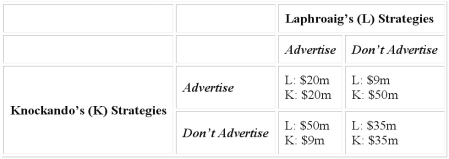
b. If Laphroaig wants to maximize profit,it will advertise.If Knockando advertises,then Laphroaig will make $9 million if it does not advertise,and $20 million if it does.Therefore,it will choose to advertise.If Knockando does not advertise,then Laphroaig will make $50 million if it advertises and $35 million if it does not.Therefore,it will choose to advertise.
c. If Knockando wants to maximize profit,it will advertise.Same reasoning as used in (b).
d. Yes,the dominant strategy is to advertise.Same reasoning as in part b.
The Jeans Store sells 7 pairs of jeans per day when it charges $100 per pair.It sells 8 pairs of jeans per day at a price of $90 per pair.The marginal revenue of the eighth pair of jeans is
(Multiple Choice)
4.8/5 (77)
(77) Table 11-3
Quantity Price (dollars) Total Revenue (dollars) Total Variable Cost (dollars) Total Cost (dollars) 0 \ 21 \ 0 \ 0 \ 50 1 20 20 16 66 2 19 38 31 81 3 18 54 45 95 4 17 68 59 109 5 16 80 75 125 6 15 90 93 143 7 14 98 112 162 8 13 104 140 190 9 12 108 180 230 10 11 110 230 280
Table 11-3 shows the demand and cost schedules for a monopolistically competitive firm.
-Refer to Table 11-3.What is the amount of the firm's loss at its optimal output level?
(Multiple Choice)
4.8/5 (82)
(82) One way by which firms differentiate their products is to find a market niche.
(True/False)
4.8/5 (79)
(79) Game theory was developed in the 1940s by John von Neuman,a mathematician,and an economist named
(Multiple Choice)
5.0/5 (79)
(79) OPEC periodically meets to agree to restrict the cartel's oil output,and yet almost every member of OPEC produces more than its own output quota.This suggests that OPEC has
(Multiple Choice)
4.9/5 (85)
(85) The barrier to entry that allowed Alcoa to make persistent economic profits was ownership of an essential input.
(True/False)
4.8/5 (76)
(76) Producing a homogeneous product occurs in which of the following industries?
(Multiple Choice)
4.9/5 (81)
(81) Assume price exceeds average variable cost over the relevant range of demand.If a monopolistically competitive firm is producing at an output where marginal revenue is $23 and marginal cost is $19,then to maximize profits the firm should
(Multiple Choice)
4.9/5 (88)
(88) The fraction of an industry's sales that are accounted for by the largest firms is called
(Multiple Choice)
5.0/5 (82)
(82) When a monopolistically competitive firm breaks even in the long run,this is equivalent to earning a zero accounting profit.
(True/False)
4.8/5 (77)
(77) The entry and exit of firms in a monopolistically competitive market guarantee that
(Multiple Choice)
4.8/5 (64)
(64) Table 11-12
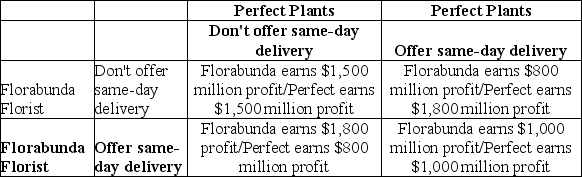 The payoff matrix shown above assumes that Perfect Plants and Florabunda Florist must decide whether to offer same-day delivery for their products. The matrix shows how much profit each firm will earn if it does or does not offer same-day delivery.The amount of profit for one firm depends on whether the other firm offers same-day delivery.
-Refer to Table 11-12.Which of the following statements is true?
The payoff matrix shown above assumes that Perfect Plants and Florabunda Florist must decide whether to offer same-day delivery for their products. The matrix shows how much profit each firm will earn if it does or does not offer same-day delivery.The amount of profit for one firm depends on whether the other firm offers same-day delivery.
-Refer to Table 11-12.Which of the following statements is true? (Multiple Choice)
5.0/5 (87)
(87) Table 11-13
Power Fuel's (P) Strategy Brawny Juice's (B) Strategy High Price Low Price High Price P: \ 12 P: \ 16 B: \ 12 B: \ 4m Low Price P: \ 4 P: \ 8 B: \ 16 B: \ 8
Two rival oligopolists in the athletic supplements industry, the Power Fuel Company and the Brawny Juice Company, have to decide on their pricing strategy.Each can choose either a high price or a low price.Table 11-13 shows the payoff matrix with the profits that each firm can expect to earn depending on the pricing strategy it adopts.
-Refer to Table 11-13.If the firms cooperate,what prices will they select?
(Multiple Choice)
4.8/5 (90)
(90) Both the perfectly competitive firm and the monopolistically competitive firm produce at the output where marginal revenue equals marginal cost (MR = MC)but only the perfectly competitive firm achieves allocative efficiency.Explain why this is the case.
(Essay)
4.8/5 (77)
(77) An equilibrium in a game in which players pursue their own self-interest is called
(Multiple Choice)
4.9/5 (74)
(74) 
Filters
- Essay(0)
- Multiple Choice(0)
- Short Answer(0)
- True False(0)
- Matching(0)