



 Chat with AI
Exam 11: Monopolistic Competition and Oligopoly

Exam 1: Economics: Foundations and Models444 Questions
Exam 2: Trade-Offs, comparative Advantage, and the Market System498 Questions
Exam 3: Where Prices Come From: the Interaction of Demand and Supply475 Questions
Exam 4: Market Efficiency and Market Failure465 Questions
Exam 5: The Economics of Health Care334 Questions
Exam 6: Firms, the Stock Market, and Corporate Governance250 Questions
Exam 7: Consumer Choice and Elasticity380 Questions
Exam 8: Technology, production, and Costs276 Questions
Exam 9: Firms in Perfectly Competitive Markets297 Questions
Exam 10: Monopoly and Antitrust Policy271 Questions
Exam 11: Monopolistic Competition and Oligopoly414 Questions
Exam 12: Gdp: Measuring Total Production and Income266 Questions
Exam 13: Unemployment and Inflation292 Questions
Exam 14: Economic Growth, the Financial System, and Business Cycles257 Questions
Exam 15: Aggregate Demand and Aggregate Supply Analysis284 Questions
Exam 16: Money, banks, and the Federal Reserve System279 Questions
Exam 17: Monetary Policy277 Questions
Exam 18: Fiscal Policy282 Questions
Exam 19: Comparative Advantage, international Trade, and Exchange Rates446 Questions
Select questions type


Firms in monopolistic competition compete by selling similar,but not identical products.
(True/False)
4.7/5  (65)
(65) Starbucks started out small in 1971,but by 1993 Starbucks was a national chain and had coffeehouses in 38 countries.A key to the company's success was the realization by executives that
(Multiple Choice)
4.9/5 (78)
(78) A monopolistically competitive firm earning profits in the short run will find the demand for its product decreasing and becoming more elastic in the long run as new firms move into the industry until
(Multiple Choice)
5.0/5 (73)
(73) What is the difference between explicit collusion and implicit collusion?
(Essay)
4.8/5 (81)
(81) In a Nash equilibrium,all players select non-dominant strategies.
(True/False)
4.8/5 (80)
(80) One reason why the coffeehouse market is competitive is that
(Multiple Choice)
4.8/5 (81)
(81) Table 11-8
Saudi Arabia's (S) Choices Nigeria's (N) Choices Low Output High Output Low Output S: \ 100 million profit N: \ 20 million profit S: \ 75 million profit N: \ 12 million profit High Output S: \ 80 million profit N: \ 30 million profit S: \ 60 million profit N: \ 20 million profit
Suppose OPEC has only two producers, Saudi Arabia and Nigeria.Saudi Arabia has far more oil reserves and is the lower cost producer compared to Nigeria.The payoff matrix in Table 11-8 shows the profits earned per day by each country."Low output" corresponds to producing the OPEC assigned quota and "high output" corresponds to producing the maximum capacity beyond the assigned quota.
-Refer to Table 11-8.Is there a dominant strategy for Saudi Arabia and,if so,what is it?
(Multiple Choice)
4.9/5 (89)
(89) Figure 11-11
 -Refer to Figure 11-11.What is the amount of excess capacity?
 (Multiple Choice)
4.9/5 (74)
(74) Which of the following would not occur as a result of a monopolistically competitive firm suffering a short-run economic loss?
(Multiple Choice)
4.9/5 (68)
(68) Table 11-1
Quantity Price (dollars) Total Revenue (dollars) 1 \ 7.50 \ 7.50 2 7.00 14.00 3 6.50 19.50 4 6.00 24.00 5 5.50 27.50 6 5.00 30.00
-Refer to Table 11-1.What portion of the marginal revenue of the 5th unit is due to the output effect and what portion is due to the price effect?
(Multiple Choice)
4.8/5 (74)
(74) Figure 11-4
 Figure 11-4 shows short-run cost and demand curves for a monopolistically competitive firm in the market for designer watches.
-Refer to Figure 11-4.If the firm represented in the diagram is currently producing and selling Qₐ units,what is the price charged?
Figure 11-4 shows short-run cost and demand curves for a monopolistically competitive firm in the market for designer watches.
-Refer to Figure 11-4.If the firm represented in the diagram is currently producing and selling Qₐ units,what is the price charged? (Multiple Choice)
4.9/5 (78)
(78) Long-run equilibrium under monopolistic competition is similar to that under perfect competition in that
(Multiple Choice)
4.9/5 (82)
(82) Figure 11-10
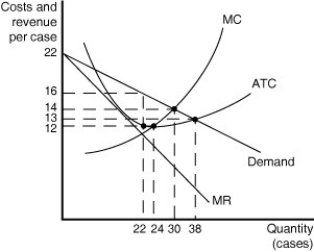 Figure 11-10 shows cost and demand curves for a monopolistically competitive producer of iced-tea.
-Refer to Figure 11-10.to answer the following questions.
a.What is the profit-maximizing output level?
b.What is the profit-maximizing price?
c.At the profit-maximizing output level,how much profit will be realized?
d.Does this graph most likely represent the long run or the short run? Why?
Figure 11-10 shows cost and demand curves for a monopolistically competitive producer of iced-tea.
-Refer to Figure 11-10.to answer the following questions.
a.What is the profit-maximizing output level?
b.What is the profit-maximizing price?
c.At the profit-maximizing output level,how much profit will be realized?
d.Does this graph most likely represent the long run or the short run? Why? (Essay)
4.8/5 (94)
(94) Hewlett-Packard will not raise the prices of its personal computers without first considering how Dell might respond.This is evidence of
(Multiple Choice)
4.7/5 (68)
(68) Figure 11-3
 -Refer to Figure 11-3.The marginal revenue from one additional unit sold is the sum of the gain in revenue from selling the additional unit and the loss in revenue from having to charge a lower price to sell the additional unit.Based on the diagram in the figure,
 (Multiple Choice)
4.7/5 (74)
(74) If a monopolistically competitive firm has excess capacity
(Multiple Choice)
4.8/5 (62)
(62) 
Filters
- Essay(0)
- Multiple Choice(0)
- Short Answer(0)
- True False(0)
- Matching(0)