



 Chat with AI
Exam 10: Thoracic Viscera

Exam 1: Preliminary Steps in Radiography33 Questions
Exam 2: Compensating Filters14 Questions
Exam 3: General Anatomy and Radiographic Positioning Terminology101 Questions
Exam 4: Upper Limb125 Questions
Exam 5: Shoulder Girdle92 Questions
Exam 6: Lower Limb143 Questions
Exam 7: Pelvis and Upper Femora53 Questions
Exam 8: Vertebral Column175 Questions
Exam 9: Bony Thorax58 Questions
Exam 10: Thoracic Viscera74 Questions
Exam 11: Long Bone Measurement10 Questions
Exam 12: Contrast Arthrography5 Questions
Exam 13: Trauma Radiography10 Questions
Exam 14: Mouth and Salivary Glands10 Questions
Exam 15: Anterior Part of Neck9 Questions
Exam 16: Abdomen30 Questions
Exam 17: Digestive System: Alimentary Canal130 Questions
Exam 18: Urinary System and Venipuncture96 Questions
Exam 19: Reproductive System11 Questions
Exam 20: Skull, Facial Bones, and Paranasal Sinuses196 Questions
Exam 21: Mammography35 Questions
Exam 22: Central Nervous System15 Questions
Exam 23: Vascular, Cardiac, and Interventional Radiography40 Questions
Exam 24: Pediatric Imaging20 Questions
Exam 25: Geriatric Radiography18 Questions
Exam 26: Mobile Radiography20 Questions
Exam 27: Surgical Radiography10 Questions
Exam 28: Sectional Anatomy for Radiographers30 Questions
Exam 29: Computed Tomography16 Questions
Exam 30: Magnetic Resonance Imaging21 Questions
Exam 31: Diagnostic Ultrasound14 Questions
Exam 32: Nuclear Medicine18 Questions
Exam 33: Bone Densitometry18 Questions
Exam 34: Radiation Oncology20 Questions
Select questions type


Which side of the patient's chest is placed against the vertical IR for a ventral or dorsal decubitus lateral projection?
(Multiple Choice)
4.8/5  (68)
(68) Which of the following are required to produce a radiograph using a decubitus position?
1)Breathing technique
2)Patient in the recumbent position
3)Horizontal x-ray beam
(Multiple Choice)
4.9/5 (81)
(81) Where are the hands placed for a PA projection of the chest?
(Multiple Choice)
4.9/5 (76)
(76) When the patient is properly positioned for a PA oblique of the chest, the central ray will enter the body:
(Multiple Choice)
4.8/5 (83)
(83) Which of the following must be clearly demonstrated on x-ray projections done using a decubitus position?
1)Entire lung fields
2)Patient's arms not visible in the image
3)Identification to indicate which decubitus
(Multiple Choice)
4.8/5 (86)
(86) What is the name of the double-walled serous membrane sac that encloses the lung?
(Multiple Choice)
4.9/5 (93)
(93) For PA oblique projections of the chest, the side of interest is generally the side _____ the IR.
(Multiple Choice)
4.9/5 (85)
(85) Which of the following radiographs are usually taken on a patient who is suspected of having a small amount of free air in the pleural cavity?
1)AP, full inspiration
2)AP, full expiration
3)AP, R or L lateral decubitus
(Multiple Choice)
4.8/5 (77)
(77) What is the optimal respiration phase for a PA or lateral chest radiograph?
(Multiple Choice)
4.9/5 (74)
(74) Which positioning maneuver moves the scapulae out of the lateral aspects of the lungs?
(Multiple Choice)
5.0/5 (73)
(73) How far above the shoulders should the IR be positioned for PA and lateral chest radiographs?
(Multiple Choice)
4.9/5 (81)
(81) The aspiration of a foreign particle in the lung would be termed:
(Multiple Choice)
4.8/5 (84)
(84) For AP oblique projections of the chest, the side of interest is generally the side _____ the IR.
(Multiple Choice)
4.7/5 (83)
(83) What is the name of the tongue-shaped process on the anterior-medial border of the left lung?
(Multiple Choice)
4.8/5 (85)
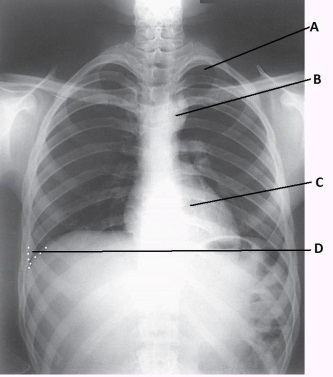
(85) 
Why is the left lateral chest position the most commonly used for lateral radiographs of the chest?
(Multiple Choice)
5.0/5 (77)
(77) 
Filters
- Essay(0)
- Multiple Choice(0)
- Short Answer(0)
- True False(0)
- Matching(0)